
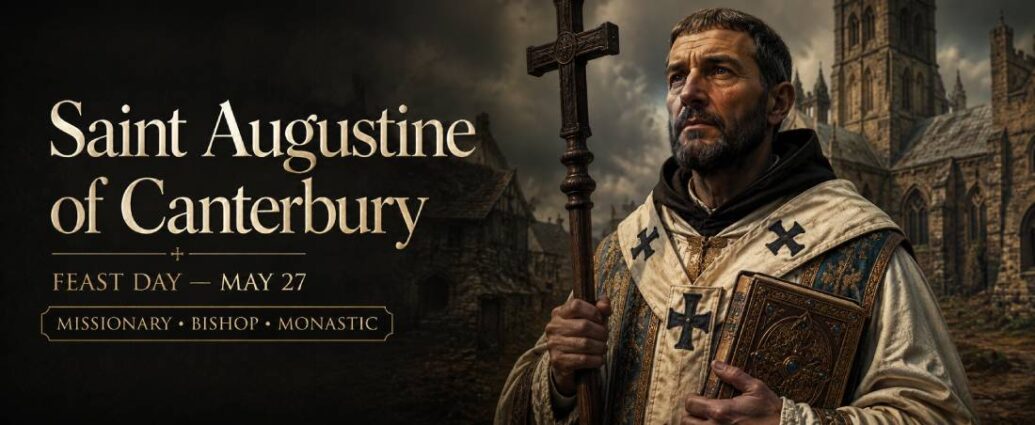
Every year on May 27, the Catholic Church honors Saint Augustine of Canterbury, the humble Benedictine monk who led the mission that restored Christianity to Anglo-Saxon England. Though history often remembers him as a missionary bishop and church leader, the heart of Augustine’s life was prayer. Before he became a preacher to kings, he was a monk devoted to silence, obedience, contemplation, and the worship of God.
Saint Augustine of Canterbury lived during a turbulent period when much of England had fallen away from Christianity after the collapse of Roman influence. Yet through deep trust in Christ, persistent prayer, and unwavering faith, Augustine became an instrument God used to rekindle the light of the Gospel.
His life offers modern Catholics a powerful witness that authentic evangelization always begins in prayer. Augustine’s holiness did not come from worldly power or personal ambition, but from his surrender to God through monastic discipline, humility, and faithful service.
Early Life
Very little is historically known about the early life of Saint Augustine of Canterbury. He likely lived during the sixth century and became a monk in Rome at the monastery of Saint Andrew, founded by Pope Gregory the Great before Gregory became pope.
The monastery followed the spirituality of the Saint Benedict of Nursia and emphasized a balanced life of prayer, work, fasting, Scripture reading, and communal worship. Augustine was shaped profoundly by this Benedictine rhythm of life. Long before he preached publicly, he learned how to pray privately.
In the monastery, Augustine immersed himself in the Psalms, the Eucharist, sacred silence, and obedience to authority. These years formed the spiritual foundation that later sustained him during the immense challenges of missionary work.
Pope Gregory recognized Augustine’s wisdom, prudence, and spiritual maturity. Eventually, Gregory chose him to lead a missionary expedition to England, where pagan Anglo-Saxon tribes dominated much of the land.
The Calling to Evangelize England
The mission to England was not an easy assignment. According to tradition, Pope Gregory the Great had long desired to bring the Gospel to the English people after encountering Anglo-Saxon slaves in Rome. Deeply moved by their appearance and spiritual condition, Gregory famously remarked that they were not “Angles” but “angels.”
Around AD 597, Augustine and approximately forty monks were sent from Rome to England. The journey itself was dangerous and uncertain. At one point, Augustine and his companions became discouraged and fearful about the mission. Historical accounts record that Augustine even returned temporarily to Rome seeking permission to abandon the effort.
Pope Gregory, however, encouraged him to persevere. Gregory reminded Augustine that missionary success depended not on human strength but on confidence in God’s grace. Strengthened by prayer and obedience, Augustine resumed the journey.
This moment reveals an important aspect of Augustine’s spiritual life: he was not fearless by nature. He experienced anxiety, uncertainty, and weakness. Yet he brought those struggles before God instead of allowing them to defeat him.
His courage came through prayerful dependence on Christ.
The Prayer Life of Saint Augustine of Canterbury
The heart of Augustine’s holiness was his life of prayer. Even after becoming Archbishop of Canterbury, he remained deeply shaped by monastic spirituality.
Prayer was not merely one activity among many in Augustine’s life. It was the source from which everything else flowed.
A Monk Before a Missionary
Augustine approached missionary work not as a political project but as a spiritual mission rooted in holiness. His Benedictine background taught him that fruitful ministry begins with union with God.
The monks who accompanied Augustine to England lived visibly prayerful lives. They prayed the Divine Office, celebrated Mass faithfully, chanted Psalms, and practiced communal discipline. Their witness often spoke more powerfully than words.
Historical writings describe how the missionaries processed through towns carrying crosses and chanting litanies. Their visible devotion impressed many who encountered them.
Augustine understood that conversion happens first through grace. Therefore, prayer had to precede preaching.
Eucharistic Devotion
Like many early saints, Augustine centered his spiritual life on the Eucharist. The Holy Mass nourished his missionary zeal and sustained him amid hardship.
The Eucharist gave Augustine strength during difficult negotiations with rulers, resistance from pagan communities, and the enormous burden of establishing the Church in unfamiliar territory.
His mission was never simply about creating institutions. It was about leading souls into communion with Christ.
Prayer During Difficulty
Missionary life in England brought many challenges. Augustine faced cultural barriers, political tensions, and the immense responsibility of organizing the Church in a pagan land.
Yet he continually turned to prayer rather than despair.
The historical record suggests that Augustine sought guidance constantly through correspondence with Pope Gregory the Great. Gregory’s letters frequently advised patience, humility, mercy, and trust in divine providence.
This spiritual dependence prevented Augustine from becoming prideful or authoritarian. He governed the Church as a servant, not as a conqueror.
Spiritual Practices and Devotions
Benedictine Spirituality
The Rule of Saint Benedict shaped Augustine profoundly. This spirituality emphasized:
- Stability
- Obedience
- Humility
- Liturgical prayer
- Sacred reading
- Simplicity of life
- Community
These practices cultivated inner peace and spiritual discipline.
Augustine’s missionary work reflected Benedictine balance. He did not attempt forced conversions or reckless confrontation. Instead, he patiently built relationships and allowed Christian witness to transform society gradually.
Sacred Scripture
As a monk, Augustine would have spent many hours meditating on Scripture, especially the Psalms. The Psalms formed the prayer language of monastic life and deeply influenced early Christian spirituality.
This immersion in God’s Word strengthened Augustine during moments of uncertainty and spiritual fatigue.
Fasting and Sacrifice
Missionary life itself became a form of sacrifice. Augustine left the comfort and familiarity of Rome to serve in distant lands. Such a decision required detachment, trust, and self-denial.
The monks likely practiced regular fasting according to Benedictine customs. Their disciplined lives offered a powerful contrast to the worldly values around them.
Trials, Sacrifices, and Faith
Though Augustine achieved significant missionary success, his work was not without suffering.
Fear and Discouragement
One of the most relatable aspects of Augustine’s life is his humanity. He was not naturally heroic in the worldly sense. He struggled with fear before entering England.
Many Catholics today can identify with spiritual hesitation, uncertainty about God’s plans, or fear of failure. Augustine’s example reminds believers that sanctity does not require perfect confidence. It requires faithful obedience.
Challenges with the British Christians
Augustine also faced difficulties uniting with existing Celtic Christian communities already present in parts of Britain. Differences in liturgical practices and ecclesiastical customs created tensions.
Despite these conflicts, Augustine continued seeking unity within the Church.
The Burden of Leadership
As Archbishop of Canterbury, Augustine carried immense responsibility. Establishing dioceses, evangelizing populations, training clergy, and maintaining communication with Rome required tremendous perseverance.
Yet Augustine remained fundamentally a monk at heart — a servant grounded in prayer.
Legacy in the Catholic Church
Saint Augustine of Canterbury is remembered as the “Apostle to the English.” His mission marked the beginning of the organized Catholic Church in Anglo-Saxon England.
Through his efforts:
- The See of Canterbury was established
- King Ethelbert of Kent converted to Christianity
- Thousands were baptized
- Monasteries and churches were founded
- Christian worship spread throughout England
His influence shaped English Christianity for centuries.
More importantly, Augustine demonstrated that missionary success flows from holiness. The lasting fruit of his work came not merely from strategy or diplomacy but from a life deeply rooted in God.
Today, the Catholic Church continues to honor Augustine as a model missionary bishop and faithful monk.
What Catholics Can Learn Today
Prayer Must Come First
Saint Augustine of Canterbury teaches modern Catholics that true evangelization begins in prayer. Before speaking to the world about God, believers must first speak to God.
In a noisy and distracted culture, Augustine’s contemplative spirit remains deeply relevant.
Holiness Requires Humility
Augustine never sought fame or power. He accepted difficult responsibilities out of obedience and trust in God.
His humility allowed God to work through him.
Courage Comes Through Grace
Augustine experienced fear and uncertainty. Yet he continued forward because he relied on God rather than himself.
Catholics facing difficult vocations, family struggles, or spiritual challenges can find encouragement in his perseverance.
The Importance of Community
Augustine did not evangelize alone. He journeyed with fellow monks who prayed and worked together.
The Christian life is not meant to be lived in isolation. Parish life, communal worship, and faithful friendships remain essential for spiritual growth.
Conclusion
Saint Augustine of Canterbury stands as a beautiful example of how prayer transforms ordinary human weakness into extraordinary spiritual fruitfulness. He was not remembered because of military power, wealth, or political influence. He is remembered because he allowed God to work through a humble and prayerful heart.
His mission to England changed Christian history, but that mission was born in the silence of monastic prayer, Eucharistic devotion, Scripture meditation, and obedience to Christ.
In a world hungry for authentic faith, Saint Augustine reminds Catholics that holiness still begins on our knees.
As we celebrate his feast day on May 27, may his example inspire us to deepen our prayer lives, trust God more fully, and courageously share the Gospel with humility and love.