
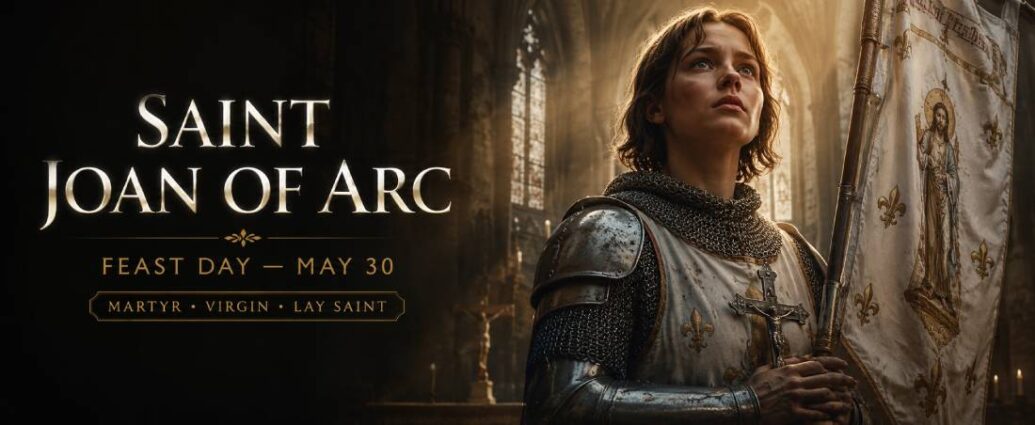
Among the most extraordinary saints in Catholic history, Saint Joan of Arc stands as a radiant witness to courage, purity, obedience, and unwavering trust in God. Though she lived only nineteen years, her life transformed the history of France and inspired generations of Catholics to pursue holiness with fearless conviction.
Known as the “Maid of Orléans,” Joan was not a scholar, nun, or noblewoman. She was a simple peasant girl whose deep prayer life and obedience to what she believed was God’s call led her into the center of war, politics, suffering, and martyrdom. Her sanctity was not rooted merely in military victory, but in her profound spiritual discipline, Eucharistic devotion, humility, and willingness to suffer for Christ.
For modern Catholics living in times of confusion and spiritual struggle, Saint Joan of Arc remains a powerful example of how God can work through souls completely surrendered to His will.
Early Life and Historical Background
Saint Joan of Arc was born around 1412 in the small village of Domrémy in northeastern France during the devastating period of the Hundred Years’ War between France and England. She was born to a devout Catholic peasant family and grew up in a deeply religious environment shaped by daily prayer, frequent participation in the sacraments, and reverence for the Church.
France at the time was politically fractured and militarily weakened. English forces and their Burgundian allies occupied much of the kingdom, while the French people suffered poverty, violence, fear, and instability. Joan grew up witnessing destruction and hearing stories of villages burned by soldiers.
Despite these hardships, historical accounts consistently describe Joan as exceptionally pious from childhood. Witnesses at her later canonization proceedings testified that she loved attending Mass, prayed often, practiced charity toward the poor, and possessed unusual purity of character.
She reportedly spent long periods in silent prayer before crucifixes and sacred images. Her spiritual sensitivity would eventually shape the course of her life and mission.
Calling and Spiritual Transformation
At approximately thirteen years old, Joan began experiencing what she described as heavenly voices and visions. According to her testimony during her trial, she heard the voices of Saint Michael the Archangel, Saint Catherine of Alexandria, and Saint Margaret of Antioch.
These visions instructed her to remain faithful to God and eventually revealed a startling mission: she was to help deliver France and support the coronation of the rightful king, Charles VII.
Joan approached this mission with humility and hesitation. She initially resisted the call, understanding the immense danger involved. Yet her prayer life deepened as she discerned God’s will.
Historical records from her trial reveal a young woman profoundly aware of spiritual realities. She regularly confessed her sins, attended Mass whenever possible, and sought purity of soul before undertaking any military action. She insisted her soldiers avoid blasphemy, prostitution, theft, and immoral behavior.
Her leadership was unlike that of ordinary military commanders. Joan viewed her mission not as political ambition but as obedience to divine providence.
The Prayer Life of Saint Joan of Arc
The heart of Joan’s sanctity was her prayer life.
Before battles, Joan frequently withdrew into prayer. Witnesses recounted seeing her kneeling in churches for long periods, weeping before the Blessed Sacrament, and seeking guidance from God before major decisions.
She loved hearing church bells because they reminded her to pray. Even amid military campaigns, she maintained a disciplined spiritual routine centered on prayer, confession, fasting, and reverence for the Holy Eucharist.
Joan often carried a banner depicting Christ and sacred imagery rather than relying primarily on weapons. She preferred her banner to her sword because, as she reportedly said, it had “borne no blood.”
Her spirituality was profoundly Christ-centered. During her interrogations, Joan repeatedly invoked “Our Lord” with calm confidence even while threatened with torture and execution.
One of the most moving aspects of Joan’s spiritual life was her devotion to the Holy Name of Jesus. Contemporary accounts report that the names “Jesus” and “Mary” were frequently upon her lips.
She also demonstrated remarkable trust in divine providence. Though surrounded by danger, betrayal, and political manipulation, Joan continually surrendered herself to God’s will.
Her faith was not naïve optimism. It was forged through suffering, uncertainty, ridicule, imprisonment, and eventually martyrdom.
Devotions, Sacrifices, and Spiritual Practices
Saint Joan practiced intense spiritual discipline unusual for someone so young.
Eucharistic Devotion
Joan displayed deep reverence for the Eucharist. Before entering battle, she sought confession and reception of Holy Communion whenever possible. Historical witnesses described her profound respect during Mass and her desire to remain spiritually pure.
The Eucharist strengthened her courage and sustained her through unimaginable trials.
Confession and Purity
Accounts from those who knew Joan consistently emphasize her chastity and moral integrity. She encouraged soldiers to go to confession and expelled immoral women from military camps.
Her personal purity became one of the defining marks of her sanctity.
Fasting and Penance
Though historical documentation on specific fasting practices is limited, her broader spiritual discipline strongly reflected penitential Catholic devotion common in medieval France. Joan willingly embraced suffering, discomfort, exhaustion, and hardship as part of her mission.
Marian Devotion
Like many medieval Catholics, Joan possessed strong devotion to the Blessed Virgin Mary. Her spirituality reflected deep trust in heavenly intercession and obedience to God through humility and purity.
Trials, Suffering, and Faithfulness
Despite extraordinary victories, including the liberation of Orléans in 1429, Joan’s earthly mission ended in profound suffering.
She was eventually captured by Burgundian forces and sold to the English. Imprisoned, isolated, and subjected to an intensely political ecclesiastical trial, Joan endured months of interrogation designed to discredit both her and the legitimacy of Charles VII.
The trial records remain among the most important historical documents of the Middle Ages because they preserve Joan’s actual words.
Throughout the proceedings, Joan demonstrated remarkable intelligence, courage, and spiritual composure. Though only a teenager, she answered trained theologians and judges with clarity and humility.
When asked if she was in God’s grace — a theological trap — she famously responded:
“If I am not, may God put me there; and if I am, may God so keep me.”
This answer stunned her interrogators because of its theological wisdom.
Joan suffered deeply during imprisonment. She faced threats of torture, abandonment, humiliation, and fear of execution. Yet she continued turning toward God.
On May 30, 1431, Joan was burned at the stake in Rouen at approximately nineteen years old.
Witnesses reported that she repeatedly called upon the name of Jesus during her execution. A crucifix was held before her as she died.
Even some of her executioners were reportedly shaken with remorse afterward, believing they had condemned a holy soul.
Legacy in the Catholic Church
Twenty-five years after her death, Joan’s trial was formally overturned through a retrial authorized by the Church. The earlier proceedings were declared corrupt and unjust.
Centuries later, devotion to Joan continued to grow throughout France and the wider Catholic world.
She was beatified in 1909 by Pope Pius X and canonized in 1920 by Pope Benedict XV.
Today Saint Joan of Arc is honored as one of the patron saints of France and remains beloved by Catholics worldwide.
Her legacy transcends military history. She is remembered primarily as:
- a martyr of conscience,
- a courageous defender of truth,
- a faithful daughter of the Church,
- and a soul completely surrendered to God.
What Catholics Can Learn Today
Saint Joan of Arc speaks powerfully to modern Catholics navigating fear, confusion, hostility, and moral compromise.
Courage in Obedience
Joan teaches that holiness often requires courage. God’s call may lead into suffering, misunderstanding, or sacrifice.
Prayer Before Action
Her life demonstrates the necessity of grounding every mission in prayer and sacramental life. Joan did not rely merely on human strength.
Purity and Integrity
In a morally confused world, Joan’s commitment to chastity, truth, and virtue remains deeply relevant.
Trust During Suffering
Joan endured betrayal and injustice without abandoning God. Her faithfulness during suffering reveals authentic Christian discipleship.
Love for Christ Above Earthly Success
Though she achieved military victories, Joan ultimately measured life not by worldly success but by fidelity to God.
Conclusion
Saint Joan of Arc remains one of the most compelling saints in Christian history because her sanctity emerged not from comfort or security, but from radical trust in God amid fear and suffering.
She reminds Catholics that holiness is possible at any age, in any vocation, and even during times of political chaos and personal trial.
Her prayer life sustained her mission. Her Eucharistic devotion strengthened her courage. Her obedience shaped history.
Above all, Joan’s life points toward Christ — the true King whom she served faithfully unto death.
May Saint Joan of Arc inspire modern believers to pray with greater sincerity, suffer with greater faith, and follow God with fearless hearts.