
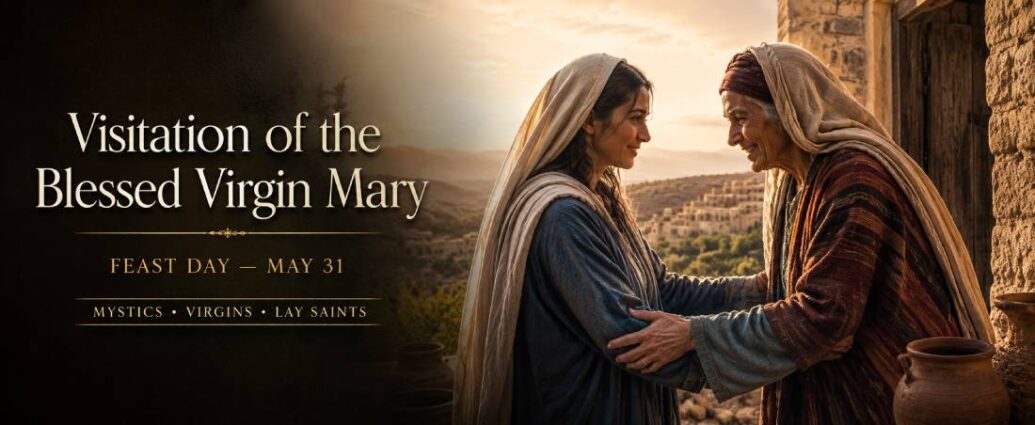
The Feast of the Visitation of the Blessed Virgin Mary commemorates one of the most tender and spiritually profound moments in the Gospel: the journey of the Virgin Mary to visit her cousin Elizabeth after the Annunciation. Recorded in the Gospel of Luke (Luke 1:39–56), this sacred encounter reveals the hidden beauty of humility, charity, contemplative prayer, and joyful obedience to God.
The Visitation is far more than a simple family visit. It is a living icon of Christ carried into the world through the obedience of Mary. The unborn John the Baptist rejoices in Elizabeth’s womb at the presence of Jesus, while Mary proclaims the Magnificat — one of the greatest hymns of praise and surrender in Christian history.
For Catholics, the Visitation reveals the heart of Marian spirituality: silence transformed into praise, contemplation flowing into action, and love expressed through sacrificial service. The feast invites believers to imitate Mary’s readiness to carry Christ to others through holiness, prayer, humility, and charity.
Early Life and Historical Background
The Visitation took place shortly after the Annunciation, when the Archangel Gabriel revealed to Mary that she would conceive Jesus by the Holy Spirit. Gabriel also informed her that Elizabeth, though advanced in age and previously barren, had conceived a son.
According to the Gospel account, Mary “went in haste” into the hill country of Judea to visit Elizabeth. Traditionally, this journey is believed to have covered nearly 80 to 100 miles from Nazareth to the region surrounding Hebron or Ein Karem.
Mary was likely a young Jewish woman in her mid-teens, clothed in the modest garments typical of first-century Galilee. Elizabeth was older, the wife of the priest Zechariah, living a life rooted deeply in Jewish prayer traditions and fidelity to God.
The Visitation has been celebrated in Christian devotion for centuries. The feast became widespread in the Western Church during the Middle Ages and was formally extended to the universal Church by Pope Urban VI in 1389 during a time of ecclesial division, as a prayer for unity and peace.
The scene has inspired countless Catholic artists, iconographers, theologians, and saints because it captures the meeting of both the Old and New Covenants:
- Elizabeth represents faithful Israel awaiting redemption.
- Mary bears the Messiah Himself.
- John the Baptist prepares the way even before birth.
The Visitation remains one of the Church’s most beloved mysteries of the Rosary and an enduring symbol of active charity flowing from contemplative union with God.
Calling and Spiritual Transformation
Mary’s journey to Elizabeth demonstrates the immediate fruit of authentic prayer: loving service. After receiving the divine message, Mary did not remain centered on herself. Instead, filled with grace and carrying Christ within her, she traveled to help another.
This reveals a profound truth in Catholic spirituality: genuine encounters with God always lead outward in charity.
Mary’s “yes” at the Annunciation transformed all of salvation history. Yet her holiness is revealed not only in mystical privilege, but in ordinary acts of love. She embraced inconvenience, hardship, fatigue, and uncertainty to serve Elizabeth.
The Visitation also marks the sanctification of John the Baptist in the womb. At Mary’s greeting, Elizabeth declared:
“For behold, when the voice of your greeting came to my ears, the babe in my womb leaped for joy.” (Luke 1:44)
Catholic tradition sees this as John being cleansed from original sin before birth through the presence of Christ.
Mary’s spiritual transformation was rooted in complete surrender to God’s will. She became the first disciple of Christ — carrying Him physically and spiritually into the world.
The Prayer Life of the Visitation of the Blessed Virgin Mary
The Visitation is deeply centered on prayer.
Mary’s interior life radiates throughout the Gospel account. Her journey was not merely physical; it was contemplative. She traveled while carrying within her the Incarnate Word, living in profound union with God.
The greatest expression of this prayerful spirit is the Magnificat:
“My soul magnifies the Lord, and my spirit rejoices in God my Savior.” (Luke 1:46–47)
The Magnificat reflects Mary’s deep familiarity with Sacred Scripture. Its language echoes the Psalms, the prayers of Hannah, and Israel’s ancient hymns of praise. Mary’s prayer life was clearly formed by meditation on the Word of God.
Several key spiritual themes emerge from the Magnificat:
Humility
Mary recognizes her lowliness before God:
“He has regarded the low estate of His handmaiden.”
Her holiness is rooted not in self-glorification but in complete humility.
Praise
Mary magnifies God rather than herself. Every grace she receives becomes an occasion for worship.
Trust
She believes fully in God’s promises despite uncertainty.
Contemplation
Mary reflects deeply upon God’s actions in history and salvation.
Joy
Christian joy radiates throughout the Visitation narrative. This joy comes not from comfort, but from God’s presence.
The Church has incorporated the Magnificat into the Liturgy of the Hours, where it is prayed daily during Evening Prayer. Through centuries of Catholic devotion, monks, nuns, priests, and lay faithful have united themselves spiritually to Mary’s song of praise.
Devotions, Sacrifices, and Spiritual Practices
The Visitation demonstrates several core spiritual disciplines central to Catholic life.
Charity Through Service
Mary undertook a difficult journey through rugged terrain while pregnant. This was an act of sacrificial love.
Her service teaches Catholics that holiness is not merely contemplative isolation but active charity rooted in prayer.
Silence and Hiddenness
The Visitation occurred quietly, away from worldly attention. The most important events in salvation history unfolded in humility and obscurity.
Mary embraced hidden holiness rather than public recognition.
Trust in Divine Providence
Mary did not fully understand everything that would happen, yet she entrusted herself completely to God.
Marian Devotion
The Visitation remains foundational to Marian spirituality:
- It is the Second Joyful Mystery of the Rosary.
- It highlights Mary as the Ark of the New Covenant.
- It reveals Mary as intercessor and bearer of Christ.
Prayerful Meditation
Catholic saints throughout history have meditated deeply upon the Visitation:
- Saint Ambrose emphasized Mary’s haste in charity.
- Saint Bede the Venerable reflected on John’s sanctification.
- Saint John Paul II frequently connected the Visitation to missionary discipleship.
Trials, Suffering, and Faithfulness
Though joyful, the Visitation occurred amid uncertainty.
Mary had accepted a miraculous and socially dangerous pregnancy. In first-century Jewish society, misunderstanding and suspicion could easily arise. Yet she remained faithful.
Elizabeth herself had endured years of barrenness, social shame, and waiting.
The Visitation reveals how God often works through hidden suffering:
- Mary carried future sorrows silently.
- Elizabeth experienced long years of prayer before receiving consolation.
- John the Baptist would later become a martyr.
The feast reminds Catholics that holiness frequently grows in obscurity, patience, and trust.
Mary’s perseverance amid uncertainty continues to inspire believers facing fear, misunderstanding, loneliness, or suffering.
Legacy in the Catholic Church
The Visitation has profoundly shaped Catholic spirituality, theology, liturgy, art, and devotion.
It remains:
- The Second Joyful Mystery of the Rosary
- A major Marian feast
- A model of Christian charity
- A symbol of missionary evangelization
Catholic sacred art has portrayed the Visitation for centuries in:
- Byzantine icons
- Renaissance frescoes
- Gothic manuscripts
- Baroque altarpieces
- Marian shrines and mosaics
Famous depictions include works by:
- Giotto
- Domenico Ghirlandaio
- Jacopo Pontormo
These artworks consistently portray:
- Reverent embrace between Mary and Elizabeth
- Humility and tenderness
- Sacred joy
- Rural Judean architecture
- Simple historical garments
- Spiritual intimacy rather than grandeur
The feast continues to inspire:
- Marian pilgrimages
- Rosary devotion
- Eucharistic spirituality
- Catholic motherhood
- Service to the vulnerable
What Catholics Can Learn Today
Modern Catholics can draw powerful lessons from the Visitation.
Carry Christ to Others
Mary becomes the first missionary by bringing Jesus to Elizabeth. Catholics are called to carry Christ into homes, workplaces, families, and communities.
Prayer Must Lead to Charity
Authentic spirituality always bears fruit in love and service.
Holiness Flourishes in Humility
Mary’s greatness came through surrender, not self-promotion.
Joy Comes From God’s Presence
The Visitation reveals supernatural joy rooted in Christ.
Hidden Acts Matter
God works powerfully through quiet obedience and unnoticed sacrifices.
In a culture often marked by noise, pride, distraction, and self-centeredness, the Visitation invites believers back to contemplative silence, humility, and joyful service.
Conclusion
The Feast of the Visitation of the Blessed Virgin Mary reveals the radiant beauty of humble holiness. Mary’s journey to Elizabeth is one of the clearest Gospel images of prayer transformed into charity.
Filled with grace, Mary carried Christ into the world quietly, faithfully, and lovingly. Her Magnificat continues to echo through the Church as a hymn of praise, humility, and trust in God’s mercy.
For Catholics today, the Visitation remains a profound invitation:
- to pray deeply,
- to serve generously,
- to trust God completely,
- and to bring Christ joyfully to others.
Through the intercession of the Blessed Virgin Mary, may believers learn to magnify the Lord with their own lives.