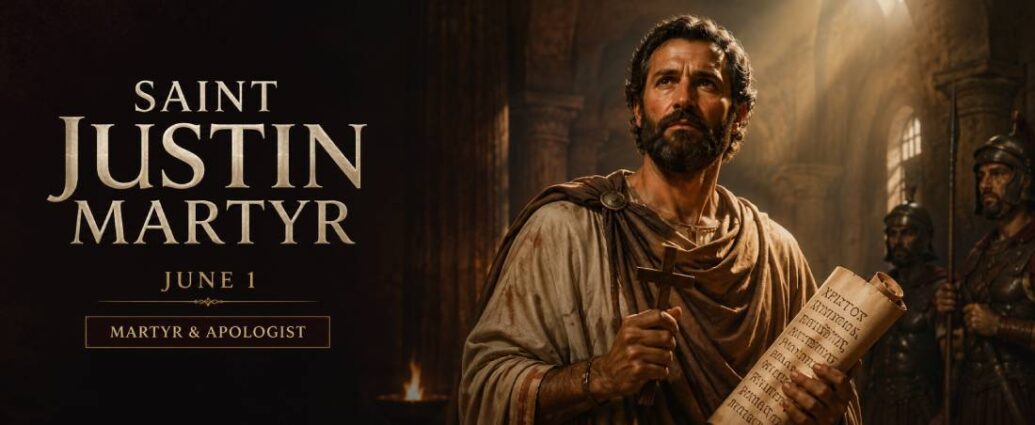
Among the great saints of the early Church, few combined intellectual brilliance and deep spiritual devotion as powerfully as Saint Justin Martyr. Living during a time when Christianity was misunderstood, persecuted, and often mocked by pagan society, Justin became one of the earliest and most courageous defenders of the Catholic faith. Yet beneath his reputation as a philosopher and apologist was a soul deeply devoted to prayer, truth, sacrifice, and complete obedience to Christ.
Saint Justin Martyr is remembered not merely because he argued for Christianity intellectually, but because he lived the Gospel with heroic conviction. His writings reveal a man captivated by the beauty of Christ, devoted to the Eucharist, committed to prayer, and willing to surrender his life rather than deny the Lord.
For modern Catholics living in a culture often hostile to faith, Saint Justin Martyr remains a profound example of courage, holiness, and unwavering devotion to God.
Early Life and Historical Background
Saint Justin was born around the year 100 AD in Flavia Neapolis, a Roman city in Samaria near present-day Nablus in the Holy Land. He was born into a pagan Greek-speaking family during the height of the Roman Empire. From an early age, Justin possessed an intense hunger for truth and wisdom.
As a young man, he studied several philosophical schools common in the Greco-Roman world. He explored Stoicism, Aristotelian philosophy, Pythagorean teachings, and eventually Platonism. Despite his education and intellectual accomplishments, Justin remained spiritually unsatisfied. Human philosophy could not answer the deepest longings of his soul.
According to his own writings, Justin’s life changed after meeting an elderly Christian who spoke to him about the prophets, Christ, and the fulfillment of divine truth in Christianity. The encounter profoundly moved him. Justin came to believe that Christianity was not merely another philosophy but the fullness of truth itself.
He later wrote that the teachings of Christ surpassed all human wisdom because they came directly from God.
After his conversion, Justin continued to wear the philosopher’s cloak, but now he used his education and rhetorical skill to defend the Catholic faith against pagan accusations and Roman persecution.
Calling and Spiritual Transformation
Justin’s conversion was not simply intellectual. It became deeply spiritual and transformative. He recognized in Christianity a call to holiness, prayer, and communion with God that philosophy alone could never provide.
His writings consistently demonstrate a profound reverence for:
- the Eucharist
- Sacred Scripture
- Christian morality
- martyrdom
- prayer
- obedience to divine truth
Justin traveled extensively, eventually settling in Rome where he opened a Christian school and taught the faith publicly. At great personal risk, he explained Christian doctrine to pagans and Roman authorities who often viewed Christians as dangerous enemies of the empire.
What made Justin remarkable was not only his intelligence, but his willingness to suffer for Christ. He understood that truth demanded sacrifice.
For Justin, Christianity was not an abstract theory. It was a way of life centered on union with Jesus Christ.
The Prayer Life of Saint Justin Martyr
The spiritual life of Saint Justin Martyr was deeply rooted in prayer and worship. Although much of his fame comes from his apologetic writings, those writings reveal the heart of a man immersed in Christian devotion.
One of Justin’s greatest contributions to Church history is his detailed description of early Christian worship in his work First Apology. In this text, he describes how Christians gathered on Sunday for:
- the reading of Scripture
- communal prayers
- preaching
- the sign of peace
- the Eucharistic sacrifice
His writings provide one of the earliest surviving descriptions of the Holy Mass outside the New Testament.
Justin spoke reverently of the Eucharist, affirming the true presence of Christ. He explained that the bread and wine offered at Mass were not ordinary food, but became the Body and Blood of Jesus Christ through prayer and consecration.
This reveals how central Eucharistic devotion was in his spiritual life.
Prayer for Justin was inseparable from truth. He believed Christians must seek purity of heart, holiness of conduct, and continual communion with God. He admired the courage of Christian martyrs because he believed their strength came through grace and prayer.
Unlike many pagan philosophers who pursued wisdom for pride or status, Justin sought wisdom as a path toward God.
His prayer life likely included:
- fasting
- meditation on Scripture
- liturgical prayer
- contemplation
- preparation for martyrdom
His writings show extraordinary peace and confidence even amid persecution.
Devotions, Sacrifices, and Spiritual Practices
Saint Justin lived during an era when becoming Christian could cost a person everything. Christians faced imprisonment, torture, social rejection, and execution. Yet Justin willingly embraced this path.
His sacrifices included:
- abandoning pagan prestige
- risking public ridicule
- exposing himself to Roman authorities
- dedicating his life to evangelization
- eventually surrendering his life in martyrdom
Justin viewed suffering as participation in Christ’s own sacrifice.
His spirituality reflected the discipline common among early Christians:
- simplicity of life
- moral purity
- charity toward the poor
- fidelity to apostolic teaching
- courage under persecution
His writings also reveal a profound respect for chastity, virtue, and self-control. He criticized pagan immorality and defended Christian ethics as expressions of divine truth.
Although historical evidence regarding Marian devotion in Justin’s life is limited, he contributed significantly to early Marian theology by comparing Mary to Eve. Justin explained that just as Eve’s disobedience contributed to humanity’s fall, Mary’s obedience helped bring salvation through Christ.
This theological insight became foundational for later Catholic teaching on the Blessed Virgin Mary.
Trials, Suffering, and Faithfulness
Saint Justin’s fidelity to Christ eventually led to his arrest during the reign of Emperor Marcus Aurelius.
He was brought before the Roman prefect Junius Rusticus along with several Christian companions. During the trial, Justin was ordered to renounce Christianity and sacrifice to the Roman gods.
He refused.
The surviving account of his martyrdom records his calm and unwavering faith. When threatened with torture and execution, Justin declared that Christians desired nothing more than to suffer for Christ and attain salvation.
His courage reflected a soul strengthened through prayer and intimate union with God.
Justin and his companions were scourged and then beheaded around the year 165 AD in Rome.
The Church honored him with the title “Martyr” because he willingly gave his life rather than betray Jesus Christ.
His martyrdom demonstrated that authentic Christian witness requires both truth and sacrifice.
Legacy in the Catholic Church
Saint Justin Martyr occupies a foundational place in Catholic history.
He is considered one of the most important early Christian apologists because his writings defended Christianity against false accusations and explained Catholic doctrine to the Roman world.
His surviving works include:
- First Apology
- Second Apology
- Dialogue with Trypho
These texts preserve invaluable information about:
- early Christian worship
- Eucharistic theology
- apostolic tradition
- moral teaching
- the relationship between faith and reason
Justin helped establish an intellectual tradition within Christianity that showed faith and reason are not enemies. This legacy later influenced great Catholic thinkers such as Saint Augustine of Hippo and Saint Thomas Aquinas.
His witness remains especially important in modern times when many believers struggle to defend their faith in secular societies.
The Catholic Church venerates Justin not only as a brilliant thinker, but as a holy martyr whose life demonstrated complete fidelity to Christ.
What Catholics Can Learn Today
Saint Justin Martyr offers many lessons for modern Catholics.
1. Truth Must Lead to God
Justin spent years searching for truth before finding fulfillment in Christ. His life reminds Catholics that authentic truth ultimately leads to God.
2. Faith and Reason Work Together
Justin rejected the false idea that intelligence and faith are incompatible. Catholics today can confidently engage culture, science, and philosophy while remaining faithful to the Church.
3. Prayer Sustains Courage
Justin’s strength during persecution did not come merely from intellect. It came from prayer, sacramental life, and trust in Christ.
4. The Eucharist Is Central
His testimony about the Mass reminds Catholics that the Eucharist has always been the heart of Christian worship since the earliest centuries.
5. Holiness Requires Sacrifice
Justin understood that following Christ involves suffering and surrender. Modern believers are likewise called to fidelity even when faith becomes difficult or unpopular.
Conclusion
Saint Justin Martyr stands among the great heroes of the early Church because he united intellect with holiness, philosophy with prayer, and truth with sacrifice.
His life demonstrates that Christianity is not merely a belief system but a total surrender to Jesus Christ. Through prayer, study, Eucharistic devotion, and fearless witness, Justin became a powerful defender of the Catholic faith during one of the Church’s most dangerous periods.
Even centuries later, his example continues to inspire Catholics to seek truth courageously, pray faithfully, and remain steadfast in love for Christ no matter the cost.