
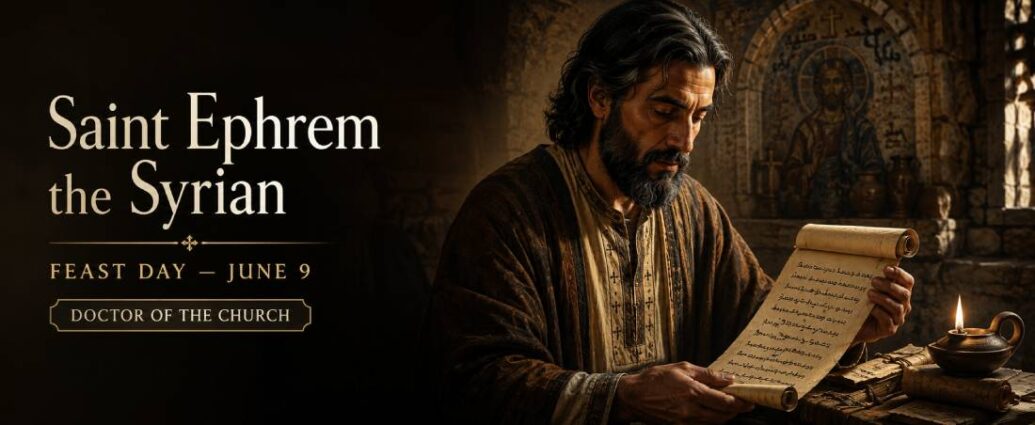
Among the greatest spiritual writers of the early Church, Saint Ephrem the Syrian stands as a radiant witness to prayer, humility, and sacred devotion. Known as the “Harp of the Holy Spirit,” Saint Ephrem transformed theology into poetry and prayer into song. His writings continue to nourish Catholics centuries after his death because they were born not merely from scholarship, but from deep contemplation before God.
Living during the turbulent fourth century in the ancient Christian East, Ephrem defended the true faith against heresy while calling souls to repentance, purity, and intimacy with Christ. He possessed extraordinary intellectual brilliance, yet he embraced humility and simplicity. Though revered as a theologian and teacher, he chose to remain a deacon rather than pursue ecclesiastical honor. His life reveals that holiness is not achieved through worldly greatness but through surrender to God in prayer and sacrifice.
Saint Ephrem’s spirituality was profoundly biblical, Eucharistic, ascetical, and poetic. He believed that every part of creation revealed the glory of God and that prayer purified the soul to perceive divine mysteries. His hymns and meditations continue to shape Catholic spirituality, particularly in the Eastern Churches, where he remains one of the most beloved saints.
On June 9, the Church honors this holy Doctor whose tears of repentance, hymns of praise, and devotion to Christ still echo throughout Christian history.
Early Life and Historical Background
Saint Ephrem was born around AD 306 in Nisibis, a fortified city in Mesopotamia, located in present-day southeastern Turkey near the Syrian border. He lived during a period of immense theological conflict and political instability. Christianity had only recently emerged from persecution, and the Church faced internal battles against heresies such as Arianism.
Ephrem was raised in a Christian environment deeply influenced by Syriac spirituality, a tradition rich in symbolism, poetry, fasting, and scriptural meditation. Ancient traditions suggest that his father may have been a pagan priest, though historians debate this detail. What is certain is that Ephrem embraced Christianity wholeheartedly from a young age and became a disciple of Saint Jacob of Nisibis, the holy bishop who greatly shaped his spiritual and theological formation.
Under Saint Jacob’s guidance, Ephrem studied Sacred Scripture intensely. Unlike many theologians of his era who wrote in Greek or Latin, Ephrem composed in Syriac, the language of ordinary Christians in the region. This made his teachings accessible to common believers and allowed his hymns to spread rapidly among the faithful.
Ephrem lived during repeated Persian invasions of Nisibis. These wars deeply marked his spirituality. He witnessed suffering, displacement, fear, and uncertainty, yet he consistently interpreted earthly trials through the lens of eternity. For Ephrem, worldly instability reminded Christians to seek the eternal Kingdom of God.
When Nisibis eventually fell under Persian control in 363, many Christians fled the city. Ephrem relocated to Edessa, an important center of Christian scholarship. There he spent the final years of his life teaching, writing hymns, serving the poor, and deepening his life of prayer.
Calling and Spiritual Transformation
From an early age, Ephrem showed a profound attraction to asceticism and contemplation. He desired a life entirely consecrated to God. Unlike many celebrated Church figures who became bishops or priests, Ephrem intentionally remained a deacon throughout his life. This choice reflected his deep humility and understanding of Christian service.
His vocation was not centered on ecclesiastical authority but on spiritual fatherhood through teaching, prayer, and sacred poetry. Ephrem believed theology should lead souls into worship rather than intellectual pride. For him, true knowledge of God required purity of heart.
The theological crises of his era became part of his spiritual mission. Heretical teachers often spread false doctrines through catchy songs and popular verse. Ephrem responded by composing orthodox Christian hymns filled with scriptural truth and profound beauty. Choirs of faithful women reportedly sang his hymns publicly, helping defend the faith of ordinary believers.
His writings reveal a soul deeply aware of human weakness and God’s mercy. Repentance was central to his spirituality. He frequently wept over sin and urged Christians to seek continual conversion through fasting, confession, humility, and prayer.
One of his most famous prayers captures this spirit perfectly:
“O Lord and Master of my life, take from me the spirit of sloth, despair, lust of power, and idle talk.”
This prayer remains beloved throughout Eastern Christianity, especially during Lent.
The Prayer Life of Saint Ephrem
Prayer was the center of Saint Ephrem’s existence. Everything he wrote emerged from contemplation. He did not separate theology from devotion because he understood that true doctrine must lead the soul toward communion with God.
Ephrem immersed himself in Sacred Scripture daily. He approached the Bible not merely as a text for study but as living revelation. His biblical commentaries reveal a deeply contemplative mind capable of perceiving spiritual symbolism throughout salvation history.
Silence and solitude played important roles in his spiritual discipline. Though he ministered publicly through preaching and teaching, Ephrem frequently withdrew for prayer and reflection. Ancient accounts associate him with cave-like dwellings and monastic simplicity.
Fasting was another cornerstone of his prayer life. Like many early Eastern Christians, Ephrem embraced rigorous ascetic practices. He believed bodily discipline purified the heart and freed the soul for deeper intimacy with God. Yet his asceticism was never harsh for its own sake. It flowed from love and longing for holiness.
His prayers are marked by humility and tears. Ephrem often described himself as a sinner entirely dependent on divine mercy. This deep awareness of human frailty gave extraordinary tenderness to his spirituality. He taught that repentance was not despair but the pathway to healing and union with Christ.
The Eucharist also occupied a central place in his theology and devotion. Ephrem wrote beautifully about the mystery of Christ’s Body and Blood, emphasizing the transforming grace received through worthy participation in the sacred mysteries.
His hymns frequently contemplated the Incarnation of Christ, the purity of the Virgin Mary, and the wonder of salvation. Through poetic imagery, he invited believers into awe before divine mysteries rather than cold analysis.
Devotions, Sacrifices, and Spiritual Practices
Saint Ephrem practiced radical simplicity. He rejected worldly ambition and embraced poverty of spirit. Historical accounts describe him wearing plain garments and living modestly despite his widespread reputation for wisdom.
His devotion to Christ crucified shaped his understanding of suffering. Ephrem viewed earthly hardships as opportunities for purification and spiritual growth. The repeated wars and displacements he experienced strengthened rather than weakened his faith.
Marian devotion appears prominently in his writings. Ephrem composed some of the earliest and most beautiful Christian hymns honoring the Blessed Virgin Mary. He emphasized her purity, obedience, and role in salvation history with remarkable theological depth.
He also possessed profound compassion for the poor and suffering. During a severe famine in Edessa, Ephrem organized charitable relief efforts and personally served the sick and hungry. Tradition states that the exhaustion from these labors contributed to his final illness.
Unlike intellectuals who seek admiration, Ephrem feared pride intensely. Humility became one of his greatest spiritual disciplines. He believed spiritual knowledge without humility could destroy the soul.
Music and sacred poetry themselves became acts of devotion in Ephrem’s life. He understood beauty as a pathway to God. His hymns were not entertainment but sacred instruments meant to awaken repentance, worship, and contemplation.
Trials, Suffering, and Faithfulness
Saint Ephrem endured many hardships throughout his life. Political violence, displacement, theological conflict, and personal ascetic struggles shaped his spiritual journey.
The fall of Nisibis deeply wounded him emotionally and spiritually. Leaving his homeland forced him into exile, yet he accepted this suffering with faith. Rather than becoming bitter, Ephrem saw earthly instability as a reminder that Christians are pilgrims journeying toward heaven.
He also battled doctrinal confusion within the Church. False teachings threatened many believers, and Ephrem responded tirelessly through preaching and writing. His defense of orthodoxy required courage, wisdom, and perseverance.
Internally, Ephrem continually struggled against pride and temptation. His prayers reveal ongoing self-examination and sincere repentance. He never portrayed holiness as effortless perfection. Instead, he emphasized dependence on God’s grace.
Toward the end of his life, Ephrem dedicated himself to caring for plague victims and famine sufferers in Edessa. This sacrificial charity demonstrated the authenticity of his spirituality. His prayer life overflowed into concrete love for others.
He died around AD 373, likely from illness contracted while serving the afflicted. The Church remembers him not only as a brilliant theologian but as a humble servant who lived what he taught.
Legacy in the Catholic Church
The influence of Saint Ephrem upon Christian spirituality is immense. In 1920, Pope Benedict XV officially declared him a Doctor of the Church, recognizing the enduring theological and spiritual value of his writings.
Ephrem’s hymns and biblical commentaries profoundly shaped Eastern Christian liturgy and devotion. He remains especially beloved within Syriac Christianity, where his poetry continues to be sung in worship.
His writings helped preserve orthodox doctrine during one of the Church’s most turbulent eras. Yet what makes Ephrem remarkable is that he defended truth not merely through argument but through beauty, prayer, and worship.
Catholics today continue to draw inspiration from his teachings on repentance, humility, fasting, contemplation, and divine mercy. His spirituality offers a corrective to modern distractions by reminding believers that holiness begins in silence before God.
The Church especially honors him as a master of sacred poetry and theological symbolism. Few saints united intellect and devotion as harmoniously as Ephrem.
What Catholics Can Learn Today
Modern Catholics can learn many powerful lessons from Saint Ephrem the Syrian.
First, prayer must come before intellectual pride. Ephrem teaches that theology without holiness becomes empty. Knowledge of God grows through humility and purity of heart.
Second, repentance is essential to spiritual growth. Ephrem’s tears were not signs of despair but expressions of love for God and sorrow for sin. In an age that often minimizes sin, his witness calls Catholics back to sincere conversion.
Third, beauty can lead souls to Christ. Through poetry, music, and sacred imagery, Ephrem showed that art can become evangelization when rooted in truth.
Fourth, suffering can sanctify the soul. Ephrem endured exile, instability, and hardship without losing faith. His life encourages Christians facing uncertainty today.
Finally, holiness requires charity. Ephrem’s final years serving the poor reveal that authentic contemplation must bear fruit in love.
Conclusion
Saint Ephrem the Syrian remains one of the Church’s greatest masters of prayerful theology. His hymns continue to echo across centuries because they emerged from a heart wholly surrendered to God. Through fasting, contemplation, humility, and devotion to Christ, he became a living instrument of divine grace.
As Catholics honor him on June 9, his life invites believers to rediscover the beauty of prayer, the necessity of repentance, and the transforming power of sacred worship. In a noisy world, Saint Ephrem reminds the faithful that true wisdom begins on one’s knees before God.