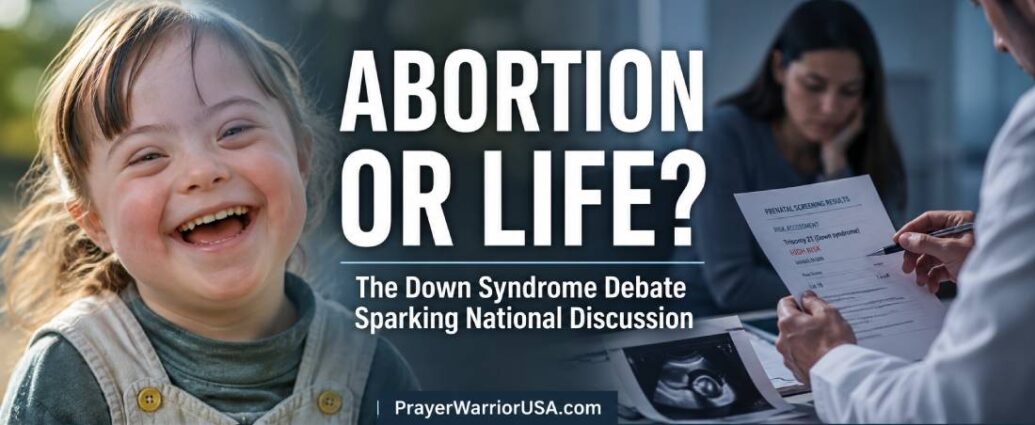
YouTuber Jesse Ridgway recently defended his decision to have his unborn child aborted after a Down syndrome diagnosis. His reasoning? “Of course I’m glad my dad didn’t f–ing terminate me, but I’m normal.” The comment has sparked outrage, but it deserves more than our anger. It deserves our grief. Because in those few words, Ridgway drew a line between human lives worth living and human lives worth ending. And that line was the word “normal.”
We’ve reached a point where abortion in Down syndrome cases has become so routine, so accepted, that a man can publicly declare his own worth while simultaneously denying worth to his child—and expect sympathy. This isn’t just about one YouTuber’s tragic choice. This is about the silent genocide happening in prenatal diagnosis rooms across America. This is about who gets to be called normal. And who gets discarded before they draw their first breath.
Ridgway’s statement reveals something we need to confront head-on. He’s grateful for his own life. Values his own existence. He recognizes that his father could’ve chosen abortion, and he’s relieved that didn’t happen. But he cannot—or will not—extend that same value to a child with an extra chromosome.
The Jesse Ridgway Abortion Controversy and What ‘Normal’ Really Means
This is the poisonous logic of selective abortion. Some lives are gifts, it says, others are burdens. Some children are blessings, others are mistakes we can correct. Some humans deserve protection, others deserve death. The dividing line? A diagnosis. A genetic difference. A deviation from what we’ve decided is “normal.”
But normal is a cruel god. It demands sacrifice. Requires us to offer up the vulnerable, the different, the ones who need us most. And it promises us nothing in return except the cold comfort that we avoided inconvenience.
Scripture doesn’t give us the luxury of drawing lines between worthy lives and disposable ones. Listen to what God says through the prophet Isaiah: “Listen to me, O house of Jacob, all the remnant of the house of Israel, who have been borne by me from before your birth, carried from the womb; even to your old age I am he, and to gray hairs I will carry you. I have made, and I will bear; I will carry and will save” (Isaiah 46:3-4, ESV).
A Biblical View of Abortion and Every Human Life
God carries us from the womb. Not just the healthy ones. Not just the “normal” ones. All of us. He made each one, and He bears each one, and He doesn’t sort us into categories of keepable and disposable. The God who knit us together in secret doesn’t make mistakes that require our correction.
James tells us plainly where the impulse to rank human worth really comes from: “My brothers, show no partiality as you hold the faith in our Lord Jesus Christ, the Lord of glory” (James 2:1, ESV). Partiality. That’s what this is. When we decide that a child with Down syndrome is less valuable than a child without it, we’re showing partiality. Judging by appearance, by ability, by our own standards of acceptability. And James says we can’t do that and claim to hold faith in Jesus at the same time.
These aren’t abstract theological points. This is the foundation of everything we believe about human dignity. Either God creates each person with infinite worth, or we get to decide who matters based on our own preferences. There’s no middle ground.
What This Means for Christians Facing Down Syndrome Abortion Ethics
We need to speak truth, and we need to speak it clearly. Children with Down syndrome aren’t tragedies waiting to happen. They’re not lives of diminished value. They’re image-bearers of the living God, fully human, fully worthy of protection and love.
But we also need to recognize the pressure parents face when they receive that diagnosis. The medical establishment often presents Down syndrome as a problem to be solved rather than a child to be welcomed. Statistics tell us that over 60% of Down syndrome pregnancies in the United States end in abortion. In some countries, that number approaches 100%. This isn’t happening in a vacuum. It’s systematic. It’s cultural. And it’s accelerating.
So what do we do? We become the voices that speak a different truth. When a friend gets a prenatal diagnosis, we don’t offer sympathy tinged with understanding if they “make a difficult choice.” We offer hope. Connect them with families who are raising children with Down syndrome. We show them the testimonies of joy, of unexpected blessing, of lives that are rich and full and worth living.
Prayer Points for the Unborn and Those Deemed ‘Different’: Syndrome
We also need to examine our own hearts. Do we truly believe that every life has equal worth? Or have we, too, absorbed some of the world’s ranking system? Would we hesitate if our own child received this diagnosis? These aren’t comfortable questions, but they’re necessary ones. We can’t call others to a standard we haven’t wrestled with ourselves.
And we speak up. We don’t let comments like Ridgway’s pass unchallenged. Not with rage, but with firm clarity: there is no such thing as a normal person who deserves life more than an “abnormal” one. There are only people. All created. All valuable. All deserving of our protection.
- Lord, we pray for every child currently growing in the womb who carries a Down syndrome diagnosis. Protect them from the hands that would destroy them. Soften the hearts of their parents. Give them courage to choose life even when the world tells them it’s reasonable to choose death.
- Father, forgive us for the times we’ve assigned value to human beings based on their abilities rather than Your image in them. Cleanse us from the subtle ways we’ve absorbed this culture’s utilitarian view of human worth.
- We lift up families raising children with Down syndrome and other differences. Strengthen them when they’re tired. Encourage them when the world treats their children as less-than. Let their joy be a witness to everyone who believes some lives aren’t worth the trouble.
- God, we ask that You would raise up a generation of Christian doctors, counselors, and advocates who will stand in the gap when parents receive difficult prenatal diagnoses. Give them wisdom and compassion to present hope instead of despair, life instead of elimination.
- Break our hearts for what breaks Yours. Don’t let us become numb to the reality that thousands of children are being killed simply because they’re different. Keep us urgent. Keep us loving. Keep us speaking.
📖 You Might Also Like

This is a faith commentary responding to reporting by LifeSiteNews. PrayerWarriorsUSA does not reproduce the original article — we offer a Christian perspective and call to prayer in response to current events.