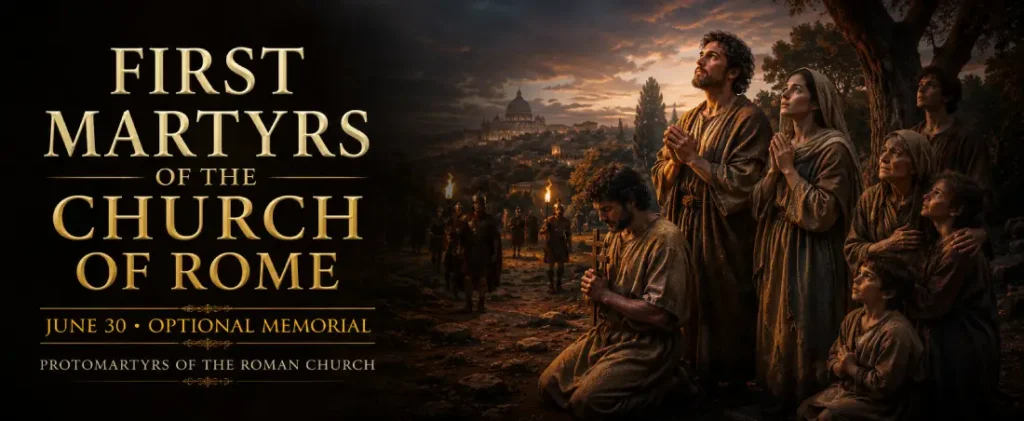
The First Martyrs of the Church of Rome are unlike most saints honored by the Catholic Church. We do not know their names. We do not know where most of them were born, what professions they held, or even how many there were. Yet every year on June 30, the Church pauses to remember them.
Why?
Because these anonymous believers became the first great witnesses of Christianity in the city of Rome. Their blood was shed during one of the darkest moments in the early Church, and their courage helped shape the identity of Christianity for centuries to come.
They were ordinary men and women who faced extraordinary suffering. They were not bishops, kings, or famous missionaries. Most were simply Christians who refused to deny Jesus Christ.
Their story reminds us that the Church was built not only by great apostles like Saints Peter and Paul but also by countless faithful believers whose names are known only to God.
Who Were the First Martyrs of the Church of Rome?
The First Martyrs of the Church of Rome were the Christians executed in Rome during the persecution ordered by the Roman Emperor Nero after the Great Fire of Rome in AD 64.
The Church honors them collectively because they were among the earliest Christians to die specifically for their faith in Christ in the capital of the Roman Empire.
Their feast day is celebrated on June 30, immediately after the Solemnity of Saints Peter and Paul on June 29. The placement is intentional. The Church remembers that after the apostles preached the Gospel in Rome, many ordinary Christians followed their example and gave their lives for Christ.
The Roman Martyrology describes them as disciples who endured mockery, torture, crucifixion, and death by fire, becoming the first fruits of the Church of Rome.
The World They Lived In
To understand their sacrifice, we must understand Rome in the first century.
The Roman Empire was the most powerful political force in the Mediterranean world. Its roads, trade routes, and relative peace allowed Christianity to spread rapidly from Jerusalem to major cities throughout the empire.
Rome itself was a vast and crowded city of perhaps one million inhabitants. Wealth and poverty existed side by side. Grand temples and imperial palaces stood near overcrowded neighborhoods and wooden apartment buildings.
Religion was woven into daily life. Romans honored many gods and expected citizens to participate in public religious ceremonies. Worship of the emperor was also becoming increasingly important.
Christians appeared strange and even dangerous to many Romans. They worshiped one God, refused to sacrifice to pagan deities, and gathered privately for prayer and the Eucharist. Rumors and misunderstandings spread about them.
At this time, Christianity was still a small and vulnerable movement.
The Christian Community in Rome Before the Persecution
Christianity reached Rome long before the persecution of Nero.
By the time Saint Paul wrote his Letter to the Romans around AD 57, a thriving Christian community already existed there. The Church in Rome included Jewish converts, Gentile believers, merchants, freed slaves, and members of wealthy households.
Many of these Christians likely met in house churches. They gathered to hear the teachings of the apostles, pray together, and celebrate the Eucharist.
Tradition also associates Saints Peter and Paul with the Roman Church during this period. Their preaching strengthened the faith of the Christian community and helped establish Rome as one of the most important centers of Christianity.
No one could have imagined how quickly this growing community would face tragedy.
The Great Fire of Rome
In July of AD 64, disaster struck.
A massive fire broke out in Rome and burned for several days. Ancient historians report that much of the city was destroyed. Thousands lost their homes, and many people died.
The exact cause of the fire remains unknown.
Ancient sources indicate that many Romans suspected Emperor Nero himself had some responsibility for the disaster or had at least failed to prevent it. Whether these suspicions were fair or not remains debated by historians.
What is clear is that Nero needed someone to blame.
He chose the Christians.
Nero’s Persecution of Christians
Our most important historical source for this persecution is the Roman historian Tacitus, who was not a Christian and had no reason to exaggerate Christian suffering.
Tacitus records that Nero accused Christians of causing the fire and subjected them to terrible punishments.
Some were covered with animal skins and torn apart by dogs.
Some were crucified.
Others were burned alive to illuminate Nero’s gardens during nighttime entertainments.
The cruelty shocked even many Romans who had little sympathy for Christians. Tacitus wrote that people began to feel pity for the victims because they appeared to be suffering not for the public good but because of the emperor’s brutality.
This persecution marks the first large-scale state-sponsored persecution of Christians in Roman history.
Why Were Christians Hated?
The Christians were not executed simply because they believed in Jesus.
The deeper issue was that Christians refused to worship the Roman gods and the emperor. To many Romans, this seemed dangerous and even unpatriotic.
Christians also refused to participate in many pagan festivals and religious practices that were considered essential for maintaining the favor of the gods.
Because they met privately and celebrated mysterious rites such as the Eucharist, false rumors spread about them.
They were accused of strange crimes they had never committed.
Their true offense was their loyalty to Jesus Christ.
Like the apostles before them, they lived the words of Saint Peter:
“We must obey God rather than men.” (Acts 5:29)
Were Saints Peter and Paul Among These Martyrs?
The Church commemorates Saints Peter and Paul separately, and their martyrdoms are among the most important events in Christian history.
Many historians believe that Peter and Paul were also victims of Nero’s persecution, although the exact dates and circumstances are not known with complete certainty.
The feast of the First Martyrs of the Church of Rome follows the feast of Peter and Paul because the Church wishes to honor not only the great apostles but also the countless ordinary Christians who suffered with them.
Together they reveal an important truth: the Church is built by both leaders and faithful disciples.
Anonymous Saints Known to God
One of the most remarkable things about these martyrs is that their names have been lost to history.
Unlike many saints, there are no detailed biographies.
No individual acts of heroism survive.
No personal writings remain.
Yet the Church honors them because holiness does not depend on earthly fame.
Their anonymity carries a powerful spiritual lesson.
God knows every act of fidelity, even when history forgets the names of those who performed it.
These martyrs fulfilled the words of Christ:
“Whoever loses his life for my sake will find it.” (Matthew 16:25)
The Church may not know their names, but heaven does.
The Meaning of Martyrdom
The word “martyr” comes from a Greek word meaning “witness.”
The First Martyrs of Rome witnessed to Christ not through preaching or writing but through the gift of their lives.
The early Christians often described martyrdom as participation in the Passion of Christ. The martyrs shared in the sufferings of Jesus and became living signs of the Resurrection.
The Catechism of the Catholic Church teaches that martyrdom is the supreme witness given to the truth of the faith.
These believers did not seek death. They simply refused to abandon Christ when faced with persecution.
Their courage became one of the strongest arguments for the truth of Christianity.
Many observers were astonished that ordinary men and women could endure such suffering with hope and peace.
Did the Martyrs Perform Miracles?
No miracles are historically associated with these martyrs as a group.
The Church honors them not because they worked miracles but because they gave the ultimate witness of faith.
In many ways, their martyrdom itself became a kind of spiritual miracle.
Their deaths did not destroy Christianity.
Instead, the Church continued to grow.
The witness of the martyrs inspired countless conversions throughout the centuries.
The ancient Christian writer Tertullian famously observed that “the blood of the martyrs is the seed of Christians.”
The First Martyrs of Rome are among the earliest examples of this truth.
Early Veneration and Feast Day
Christians in Rome never forgot these martyrs.
Their memory became part of the identity of the Roman Church.
By the early centuries of Christianity, believers honored the places associated with their suffering and death. Pilgrims visited the tombs of martyrs and remembered their witness in prayer and liturgical celebrations.
Today the Church celebrates their memorial on June 30.
Their feast reminds Catholics that the history of Christianity is not only the story of famous saints but also of ordinary believers who remained faithful under unimaginable trials.
Symbols and Iconography
Because the individual identities of these martyrs are unknown, Christian art usually portrays them symbolically.
They are often shown with:
- Palm branches representing victory in martyrdom.
- Crowns symbolizing eternal life.
- Flames recalling those burned during Nero’s persecution.
- Crosses representing those who were crucified.
- White garments symbolizing purity and triumph in Christ.
These symbols point not to earthly defeat but to heavenly victory.
Why Are the First Martyrs of the Church of Rome Important Today?
Their story feels surprisingly modern.
Many Christians throughout the world still face persecution, discrimination, and violence because of their faith.
The First Martyrs of Rome remind us that Christianity has always demanded courage.
They also challenge modern believers to examine their own faith.
Would we remain faithful when following Christ becomes difficult?
Would we choose Christ over comfort, popularity, or security?
Their witness teaches that holiness is possible for ordinary people.
They were not famous saints during their lifetimes.
They were everyday Christians who remained faithful when everything was taken from them.
That is why the Church continues to honor them nearly two thousand years later.
Lessons Catholics Can Learn from the First Martyrs of Rome
First, faithfulness matters more than worldly success.
Second, suffering for Christ is never meaningless.
Third, the Church is strengthened by the witness of ordinary believers.
Fourth, God remembers those whom history forgets.
Finally, courage is contagious. The example of the martyrs has inspired generations of Christians to remain faithful in every age.
Conclusion
The First Martyrs of the Church of Rome stand among the most moving figures in Christian history precisely because we know so little about them.
Their names have disappeared.
Their personal stories are lost.
Yet their witness remains.
In the terrifying days after the Great Fire of Rome, these believers chose Christ over fear and eternal hope over temporary safety. Their sacrifice helped shape the identity of the Church and transformed Rome itself into a city sanctified by the blood of martyrs.
They remind us that the greatness of a saint is not measured by fame, learning, or power.
It is measured by fidelity.
The First Martyrs of the Church of Rome were ordinary Christians who did one extraordinary thing: they remained faithful to Jesus Christ until the end.
For that reason, the Church still remembers them, honors them, and asks their example to strengthen the faith of Christians throughout the world.