
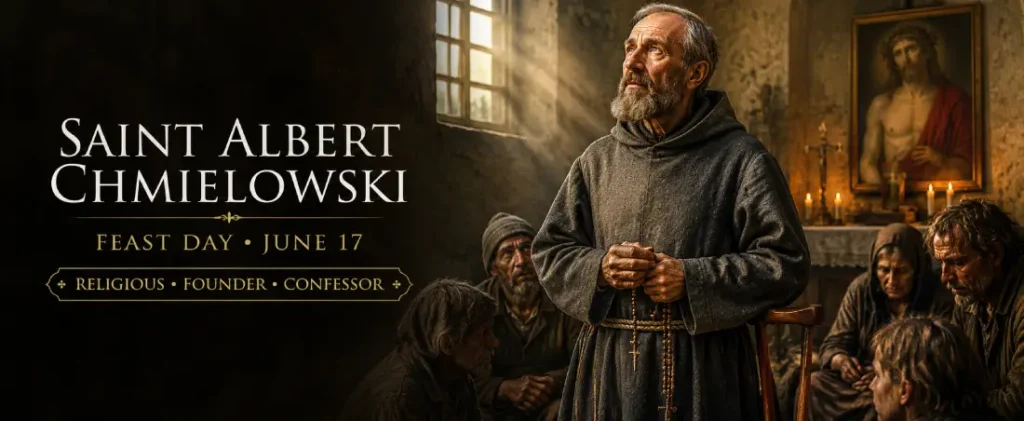
Among the great saints of modern Catholic history, few lives illustrate the transforming power of prayer and charity as profoundly as Saint Albert Chmielowski. Born into privilege, gifted with extraordinary artistic talent, and admired in intellectual circles, he could have spent his life pursuing fame and recognition. Instead, after years of spiritual searching, he abandoned worldly success to serve the homeless, abandoned, and forgotten.
Known affectionately as “Brother Albert,” he became one of Poland’s most beloved saints because he saw Christ in the poor and gave himself completely to them. His holiness was not rooted merely in charitable works but in a deep Eucharistic spirituality that transformed his heart. Every act of service flowed from prayer, contemplation, and an intimate relationship with Jesus Christ.
His life remains a powerful witness for Catholics today who seek to unite prayer and action, contemplation and charity, devotion and sacrifice.
Early Life and Historical Background
Saint Albert Chmielowski was born Adam Hilary Bernard Chmielowski on August 20, 1845, in Igołomia near Kraków, Poland. At the time, Poland was partitioned among foreign powers, and national identity was deeply intertwined with suffering and resistance.
Adam lost both of his parents while still young. Despite these hardships, he received an excellent education and showed remarkable artistic ability from an early age.
As a young man, he participated in the Polish uprising against Russian rule. During the conflict, he suffered severe injuries that resulted in the amputation of his left leg. The physical suffering and trauma of war profoundly shaped his understanding of human pain and vulnerability.
After recovering, he pursued studies in painting in Warsaw, Munich, and Paris. His artistic talent quickly earned recognition, and he became associated with prominent artistic and intellectual circles. Many expected him to become one of Poland’s greatest painters.
Yet despite success, Adam felt an increasing spiritual emptiness. Fame, artistic achievement, and social prestige could not satisfy the deeper hunger of his soul.
Calling and Spiritual Transformation
The turning point in Adam’s life came gradually through prayer and reflection.
While pursuing art, he became deeply moved by the suffering he witnessed among the poor of Kraków. The contrast between the beauty he painted and the misery endured by thousands of people troubled his conscience.
One of his most famous artistic works was his unfinished painting of Ecce Homo—Christ presented to the crowd after His scourging. As Adam contemplated the suffering face of Christ, he began to recognize that the same wounded Savior was present in the homeless and abandoned people around him.
His artistic gaze became a spiritual gaze.
Eventually, he joined the Secular Franciscans and embraced a life of deeper prayer and penance. In 1888 he founded the Brothers of the Third Order of Saint Francis, Servants of the Poor, taking the religious name Albert. Later, he also established a congregation of Albertine Sisters dedicated to serving the needy.
Brother Albert intentionally chose to live among the poor rather than merely assist them from a distance. He slept in shelters, shared their hardships, and embraced poverty as a means of solidarity with those he served.
The Prayer Life of Saint Albert Chmielowski
The foundation of Saint Albert’s holiness was not social activism but profound union with Christ.
His service to the poor emerged directly from prayer.
Brother Albert spent long hours before the Blessed Sacrament. He believed that genuine charity was impossible without first receiving the love of Christ in prayer. Eucharistic adoration became the center of his spiritual life.
His spirituality reflected a deeply Franciscan understanding of Christ’s humility and self-giving love. He contemplated the Incarnation, the Passion, and the Eucharist as expressions of God’s complete gift of Himself to humanity.
One of his most famous reflections reveals the heart of his spirituality:
“I look at Jesus in His Eucharist. Could His love have provided anything more beautiful? If He is bread, let us too become bread.”
This simple statement summarizes his entire life.
In the Eucharist, he saw Christ becoming nourishment for humanity. Therefore, Christians must also become nourishment for others through sacrificial love.
His prayer was never separated from action.
The more time he spent before Christ in the tabernacle, the more deeply he recognized Christ in the poor.
For Brother Albert, the chapel and the shelter belonged together.
Devotions, Sacrifices, and Spiritual Practices
Saint Albert embraced numerous spiritual disciplines that shaped his holiness.
Eucharistic Devotion
The Eucharist stood at the center of his life.
Daily Mass, Eucharistic adoration, and meditation on Christ’s sacrificial love formed the foundation of his ministry. He encouraged his religious communities to cultivate deep reverence for the Blessed Sacrament.
Franciscan Poverty
Inspired by Saint Francis of Assisi, Brother Albert embraced radical poverty.
Although he came from a wealthy background and could have enjoyed comfort and prestige, he deliberately chose simplicity.
He wanted nothing to separate him from those he served.
Penance and Self-Denial
Like many saints, Albert practiced self-discipline to strengthen his spiritual life.
His physical disabilities and hardships became opportunities to unite his suffering with Christ’s Passion.
Rather than seeking comfort, he embraced sacrifice as a means of growing closer to God.
Prayerful Service
One of his most distinctive practices was transforming charitable work into prayer.
Feeding the hungry, caring for the sick, and welcoming the homeless were not merely humanitarian efforts. They were acts of worship offered to Christ.
His service flowed from contemplation and returned to contemplation.
Trials, Suffering, and Faithfulness
Saint Albert’s journey to holiness was not without struggles.
He experienced physical suffering from the loss of his leg and the lifelong limitations it imposed.
He also endured spiritual trials and periods of uncertainty while discerning God’s will.
Leaving behind a promising artistic career required enormous sacrifice. Many could not understand why a respected painter would abandon everything for a life among society’s outcasts.
Financial difficulties constantly threatened his ministries.
The shelters depended largely on donations and alms. There were often moments when resources seemed insufficient.
Yet Brother Albert never lost confidence in Divine Providence.
His faith remained rooted in the conviction that Christ Himself was present among the poor.
This conviction sustained him through every hardship.
As the years passed, he became known throughout Poland as a living example of Christian charity.
His humble shelters became places where the forgotten encountered dignity, compassion, and hope.
Legacy in the Catholic Church
By the time of his death on Christmas Day in 1916, Brother Albert had established numerous shelters and charitable institutions throughout Poland. His work continued to expand through the Albertine Brothers and Sisters.
His influence extended far beyond charitable service.
A young Karol Wojtyła—later Pope Saint John Paul II—was deeply inspired by his life. Wojtyła even wrote a play entitled The Brother of Our God based on Albert’s story and later acknowledged the saint’s profound influence on his own vocation.
Pope John Paul II beatified Albert in Kraków on June 22, 1983, and canonized him on November 12, 1989.
Today, Saint Albert is remembered not only as a founder and servant of the poor but as a saint who united contemplative prayer with radical charity.
What Catholics Can Learn Today
Saint Albert Chmielowski offers several timeless lessons.
Prayer Must Lead to Charity
Authentic prayer changes how we see others.
The more we encounter Christ in the Eucharist, the more we recognize Him in those who suffer.
Success Is Not the Same as Holiness
Albert gave up artistic fame to follow God’s call.
His life reminds Catholics that holiness is measured not by achievement but by fidelity.
Christ Is Present in the Poor
Brother Albert lived the Gospel teaching that whatever we do for the least among us, we do for Christ Himself.
Sacrifice Bears Fruit
His willingness to surrender comfort, prestige, and personal ambition allowed God to use him in extraordinary ways.
The Eucharist Is the Source of Mission
His entire ministry flowed from Eucharistic devotion.
Modern Catholics can rediscover this same connection between worship and service.
Conclusion
Saint Albert Chmielowski stands as one of the Church’s greatest witnesses to the inseparable connection between prayer and charity. An accomplished artist who became a servant of the poor, he discovered that true beauty is found not merely on canvas but in a life transformed by Christ.
His deep Eucharistic devotion inspired him to become “bread” for others through sacrifice and love. Through prayer, poverty, humility, and service, he revealed the face of Christ to countless people who had been forgotten by society.
For Catholics today, Saint Albert’s example remains profoundly relevant. In a world often focused on success and self-promotion, he reminds us that holiness is found in loving God wholeheartedly and serving Christ wherever He is found—especially among the poor, the suffering, and the abandoned.