
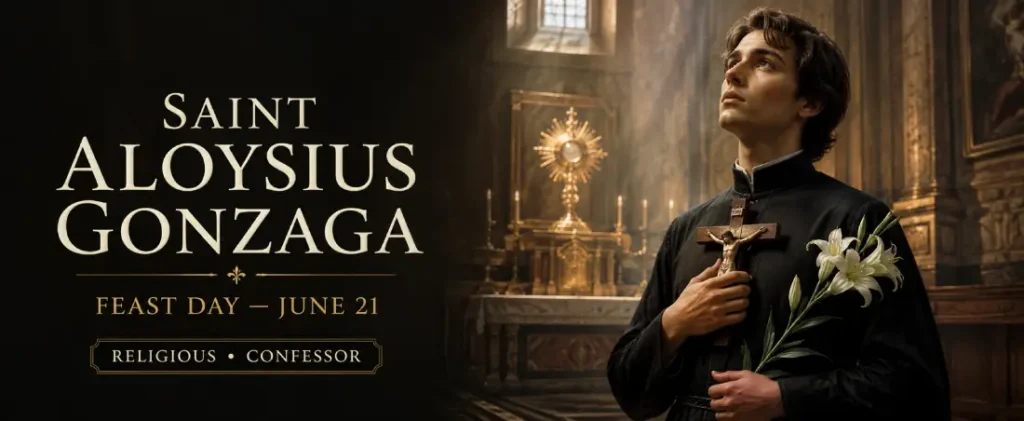
Among the great saints of the Catholic Church, few shine as brightly in youthful holiness as Saint Aloysius Gonzaga. Born into Italian nobility and destined for wealth, military power, and political influence, Aloysius abandoned everything to follow Jesus Christ.
His life was remarkably short—he died at only twenty-three years old—yet his devotion to prayer, purity, the Eucharist, and self-sacrifice left a lasting mark on the Church. His holiness did not arise from dramatic miracles or extensive missionary journeys but from a profound interior life rooted in constant prayer and complete surrender to God’s will.
For Catholics today, Saint Aloysius remains a powerful example that sanctity is not measured by age but by love of God.
Early Life and Historical Background
Saint Aloysius Gonzaga was born on March 9, 1568, in Castiglione delle Stiviere in northern Italy. He belonged to the influential Gonzaga family, one of the most powerful noble houses in Renaissance Italy.
From childhood, Aloysius was immersed in the culture of courts, politics, and military affairs. His father, Ferrante Gonzaga, envisioned a prestigious military career for his eldest son. As a young boy, Aloysius was even dressed in miniature armor and accompanied soldiers during military inspections.
Yet God was already forming a different vocation within him.
During his early years he suffered from periods of illness that frequently confined him to prayer and reflection. While serving in various royal courts, including that of Spain, he witnessed corruption, vanity, ambition, and moral decadence. Rather than being attracted by these worldly pursuits, he became increasingly detached from them.
At approximately seven years of age he began to show an unusual seriousness in spiritual matters. By adolescence, he had developed a disciplined prayer life far beyond his years.
Calling and Spiritual Transformation
A decisive turning point occurred when Aloysius encountered spiritual writings and the lives of the saints. Through prayer and meditation, he became convinced that God was calling him to religious life.
Despite being heir to significant titles and wealth, he renounced his inheritance in favor of his younger brother. This decision provoked fierce opposition from his father, who considered it a betrayal of family expectations.
For several years Aloysius endured emotional pressure, arguments, and attempts to change his mind. Yet his commitment remained firm.
After obtaining the necessary permissions, he entered the Society of Jesus, founded by Saint Ignatius of Loyola.
Joining the Jesuits required extraordinary humility. A nobleman accustomed to privilege willingly embraced obedience, simplicity, and hidden service. His decision reflected one of the central themes of his spirituality: choosing Christ above earthly honor.
The Prayer Life of Saint Aloysius Gonzaga
The defining characteristic of Saint Aloysius was his intense prayer life.
Contemporaries consistently testified that prayer seemed as natural to him as breathing. Even amid court life and later Jesuit formation, he maintained a deep awareness of God’s presence.
Aloysius dedicated long periods to:
- Meditation on Sacred Scripture
- Eucharistic adoration
- Examination of conscience
- Marian prayer
- Silent contemplation
- Devotional reading
His spiritual directors frequently observed his remarkable recollection. He sought solitude whenever possible so that he could converse with God.
Prayer was not merely an activity for him; it was the center of his existence.
He cultivated what many spiritual writers call “continuous recollection,” an ongoing attentiveness to God throughout the day. Whether studying, serving, or performing ordinary tasks, he attempted to keep his heart fixed on Christ.
The Eucharist occupied a privileged place in his spiritual life. Accounts from Jesuit records describe his profound devotion during Mass and thanksgiving afterward. Receiving Holy Communion was for him a source of immense joy and spiritual strength.
He also possessed a deep devotion to the Blessed Virgin Mary. Tradition records that he entrusted his purity and vocation to her maternal care from a young age.
Many biographers note that his prayer often moved him to tears. These were not emotional displays but expressions of profound love for God and sorrow for sin.
Devotions, Sacrifices, and Spiritual Practices
Saint Aloysius practiced a disciplined spiritual life that reflected the ascetical traditions of the Church.
His devotions included:
Frequent Meditation
He spent considerable time reflecting on Christ’s Passion. Meditation on the suffering of Jesus helped him cultivate humility and gratitude.
Eucharistic Devotion
The Blessed Sacrament remained the heart of his spirituality. His reverence before the Eucharist inspired fellow Jesuits and contributed to his reputation for holiness.
Marian Consecration
Aloysius maintained a lifelong devotion to the Blessed Virgin. He viewed Mary as a guide who led souls to deeper union with Christ.
Penance and Self-Denial
Like many saints of his era, he embraced fasting and voluntary sacrifices. These practices were not acts of self-punishment but expressions of love and spiritual discipline.
Purity of Heart
Perhaps no virtue became more associated with Aloysius than purity. He guarded his senses carefully and sought to keep his thoughts focused on God.
His pursuit of purity was not merely moral restraint. It reflected an undivided heart devoted entirely to Christ.
Trials, Suffering, and Faithfulness
Despite his reputation for holiness, Aloysius faced significant trials.
One challenge was the conflict with his father regarding his vocation. The emotional suffering caused by family opposition tested his perseverance and obedience.
Another difficulty involved his fragile health. Throughout his life he experienced physical weakness and recurring illnesses.
The greatest test came during a severe plague outbreak in Rome in 1591.
The Jesuits organized relief efforts to care for the sick and dying. Aloysius volunteered eagerly, serving patients in hospitals and carrying victims from the streets.
He understood the risks but refused to abandon those in need.
While caring for plague victims, he contracted the disease. Although he initially appeared to recover, his health deteriorated severely.
Throughout his suffering, he remained peaceful and prayerful.
Witnesses reported that he accepted illness with remarkable serenity, seeing it as an opportunity to unite himself more closely with Christ Crucified.
On June 21, 1591, he died at the age of twenty-three.
His final days reflected the same virtues that characterized his entire life: prayer, humility, purity, and complete trust in God.
Legacy in the Catholic Church
The influence of Saint Aloysius far exceeds the brief span of his earthly life.
His reputation for holiness spread rapidly after his death. Countless faithful were inspired by his example of youthful sanctity.
He was beatified in 1605 and canonized in 1726 by Pope Benedict XIII.
Today he is especially honored as:
- Patron saint of youth
- Patron saint of students
- Patron saint of young people
- Patron saint of Christian youth organizations
His witness demonstrates that holiness is not reserved for the elderly or those with long years of ministry. Young people can become saints through fidelity to prayer and love of God.
Numerous churches, schools, colleges, and institutions throughout the world bear his name.
His feast day remains an annual invitation for Catholics to rediscover the value of purity, prayer, and sacrificial love.
What Catholics Can Learn Today
Saint Aloysius Gonzaga speaks powerfully to modern Catholics.
Prayer Must Be Central
His life reminds believers that authentic holiness begins with prayer. External activity cannot replace intimate communion with God.
The Eucharist Is Essential
Aloysius found strength and joy in Christ’s Eucharistic presence. Catholics today are called to renew their devotion to the Mass and Eucharistic adoration.
Purity Is Possible
In a culture often hostile to Christian virtue, Aloysius demonstrates that purity remains attainable through grace and discipline.
God Comes Before Worldly Success
He willingly abandoned wealth, status, and privilege because he recognized that eternal treasures surpass earthly achievements.
Charity Requires Sacrifice
His service during the plague reveals authentic Christian love. He did not merely sympathize with the suffering; he gave himself for them.
Holiness Is for Every Age
Young people frequently believe sanctity belongs to later stages of life. Saint Aloysius proves otherwise.
Conclusion
Saint Aloysius Gonzaga stands among the Church’s most inspiring examples of youthful holiness. Born into privilege, he chose poverty. Offered power, he chose service. Surrounded by worldly ambition, he chose prayer.
His life was centered on the Eucharist, nourished by devotion to the Blessed Virgin Mary, strengthened by penance, and crowned by sacrificial charity during a deadly plague.
Though he lived only twenty-three years, his witness continues to challenge Catholics to seek holiness with undivided hearts. In an age distracted by noise, Saint Aloysius reminds us that true greatness is found not in earthly honors but in intimate friendship with Jesus Christ.