
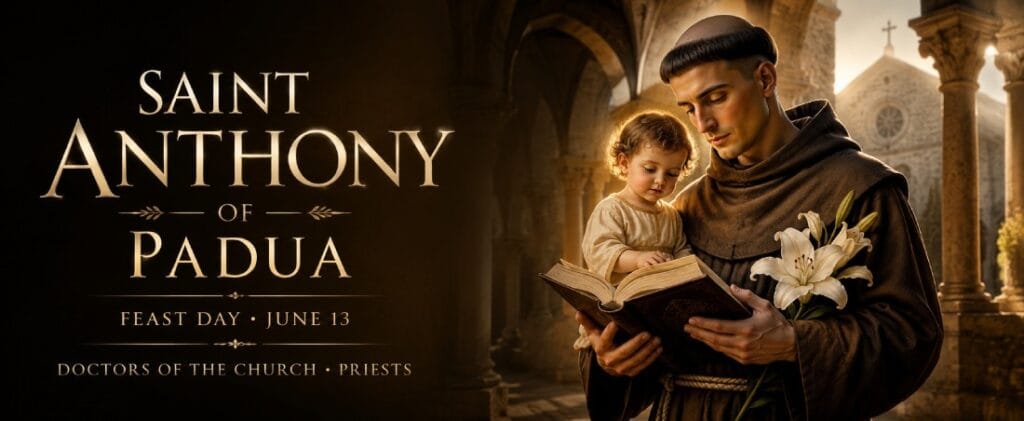
Among the most beloved saints in the history of the Catholic Church, Saint Anthony of Padua stands as a shining example of prayer, humility, theological wisdom, and charity. Known worldwide as the patron saint of lost things, Anthony was far more than a miracle worker. He was a man deeply in love with Jesus Christ, devoted to prayer, immersed in Sacred Scripture, and committed to preaching the Gospel with extraordinary zeal.
Born in Portugal and later becoming one of the greatest sons of the Franciscan Order, Saint Anthony’s life demonstrates how holiness is formed through contemplation, sacrifice, obedience, and unwavering trust in God. His feast day on June 13 remains one of the most celebrated commemorations in the Catholic calendar.
Early Life and Historical Background
Saint Anthony of Padua was born Fernando Martins de Bulhões in Lisbon, Portugal, around 1195. He was raised in a noble and wealthy family and received a strong Christian education from an early age. As a young man, he desired a life dedicated entirely to God rather than the privileges available to him through his family’s social position.
At approximately fifteen years of age, Fernando entered the Canons Regular of Saint Augustine. Seeking a more secluded environment for study and prayer, he later transferred to the Monastery of the Holy Cross in Coimbra, then one of the great intellectual centers of Portugal. There he devoted himself to Scripture, theology, and spiritual formation.
A decisive moment occurred in 1220 when the relics of five Franciscan missionaries martyred in Morocco were brought to Coimbra. Their witness profoundly moved him. Inspired by their sacrifice and longing to give his life completely to Christ, Fernando left the Augustinians and joined the Franciscans, taking the name Anthony in honor of Saint Anthony the Great.
Calling and Spiritual Transformation
Anthony initially hoped to become a missionary and martyr in Morocco. However, shortly after arriving in North Africa, he became seriously ill. Forced to return to Europe, his ship was blown off course and landed in Sicily. What appeared to be a failed mission became God’s providential redirection.
For a time, Anthony lived quietly among the Franciscans, largely unnoticed. His profound learning remained hidden until an occasion arose when no preacher was available for an ordination ceremony. Anthony was unexpectedly asked to speak.
The friars were astonished.
His preaching revealed extraordinary knowledge of Scripture, theological depth, and spiritual wisdom. Soon Saint Francis of Assisi himself recognized Anthony’s gifts and entrusted him with teaching theology to the friars. Anthony became one of the Church’s greatest preachers and defenders of the Catholic faith.
The Prayer Life of Saint Anthony of Padua
The foundation of Anthony’s holiness was not his preaching but his prayer.
His public ministry flowed from countless hidden hours spent in contemplation before God. Historical accounts and Franciscan tradition consistently portray Anthony as a man deeply immersed in prayer and Scripture. His sermons reveal a soul united with Christ through meditation on the Word of God.
Anthony approached Scripture not merely as an academic discipline but as a living encounter with God. He believed the Bible was the voice of Christ speaking directly to the soul.
One of his most famous teachings states:
“Actions speak louder than words; let your words teach and your actions speak.”
This principle characterized his entire spiritual life.
Prayer for Anthony was inseparable from holiness. Before preaching, he prayed. Before teaching, he prayed. Before making decisions, he prayed.
Many artistic traditions depict him holding the Infant Jesus. This imagery originates from a cherished tradition that describes Anthony experiencing a mystical vision of the Christ Child. While this account belongs to devotional tradition rather than verified historical documentation, it reflects how generations of Catholics understood the intimacy of his relationship with Christ.
Anthony’s spirituality was profoundly Christ-centered. His sermons continually direct believers toward repentance, conversion, humility, and union with God.
Devotions, Sacrifices, and Spiritual Practices
As a Franciscan friar, Anthony embraced poverty, simplicity, and self-denial.
He lived according to the ideals of Saint Francis of Assisi, rejecting worldly ambition and seeking conformity to Christ crucified. His life was marked by:
- Daily prayer
- Meditation on Scripture
- Fasting
- Simplicity of life
- Obedience to religious superiors
- Charity toward the poor
- Zealous preaching
- Eucharistic devotion
Anthony’s sermons reveal a deep love for the Holy Eucharist. Several traditional accounts describe miracles connected to Eucharistic faith, including the famous story of a mule kneeling before the Blessed Sacrament. While historians recognize these stories as part of devotional tradition, they express Anthony’s unwavering belief in the Real Presence of Christ in the Eucharist.
His devotion to the Blessed Virgin Mary was equally profound. His surviving sermons contain reflections on Marian themes that later influenced Franciscan spirituality and theological development. Anthony consistently honored Mary as the Mother of God and model of discipleship.
He also practiced severe personal discipline. Like many saints of his era, he viewed fasting and penance as means of purifying the heart and drawing closer to God.
Trials, Suffering, and Faithfulness
Anthony’s life was not free from suffering.
His dream of missionary martyrdom never materialized. Illness repeatedly disrupted his plans. He endured exhausting travel, harsh preaching schedules, and the physical demands of medieval life.
Yet these disappointments became opportunities for grace.
Instead of becoming discouraged when God redirected his path, Anthony embraced divine providence. The missionary who could not remain in Morocco became one of the greatest evangelists in Christian history.
His preaching confronted heresy, encouraged repentance, and strengthened Catholic faith throughout Italy and France. Thousands were converted through his ministry.
Toward the end of his life, his health deteriorated significantly. In 1231 he withdrew to a place of rest near Camposampiero. There, in a small dwelling built among the branches of a walnut tree, he continued prayer and contemplation while preparing for eternity. He died on June 13, 1231, at approximately thirty-six years of age.
Legacy in the Catholic Church
The impact of Saint Anthony after his death was extraordinary.
So widespread was his reputation for holiness that Pope Gregory IX canonized him less than one year after his death, making him one of the fastest canonized saints in Church history.
His shrine, the magnificent Basilica of Saint Anthony in Padua, became one of the world’s most important pilgrimage destinations.
In 1946, Pope Pius XII proclaimed him a Doctor of the Church, recognizing the enduring value of his theological teachings and biblical insight. He is often called the “Evangelical Doctor” or “Doctor of the Gospel.”
Today, Catholics throughout the world seek his intercession, particularly for lost items, lost people, and those who have wandered from the faith.
What Catholics Can Learn Today
Saint Anthony offers timeless lessons for modern Catholics:
1. Prayer Must Come Before Ministry
Anthony’s effectiveness flowed from his intimacy with God. Fruitful Christian service begins in prayer.
2. Know Sacred Scripture
His life demonstrates the importance of studying and meditating on God’s Word.
3. Accept God’s Redirections
What seemed like failure became God’s greater plan. Divine providence often works through unexpected circumstances.
4. Love the Eucharist
Anthony’s devotion reminds Catholics to deepen their reverence for Christ truly present in the Blessed Sacrament.
5. Live What You Preach
His famous teaching about actions speaking louder than words remains a powerful challenge to every Christian.
6. Serve the Poor
Anthony’s concern for the needy reflected Christ’s own compassion and remains an essential dimension of Catholic discipleship.
Conclusion
Saint Anthony of Padua remains one of the Church’s greatest examples of prayerful discipleship. His holiness was not built upon fame or miracles but upon a profound love for Jesus Christ. Through prayer, study, humility, sacrifice, and fidelity to God’s will, he became a powerful instrument of evangelization whose influence continues nearly eight centuries after his death.
On his feast day, Catholics are invited to look beyond the familiar devotion of finding lost objects and discover the deeper legacy of a saint who found the greatest treasure of all: complete union with God.