
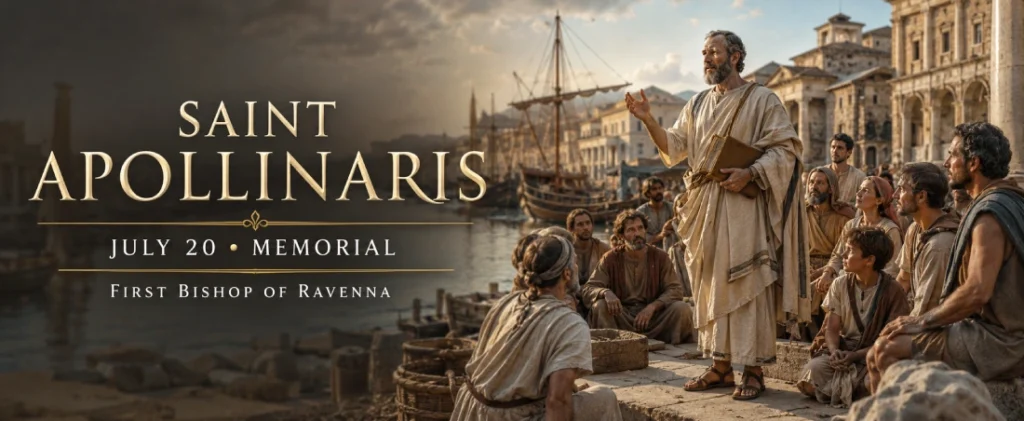
Saint Apollinaris is honored by the Catholic Church as the first bishop of Ravenna and one of the earliest missionaries to northern Italy. Although many details of his life are preserved through ancient Christian tradition rather than contemporary historical records, his witness to Christ inspired generations of believers and helped shape one of the most influential dioceses in the early Church.
Every year on July 20, Catholics remember Saint Apollinaris not only as a bishop and martyr but also as a courageous shepherd who remained faithful to Christ in the face of suffering. His story reminds us that the Church’s earliest pastors often served in difficult circumstances, planting seeds of faith that would bear fruit centuries later.
What makes Saint Apollinaris especially fascinating is the balance between history and tradition. Historians can confidently affirm his ancient veneration and lasting importance to the Church of Ravenna, while some of the familiar stories about his life belong to the rich devotional traditions that developed over time. Understanding both allows us to appreciate his legacy with honesty and faith.
Who Was Saint Apollinaris?
Saint Apollinaris is traditionally regarded as the first Bishop of Ravenna, an important Roman city on Italy’s Adriatic coast. According to ancient Christian tradition, he was sent there by Saint Peter the Apostle to preach the Gospel and establish the local Church.
Whether this direct connection to Saint Peter can be verified historically remains uncertain. Modern historians generally consider the apostolic commission to be a cherished tradition rather than an established historical fact. Nevertheless, there is no doubt that Apollinaris became the foundational figure of Christianity in Ravenna, and his influence endured for centuries.
His feast day is celebrated on July 20 in the Roman Catholic Church.
Historical Background: Ravenna and the Early Church
To understand Saint Apollinaris, it helps to understand the city where he served.
Ravenna was one of the Roman Empire’s most important ports because of its nearby harbor at Classe. Merchants, sailors, soldiers, and government officials passed through the city daily, making it an ideal place for Christianity to spread.
The early Church was still young. Christians often faced suspicion, local hostility, and occasional persecution from Roman authorities. Yet missionaries continued proclaiming Christ throughout the empire despite enormous personal risk.
Whether Apollinaris lived during the first century, as tradition maintains, or somewhat later, as many historians believe, his ministry belongs to this formative period when Christian communities were taking root across the Roman world.
Early Life and Formation
Very little is historically certain about Saint Apollinaris’ early life.
Traditional Account
According to longstanding tradition:
- He was born in Antioch of Syria.
- He became a disciple of Saint Peter.
- Peter later sent him to evangelize Ravenna.
These traditions have been treasured for centuries because they emphasize the apostolic roots of the Church in Ravenna. However, historians cannot confirm these details from contemporary sources.
What Historians Can Say
The earliest reliable evidence does not describe Apollinaris’ childhood or family. Instead, it shows that by the fifth and sixth centuries Christians already honored him as the founding bishop of Ravenna.
The Mission to Ravenna
Tradition describes Saint Apollinaris arriving in Ravenna with a single purpose: to preach Jesus Christ.
He proclaimed the Gospel publicly, baptized new believers, instructed converts in the Christian faith, and organized one of northern Italy’s earliest Christian communities.
As with many missionary saints, later accounts also describe him performing miracles that strengthened the faith of those who heard him preach.
Whether every individual event can be historically verified is less important than the broader reality reflected in these traditions: Apollinaris became remembered above all as a faithful missionary bishop whose entire life was devoted to bringing others to Christ.
Challenges and Persecution
The life of Saint Apollinaris was marked by suffering.
Traditional accounts describe repeated arrests, beatings, imprisonment, and exile because of his Christian ministry. Rather than abandoning his flock, he continued preaching despite constant opposition.
These stories reflect a pattern familiar from many early Christian saints. Even where historians cannot verify every detail, they illustrate how the early Church remembered its pastors—not as political leaders or public figures, but as men willing to suffer for the Gospel.
Jesus Himself prepared His disciples for such trials:
“If they persecuted me, they will also persecute you.” (John 15:20)
Saint Apollinaris’ witness echoes this enduring Christian reality.
The Miracles Associated with Saint Apollinaris
Many people ask, “What miracles are associated with Saint Apollinaris?”
The traditional biographies attribute several miracles to him, including:
- Healing the sick through prayer.
- Restoring sight to the blind.
- Delivering people from demonic oppression.
- Bringing many pagans to faith through miraculous signs.
These miracle accounts appear in later hagiographical writings rather than contemporary historical records.
Historical Perspective
No miracles attributed to Saint Apollinaris are documented in surviving first- or second-century sources. Catholics can appreciate these traditions as expressions of the Church’s longstanding devotion while recognizing the distinction between devotional tradition and historically documented events.
Was Saint Apollinaris Really a Disciple of Saint Peter?
This is one of the most frequently asked questions about Saint Apollinaris.
Traditional View
Ancient Christian tradition holds that Saint Peter personally ordained Apollinaris and sent him to Ravenna.
Historical Assessment
Modern scholars generally regard this claim as traditional rather than historically certain. The earliest written accounts appear centuries after the events they describe.
Even so, the tradition reflects an important theological truth cherished by the Church: the continuity of apostolic succession and the desire of early Christian communities to preserve their connection with the Apostles.
Martyrdom and Death
How did Saint Apollinaris die?
The Roman Martyrology honors him as a martyr.
Ancient traditions differ slightly regarding the circumstances of his death. Some describe him dying after repeated injuries inflicted during persecution rather than through a single execution.
The precise details cannot be confirmed historically, but his enduring reputation as one who suffered faithfully for Christ has remained constant throughout the Church’s tradition.
Burial and Relics
Saint Apollinaris was traditionally buried near Classe, just outside Ravenna.
His tomb became an important destination for Christian pilgrims, and in the sixth century the magnificent Basilica of Sant’Apollinare in Classe was constructed nearby.
Today, the basilica remains one of the world’s greatest surviving examples of early Byzantine Christian art. Its remarkable mosaics beautifully express the Church’s devotion to Saint Apollinaris and continue to inspire pilgrims from around the world.
Canonization and Veneration
People sometimes ask, “Why was Saint Apollinaris canonized?”
Saint Apollinaris lived many centuries before the Church established the modern canonization process.
Like other early saints, he was recognized through the ancient practice of local Christian veneration. His holiness, witness, and enduring devotion among the faithful led to his universal recognition within the Church.
His inclusion in the Roman Martyrology confirms his place among the saints officially honored by the Catholic Church.
What Is Saint Apollinaris the Patron Saint Of?
Saint Apollinaris is best known as:
- Patron saint of Ravenna.
- Patron of the Archdiocese of Ravenna-Cervia.
Some local traditions also invoke him as a patron against epilepsy and for domestic animals, though these patronages developed later in Christian devotion.
Symbols and Iconography
Christian art often depicts Saint Apollinaris with symbols that reveal his vocation:
- Bishop’s vestments, representing his pastoral office.
- Crozier, symbolizing his care for God’s people.
- Palm branch, the traditional sign of martyrdom.
- Gospel book, emphasizing his missionary preaching.
- The Basilica of Classe, recalling his enduring connection with Ravenna.
These images help tell his story even to those who cannot read, continuing a tradition that stretches back many centuries.
Historical Reliability: What Do We Really Know?
One of the strengths of studying Saint Apollinaris is recognizing the difference between history and tradition.
Historically Certain
- His cult was firmly established by the fifth and sixth centuries.
- He was venerated as the founding bishop of Ravenna.
- The Basilica of Sant’Apollinare in Classe became a major center of pilgrimage.
- His feast has long been celebrated by the Church.
Highly Probable
- He was an early bishop associated with the Christian community of Ravenna.
- His burial was connected with the area of Classe.
Traditional
- He came from Antioch.
- He was personally commissioned by Saint Peter.
- He served during the first century.
Legendary Elements
- Many detailed miracle narratives.
- Precise conversations and dramatic episodes preserved in later hagiographies.
Recognizing these distinctions strengthens rather than weakens our appreciation of the saint. Catholic faith welcomes both historical scholarship and the Church’s living tradition.
Why Is Saint Apollinaris Important Today?
Saint Apollinaris reminds us that the Church grows through faithful witness rather than worldly power.
His legacy teaches Catholics that:
- The Gospel is worth proclaiming even when it is unpopular.
- Good shepherds remain with their people during hardship.
- The work of evangelization often begins quietly but bears lasting fruit.
- Christian holiness is measured by fidelity to Christ rather than public recognition.
His life also highlights the importance of apostolic succession, the continuity of the Church’s mission from the Apostles through successive generations of bishops.
Lessons Catholics Can Learn from Saint Apollinaris
Saint Apollinaris speaks to modern believers in surprising ways.
His perseverance encourages Christians facing opposition because of their faith.
His missionary spirit reminds every Catholic that sharing the Gospel is not reserved for clergy or missionaries alone.
His humility shows that many of the Church’s greatest builders remain largely unknown outside their local communities.
Most importantly, his life demonstrates that enduring faithfulness often leaves a legacy far greater than immediate success.
Frequently Asked Questions
Who was Saint Apollinaris?
Saint Apollinaris is honored as the first bishop of Ravenna and an early missionary remembered for preaching the Gospel and faithfully serving the Church despite persecution.
What is Saint Apollinaris known for?
He is best known as the founding bishop of Ravenna, his enduring witness during persecution, and the ancient Christian tradition connecting him with Saint Peter.
When is Saint Apollinaris’ feast day?
The Catholic Church celebrates Saint Apollinaris on July 20.
What is Saint Apollinaris the patron saint of?
He is the patron saint of Ravenna and the Archdiocese of Ravenna-Cervia. Some local traditions also invoke his intercession against epilepsy.
Was Saint Apollinaris a disciple of Saint Peter?
According to ancient tradition, yes. Historians, however, classify this as a respected tradition rather than a historically verified fact.
How did Saint Apollinaris die?
The Roman Martyrology honors him as a martyr. Tradition says he died after enduring repeated persecution for preaching the Christian faith, although the exact circumstances remain uncertain.
Where are Saint Apollinaris’ relics?
His traditional burial site is near Classe, outside Ravenna, where the Basilica of Sant’Apollinare in Classe was later built and became a major place of pilgrimage.
What miracles are associated with Saint Apollinaris?
Traditional accounts attribute healings, exorcisms, and other miracles to him. These stories come from later hagiographical sources rather than contemporary historical records.
Why is Saint Apollinaris still important today?
His life reminds Catholics that courage, faithful leadership, and perseverance in proclaiming Christ can shape the Church for generations, even when historical details remain incomplete.
Conclusion
Saint Apollinaris stands at the crossroads of history and tradition. While historians cannot verify every detail preserved in ancient hagiographies, they agree that he became the foundational figure of Christianity in Ravenna and one of the Church’s earliest revered bishops.
For nearly two thousand years, Christians have looked to him as a model of steadfast faith, pastoral courage, and missionary zeal. His memory has been preserved not only in liturgical celebrations and ancient texts but also in the breathtaking mosaics of the Basilica of Sant’Apollinare in Classe, where art and faith together proclaim the enduring hope of the Gospel.
Whether encountered through history, prayer, or pilgrimage, Saint Apollinaris continues to point believers toward Christ—the Good Shepherd whom he faithfully served and courageously proclaimed.