
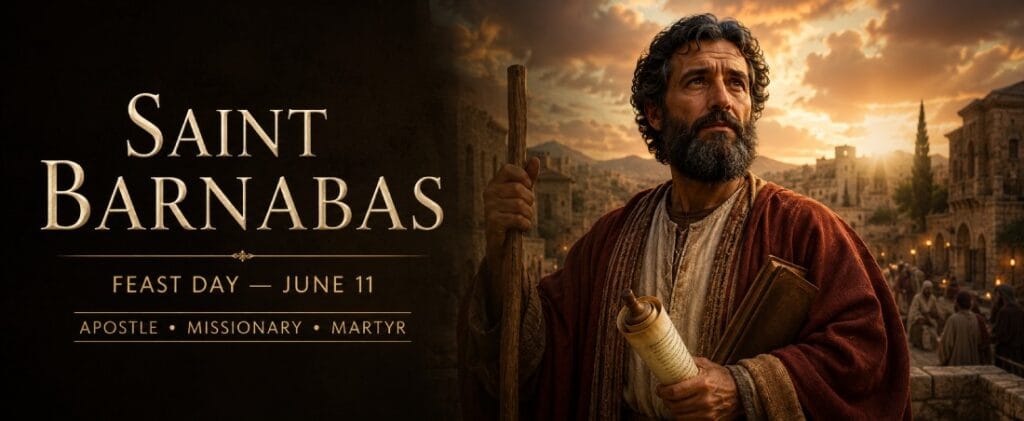
Among the great missionary saints of the early Church, few embody encouragement, sacrificial charity, and unwavering devotion to Christ as profoundly as Saint Barnabas. Though not one of the Twelve Apostles chosen during Christ’s earthly ministry, Barnabas became one of the most influential leaders of the apostolic age. The Church honors him not merely as a companion of Saint Paul, but as a holy man whose deep prayer life, humility, and obedience helped shape the expansion of Christianity across the ancient world.
Celebrated on June 11, Saint Barnabas stands as a model of apostolic courage and spiritual generosity. Sacred Scripture describes him as “a good man, filled with the Holy Spirit and faith” (Acts 11:24). This brief biblical description reveals the heart of his sanctity. Barnabas was not remembered for seeking prominence or authority. Rather, he became beloved because he strengthened others, reconciled divisions, encouraged struggling believers, and sacrificed his comfort for the Gospel of Christ.
For modern Catholics living in a distracted and divided world, Saint Barnabas offers a timeless witness of prayerful missionary discipleship. His life demonstrates that holiness is not built upon fame, but upon faithfulness, charity, and total surrender to God.
Early Life and Historical Background
Saint Barnabas was born in the first century on the island of Cyprus. According to Acts 4:36, his birth name was Joseph, and he belonged to the Jewish tribe of Levi. The Apostles later gave him the name “Barnabas,” meaning “son of encouragement” or “son of consolation.” This title reflected his spiritual character and pastoral gentleness.
As a Levite, Barnabas would have received strong religious formation within Jewish tradition. He likely possessed knowledge of Scripture, temple worship, and prayer practices rooted in ancient Israel. Historical tradition suggests he may have studied in Jerusalem and encountered the earliest Christian preaching shortly after the Resurrection of Christ.
The Book of Acts first introduces Barnabas during the life of the primitive Church in Jerusalem. In a remarkable act of charity and detachment, Barnabas sold a field he owned and laid the proceeds at the feet of the Apostles (Acts 4:37). This action was not merely financial generosity. It reflected profound evangelical poverty and complete trust in divine providence. Barnabas freely surrendered earthly possessions so that the Christian community could flourish.
This moment reveals the spiritual foundation of his holiness: he desired nothing more than communion with Christ and service to the Church.
Calling and Spiritual Transformation
The conversion and spiritual calling of Barnabas unfolded within the vibrant life of the early Christian community. Unlike many converts who struggled for recognition among Jewish believers, Barnabas quickly became trusted because of his visible holiness, humility, and fidelity.
One of his greatest acts of courage occurred after the conversion of Saint Paul. Many Christians feared Paul because of his previous persecution of the Church. Barnabas, however, discerned the genuine work of grace within him. Acts 9:27 records that Barnabas personally introduced Paul to the Apostles and testified about his conversion.
This moment was historically decisive for Christianity. Without Barnabas’ intervention, Paul might have remained isolated from the Christian community. Barnabas became a bridge-builder, reconciler, and spiritual father.
The Church at Antioch later commissioned Barnabas for missionary work. Seeing the rapid growth of Gentile converts, the Apostles entrusted him with pastoral leadership. Barnabas responded not with ambition, but with prayerful obedience.
When he witnessed the grace of God flourishing among new believers, Scripture says he “rejoiced” and exhorted them all to remain faithful to the Lord with steadfast devotion. His spirituality was deeply pastoral: he desired perseverance, holiness, and communion with God above all else.
The Prayer Life of Saint Barnabas
The prayer life of Saint Barnabas formed the hidden source of his missionary strength. Although Scripture does not record long speeches or theological writings from him, the biblical narrative consistently portrays a man guided by the Holy Spirit, rooted in worship, and attentive to divine direction.
The early Church functioned through communal prayer, fasting, Eucharistic worship, and discernment. Barnabas lived fully within this rhythm of sacred devotion. Acts 13 describes the Church in Antioch worshipping and fasting when the Holy Spirit called Barnabas and Paul for missionary work. The Apostles laid hands upon them after prayer and fasting, demonstrating the deeply sacramental and contemplative foundation of Christian mission.
Barnabas did not view evangelization as mere activism. His ministry flowed from union with God.
His spiritual life likely included:
- Daily Jewish prayer traditions fulfilled in Christ
- Eucharistic worship with the early Christian community
- Meditation upon Sacred Scripture
- Fasting and penitential practices
- Long missionary journeys sustained through prayer
- Communal discernment with fellow believers
- Dependence upon the Holy Spirit during persecution
The title “son of encouragement” also reveals the fruits of his interior life. True Christian encouragement is not superficial optimism. It emerges from deep trust in God’s providence. Barnabas strengthened others because he himself was spiritually anchored in prayer.
Many saints throughout Church history have reflected this same pattern: contemplation leading to apostolic fruitfulness. Barnabas reminds Catholics that effective ministry cannot exist without interior communion with Christ.
Devotions, Sacrifices, and Spiritual Practices
Saint Barnabas embraced a life of profound sacrifice for the Gospel. He abandoned worldly security and accepted the hardships of missionary travel during an era marked by political instability, pagan opposition, and persecution.
His sacrifices included:
- Renouncing property and wealth
- Enduring dangerous sea voyages
- Facing hostility from religious authorities
- Living in poverty during missionary work
- Accepting rejection and misunderstanding
- Laboring tirelessly for the salvation of souls
Barnabas also demonstrated remarkable humility. Although highly respected within the early Church, he willingly shared leadership with Paul and never sought personal glory. His identity remained centered on service.
One of the most revealing episodes of his spirituality involves John Mark, traditionally regarded as the future author of the Gospel of Mark. After Mark withdrew from an earlier missionary journey, Paul hesitated to trust him again. Barnabas, however, desired to give Mark another opportunity.
This disagreement eventually separated Barnabas and Paul temporarily (Acts 15:36–39). Yet Barnabas’ patience and mercy ultimately proved fruitful. Mark later became a valuable co-worker in Christian ministry and a Gospel writer honored by the universal Church.
This episode reveals Barnabas as a saint of mercy, restoration, and spiritual fatherhood.
Trials, Suffering, and Faithfulness
Like many early Christians, Saint Barnabas endured suffering for the sake of Christ. Missionary work in the first century carried immense danger. Pagan hostility, Jewish opposition, harsh travel conditions, and social instability constantly threatened the Apostles.
During missionary journeys with Paul, Barnabas faced public opposition and violence. In Lystra, crowds initially attempted to worship Barnabas and Paul as pagan gods before turning violently against them. Such instability required extraordinary spiritual resilience.
Tradition also holds that Barnabas eventually suffered martyrdom in Cyprus around the first century. Ancient accounts suggest he was stoned by opponents of Christianity for preaching the Gospel. While some historical details remain uncertain, the Church venerates him as one who gave his life faithfully for Christ.
The courage of Barnabas was not rooted in human strength alone. It emerged from prayer, sacramental life, and unwavering confidence in eternal life.
His witness challenges modern Catholics to persevere through spiritual dryness, cultural hostility, and personal suffering without abandoning fidelity to God.
Legacy in the Catholic Church
The legacy of Saint Barnabas within the Catholic Church remains immense. Though often overshadowed by Saint Paul, Barnabas played a foundational role in the spread of Christianity among the Gentiles.
His influence can be seen through:
- Supporting Paul’s apostolic ministry
- Strengthening the Church at Antioch
- Participating in early missionary expansion
- Encouraging persecuted believers
- Mentoring John Mark
- Modeling apostolic charity and unity
The Church honors Barnabas as an Apostle because of his direct participation in the apostolic mission of evangelization. His feast day on June 11 has been celebrated for centuries in both Eastern and Western Christian traditions.
Christian art traditionally depicts him with:
- A scroll or Gospel book
- Olive branches symbolizing peace
- Apostolic robes
- Sometimes stones representing martyrdom
- Missionary imagery connected to Cyprus and Antioch
His example continues inspiring priests, missionaries, catechists, and all Catholics called to encourage others in faith.
What Catholics Can Learn Today
Modern Catholics can learn many profound lessons from Saint Barnabas.
1. Encouragement is a Sacred Ministry
Barnabas reminds believers that strengthening others spiritually is a genuine Christian vocation. Many souls persevere because someone encourages them in moments of fear or weakness.
2. Prayer Must Precede Mission
Barnabas never separated ministry from worship. His missionary zeal emerged from prayer, fasting, and obedience to the Holy Spirit.
3. Holiness Requires Sacrifice
His life demonstrates evangelical poverty, detachment from possessions, and willingness to suffer for Christ.
4. Mercy Restores Souls
Barnabas’ patience toward John Mark teaches Catholics to believe in redemption and second chances.
5. Unity Builds the Church
Rather than seeking division or prominence, Barnabas worked for reconciliation and ecclesial communion.
In an age marked by anxiety, division, and spiritual exhaustion, Saint Barnabas offers the Church a deeply needed example of joyful fidelity rooted in God.
Conclusion
Saint Barnabas remains one of the most beautiful examples of apostolic holiness in the early Church. His life was marked not by self-promotion, but by humility, encouragement, prayer, sacrifice, and missionary love.
He strengthened the weak, defended the converted, proclaimed Christ courageously, and surrendered everything for the Gospel. Through fasting, prayer, obedience, and charity, Barnabas became a living witness to the transforming power of the Holy Spirit.
For Catholics today, his example invites deeper trust in God, greater generosity toward others, and renewed commitment to prayerful discipleship.
May Saint Barnabas intercede for the Church, strengthen missionaries, encourage discouraged souls, and help all believers remain faithful to Christ.