
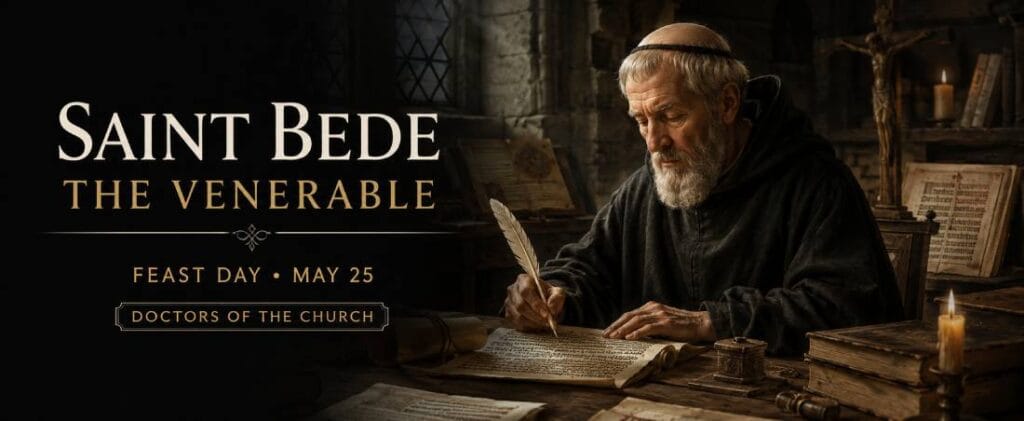
Every year on May 25, the Catholic Church honors Saint Bede the Venerable, one of the greatest scholars and spiritual teachers in Christian history. Yet behind his immense learning and influence stood something even greater: a deep and disciplined life of prayer.
Saint Bede is often remembered for his writings, especially his famous Ecclesiastical History of the English People, but his holiness did not come merely from intellectual brilliance. His wisdom flowed from a heart devoted entirely to God. He believed that true knowledge must lead to worship, humility, and holiness. For Bede, studying Scripture was not an academic exercise alone—it was prayer.
Living quietly in a monastery for most of his life, Saint Bede transformed ordinary monastic discipline into a path toward union with Christ. Through prayer, fasting, contemplation, teaching, and constant meditation on Scripture, he became a light for the Church that still shines more than a thousand years later.
His life offers modern Catholics a powerful reminder that holiness grows not through noise and fame, but through faithful daily devotion to God.
Early Life
Saint Bede was born around the year 673 in Northumbria, in what is now England. Very little is known about his family, but at only seven years old, he was entrusted to the care of the monks at the Monastery of Wearmouth, later becoming part of the twin monasteries of Wearmouth and Jarrow.
From childhood, Bede lived in an atmosphere centered on prayer, sacred learning, liturgical worship, and manual labor. Monastic life in early medieval England demanded discipline and sacrifice. The monks followed strict schedules of communal prayer, Scripture reading, fasting, and work.
Bede embraced this life wholeheartedly.
He later wrote about his years in the monastery with gratitude and simplicity. Rather than seeking worldly recognition, he desired a hidden life dedicated to Christ. Even as a child, he displayed remarkable intelligence and spiritual seriousness.
At the age of nineteen, he was ordained a deacon, unusually young for the time, and later became a priest at thirty. His superiors recognized not only his learning but also his holiness and devotion.
The Calling of Saint Bede
Unlike many saints who experienced dramatic conversions, Saint Bede’s holiness developed steadily through lifelong fidelity. His calling was rooted in the monastic vocation: prayer, study, obedience, and worship.
Bede understood that intellectual gifts were meant for the service of God and the Church. He spent his life teaching fellow monks, writing biblical commentaries, composing hymns, studying theology, and preserving Church history.
But beneath all of this activity was a profound spiritual conviction: every human mind was created to know and praise God.
His monastery became both his school and his sanctuary. He rarely traveled beyond it, yet his influence spread throughout Christendom because his writings reflected not only intelligence but sanctity.
Bede once described the rhythm of his life in words that reveal his priorities:
“I have spent all my life in this monastery, applying myself entirely to the study of Scripture.”
This devotion to Scripture was inseparable from prayer. He approached the Bible not simply to gain information, but to encounter Christ Himself.
The Prayer Life of Saint Bede the Venerable
The prayer life of Saint Bede was deeply rooted in the Benedictine monastic tradition. His days revolved around the Divine Office, also known as the Liturgy of the Hours. Multiple times each day and night, the monks gathered to chant the Psalms, hear Scripture, and offer prayers to God.
For Bede, this rhythm of prayer sanctified time itself.
He believed prayer should shape every aspect of life. Study became prayer. Teaching became prayer. Writing became prayer. Even silence became prayer when offered to God with love.
Love for Sacred Scripture
One of the defining marks of Bede’s spirituality was his profound love for the Bible. He spent countless hours reading, meditating upon, and explaining Scripture.
Unlike purely academic scholars, Bede read the Bible with the heart of a contemplative monk. He sought spiritual meaning and personal transformation. His biblical commentaries encouraged Christians not merely to understand Scripture intellectually, but to live it faithfully.
His meditation on the Word of God nourished his humility and strengthened his trust in Christ.
Liturgical Devotion
The Holy Eucharist stood at the center of Bede’s spiritual life. As a priest and monk, he celebrated and participated in the sacred liturgy with deep reverence.
Monastic worship during Bede’s era involved lengthy chanting of Psalms, solemn prayers, and frequent contemplation. These liturgical practices formed his soul and cultivated a constant awareness of God’s presence.
Bede understood that holiness grows through consistency. Daily prayer, repeated faithfully over time, transforms the heart.
Prayer Through Work and Study
Saint Bede is a beautiful example of the Benedictine principle ora et labora—“pray and work.”
He did not separate intellectual work from spiritual life. Every manuscript he copied, every sermon he wrote, and every lesson he taught became an offering to God.
For modern Catholics, this witness is deeply important. Bede reminds believers that ordinary responsibilities can become holy when united to prayer.
Spiritual Practices and Devotions
Discipline and Simplicity
Monastic life demanded sacrifice, and Bede embraced its discipline joyfully. His life included fasting, obedience, modest living, and detachment from worldly ambition.
Although famous for his learning, Bede remained humble. He never sought power or prestige. His spirituality was marked by quiet faithfulness rather than dramatic displays.
Contemplation and Silence
Silence played a major role in Bede’s spiritual growth. Medieval monasteries valued silence because it allowed the soul to listen attentively to God.
Bede cultivated interior recollection through prayerful reflection and contemplation. He believed that wisdom emerged not from endless distraction, but from attentive communion with God.
Devotion to the Saints
Bede also had a strong devotion to the saints and martyrs of the Church. His writings preserved the stories of holy men and women whose examples inspired Christian faith throughout England and beyond.
He understood that the communion of saints strengthened believers in their spiritual journey.
Trials, Sacrifices, and Faith
Saint Bede’s life may appear peaceful from the outside, but monastic life required perseverance and sacrifice.
Life in early medieval England was difficult. Disease, political instability, Viking threats, and limited medical care created constant uncertainty. Monks often endured hardship, cold, hunger, and exhausting labor.
Bede also carried the burden of preserving Christian learning during a fragile historical period. Much ancient knowledge might have disappeared without the faithful work of monks like him.
Yet through every challenge, Bede remained steadfast in prayer.
His Holy Death
The final days of Saint Bede beautifully reveal the depth of his spirituality.
As he lay dying in 735, he continued dictating translations of Scripture and praying with his fellow monks. According to tradition, he completed his translation of the Gospel of John shortly before his death.
Witnesses described him praying and singing until his final breath.
One account records that he died while reciting prayers and praising God—a fitting end for a monk whose entire life had been shaped by worship.
Legacy in the Catholic Church
Saint Bede’s influence on the Church is immense.
He was declared a Doctor of the Church in 1899 by Pope Leo XIII because of the extraordinary theological and historical value of his writings. He remains the only native of Great Britain to receive this title.
His historical writings preserved crucial knowledge about early Christianity in England. His biblical commentaries shaped generations of theologians and clergy.
But perhaps his greatest legacy is the example of sanctified learning.
Bede demonstrated that intellectual excellence and deep holiness belong together. He proved that scholarship rooted in humility and prayer can become a path to sainthood.
Today, he is especially honored among scholars, teachers, students, historians, and those devoted to Scripture study.
What Catholics Can Learn Today
The life of Saint Bede the Venerable speaks powerfully to modern Catholics living in a distracted and noisy world.
Holiness Grows Through Daily Faithfulness
Bede did not seek attention or extraordinary experiences. His sanctity developed through ordinary daily habits: prayer, worship, study, obedience, and perseverance.
Modern Catholics can learn that consistent prayer matters more than emotional intensity alone.
Knowledge Should Lead to God
In an age flooded with information, Saint Bede reminds believers that wisdom is not merely intellectual achievement. True wisdom draws the soul closer to Christ.
Catholics who study Scripture, theology, or Church history should approach learning prayerfully and humbly.
Silence Is Necessary for Spiritual Growth
Bede’s contemplative spirit challenges modern Christians to create space for silence and reflection. Constant distraction weakens prayer, while silence opens the heart to God.
Prayer Can Sanctify Ordinary Work
Whether teaching, studying, parenting, or working, Catholics can unite daily responsibilities to God. Saint Bede teaches that holiness is possible even in ordinary routines when they are offered prayerfully.
Conclusion
Saint Bede the Venerable remains one of the Church’s greatest examples of prayerful wisdom. Though he spent most of his life hidden within monastery walls, his holiness reached far beyond them.
His life reminds Catholics that intimacy with God is built through faithful daily prayer, reverent worship, humble study, and perseverance in ordinary duties.
In a world obsessed with speed and recognition, Saint Bede points believers back to silence, Scripture, contemplation, and devotion to Christ.
May his example inspire all Christians to seek not merely knowledge about God, but a deeper life with God.