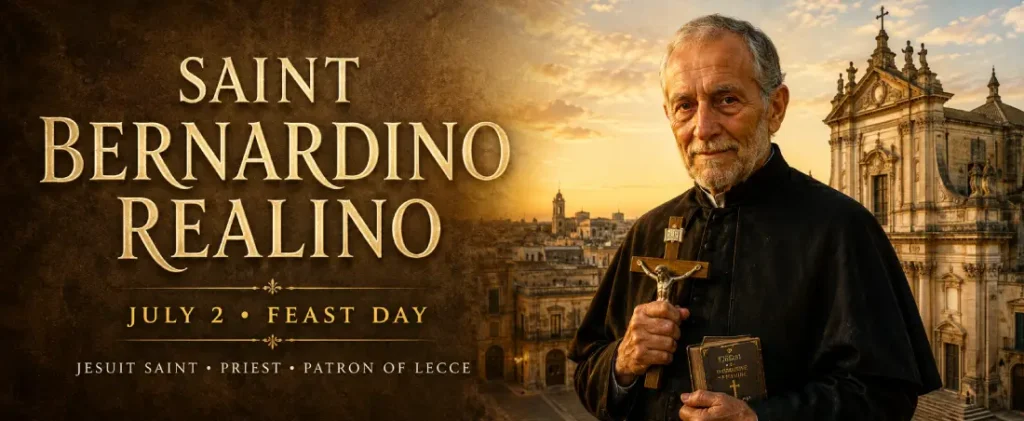
Few saints followed a path as unexpected as Saint Bernardino Realino. He was not raised in a monastery, nor did he become famous through dramatic miracles or martyrdom. Instead, he spent the first part of his life building a successful career as a lawyer, judge, and government official. By every worldly measure, he had already achieved success.
Yet God had something else in mind.
In his thirties, Bernardino left behind his prestigious career to become a simple Jesuit priest. He would spend nearly fifty years serving the people of Lecce in southern Italy, hearing confessions, teaching the faith, guiding souls, and caring for the poor. By the time he died in 1616, the people already regarded him as a saint.
Today, Catholics honor Saint Bernardino Realino as a model of conversion, humility, and pastoral charity. His life reminds us that holiness is possible at every stage of life and that God can call people to greatness even after they have already chosen another path.
Who Was Saint Bernardino Realino?
Saint Bernardino Realino was an Italian Jesuit priest born on December 1, 1530, in the city of Carpi in northern Italy. He lived during the great Catholic renewal that followed the Protestant Reformation and became one of the most beloved pastors of southern Italy.
He is especially remembered for:
- Leaving a successful legal and political career to follow Christ.
- Spending almost fifty years ministering in the city of Lecce.
- His extraordinary gentleness as a confessor and spiritual director.
- His charity toward the poor and the sick.
- His reputation for holiness that spread during his lifetime.
His feast day is celebrated on July 2, the anniversary of his death.
The World Into Which Bernardino Was Born
Saint Bernardino lived during one of the most important periods in Church history.
Europe was being shaken by the Protestant Reformation. The Catholic Church was responding through what historians often call the Catholic Reformation or Counter-Reformation. The great Council of Trent, held between 1545 and 1563, sought to renew the Church by improving the education of clergy, strengthening discipline, and encouraging deeper spiritual life among the faithful.
At the same time, Italy was divided into many different states and territories, with much of southern Italy under Spanish rule. Political uncertainty, poverty, and inadequate religious instruction affected many communities.
This was also the age of great Catholic saints such as:
- Saint Ignatius of Loyola
- Saint Francis Xavier
- Saint Charles Borromeo
- Saint Philip Neri
- Saint Teresa of Ávila
Bernardino Realino would become one of the many saints who helped renew the Church through quiet and faithful service.
Family and Early Life
Bernardino was born into a respected and educated family. His father, Aurelio Realino, was both a physician and a nobleman who served in civic administration. His mother, Elisabetta Mezzetti, provided him with a strong moral and religious upbringing.
As a young man, Bernardino displayed remarkable intelligence. He pursued studies in literature, philosophy, medicine, and eventually law. He earned a doctorate in both civil and canon law, making him one of the best-educated men of his generation.
His talents quickly brought him into public service.
A Successful Career in Government
Before becoming a priest, Bernardino enjoyed a distinguished career as a lawyer and magistrate. He held important administrative positions in several Italian cities and earned a reputation for honesty, wisdom, and competence.
Many people would have considered him fortunate. He had influence, education, social standing, and opportunities for advancement.
Yet worldly success did not fully satisfy him.
Like the rich young man in the Gospel, Bernardino possessed many good things, but God was calling him to something greater.
A Surprising Call to Religious Life
The turning point came while Bernardino was serving in Naples.
There he encountered the spirituality of the Jesuits, the newly founded Society of Jesus. The order emphasized complete dedication to Christ, missionary zeal, education, and service to souls.
The example of the Jesuits deeply affected him.
After prayer and discernment, Bernardino made a remarkable decision. At approximately thirty-three years of age, he left behind his legal career and entered the Society of Jesus in 1564.
This decision astonished many people.
He exchanged prestige for obedience, authority for humility, and worldly success for a hidden life of service.
His story beautifully illustrates Christ’s words:
“What does it profit a man to gain the whole world and forfeit his soul?” (Mark 8:36).
Formation as a Jesuit
Bernardino embraced religious life with enthusiasm.
Although he entered later in life than most novices, he quickly became known for his humility and deep spiritual maturity. He devoted himself to prayer, study, and the Spiritual Exercises of Saint Ignatius.
He was ordained a priest in 1567.
Soon afterward, his superiors assigned him to the city of Lecce in southern Italy.
It would become his lifelong mission field.
Saint Bernardino Realino and the City of Lecce
Bernardino arrived in Lecce in 1568 and remained there for nearly fifty years.
Few saints have become so closely associated with a single city.
Lecce was experiencing many of the social and religious difficulties common in sixteenth-century Europe. There was poverty, inadequate religious education, and a need for faithful clergy who could guide people spiritually.
Bernardino dedicated himself completely to the people.
He preached.
He taught.
He visited the sick.
He instructed children.
He spent countless hours hearing confessions.
He became one of the most trusted spiritual directors in the region.
People from all walks of life sought his counsel.
A Saint of the Confessional
Among all his ministries, Bernardino became especially known as a confessor.
He had a remarkable ability to guide souls gently toward repentance and holiness.
Contemporaries described him as patient, compassionate, and wise. He never treated sinners harshly. Instead, he reflected the mercy of Christ, who came “to seek and to save the lost” (Luke 19:10).
For this reason, many historians consider him one of the great pastoral saints of the Catholic Reformation.
Charity Toward the Poor
Saint Bernardino’s holiness was never limited to prayer alone.
He cared deeply for the poor, the sick, and the forgotten.
Accounts from his life describe him helping the needy, comforting the suffering, and making himself available to anyone who sought assistance.
His ministry embodied the words of Saint James:
“Faith by itself, if it has no works, is dead” (James 2:17).
The people of Lecce saw in him not only a learned priest but also a spiritual father.
Miracles and Extraordinary Gifts
Historical sources attest that many people reported favors and healings through Bernardino’s intercession after his death.
Several traditional accounts also describe extraordinary spiritual insight and an ability to read the dispositions of souls in confession. Such stories have been preserved by local devotion and early biographies, although historians classify many of these accounts as pious traditions rather than strictly verifiable historical events.
One longstanding tradition states that Bernardino foretold his own approaching death.
The Church does not require Catholics to accept these traditions as historical fact. What is certain is that he enjoyed an extraordinary reputation for sanctity during his lifetime.
His Final Days and Holy Death
As he grew older, Bernardino’s health gradually declined, but he continued his pastoral work as long as possible.
He died on July 2, 1616, in Lecce.
The reaction of the people was immediate and profound.
Large numbers of the faithful mourned him, convinced that they had lost a holy priest and gained a heavenly intercessor.
Popular devotion began almost at once.
His Relics and Incorrupt Body
One of the most remarkable aspects of Saint Bernardino’s story is the preservation of his body.
His incorrupt remains are venerated in the Church of the Gesù in Lecce, where pilgrims continue to visit and ask for his intercession.
The Catholic Church does not teach that incorruptibility automatically proves sanctity. Nevertheless, throughout history, incorrupt bodies have often been regarded by the faithful as signs associated with exceptional holiness.
Beatification and Canonization
The Church’s formal recognition of Bernardino’s sanctity took many years.
He was beatified in 1895 by Pope Leo XIII.
More than fifty years later, he was canonized on June 22, 1947, by Pope Pius XII.
His canonization affirmed what the people of Lecce had believed for centuries: Bernardino Realino had lived a life of heroic virtue and now enjoys the vision of God in heaven.
What Is Saint Bernardino Realino the Patron Saint Of?
Saint Bernardino Realino is honored as:
- A patron of the city of Lecce.
- A patron of his native city of Carpi.
- A patron of lawyers and civic officials because of his former legal and governmental career.
His patronage reminds Catholics that professional work and public service can become paths to holiness.
Symbols and Iconography
In sacred art, Saint Bernardino Realino is often depicted with:
- A Jesuit cassock, representing his religious vocation.
- A crucifix, symbolizing his love for Christ.
- A book, representing his learning and teaching.
- A lily, signifying purity and holiness.
- A rosary, expressing Marian devotion.
These symbols portray both the scholar and the pastor.
Lessons from Saint Bernardino Realino
God Can Call Us at Any Age
Bernardino entered religious life in his thirties after establishing an impressive career. His life reminds us that conversion and vocation are never limited by age.
Success Is Not the Same as Holiness
He gave up wealth, influence, and prestige to follow Christ more completely.
The Priesthood Is About Service
His greatness came not from public fame but from thousands of hidden acts of charity.
Mercy Changes Lives
His ministry in the confessional demonstrates the healing power of God’s mercy.
Holiness Often Grows Quietly
Bernardino performed no dramatic public deeds. Yet his faithfulness transformed an entire city.
Why Is Saint Bernardino Realino Important Today?
Modern Catholics live in a world that often measures success by wealth, status, and achievement.
Saint Bernardino Realino offers another vision.
He teaches that:
- careers and talents should serve God;
- conversion can happen at any stage of life;
- holiness is found in ordinary duties;
- kindness and patience can transform communities;
- true greatness comes from loving God and serving others.
In many ways, his story is especially relevant for professionals, lawyers, public servants, and anyone discerning a major change in life.
Conclusion
Saint Bernardino Realino was not born a famous saint. He began life as an ambitious and gifted scholar, became a successful government official, and only later discovered that God was calling him to something greater.
By surrendering his own plans, he became one of the great pastoral saints of the Catholic Reformation.
For nearly fifty years, he guided souls, cared for the poor, preached the Gospel, and reflected the mercy of Christ to everyone he met. His people loved him so deeply that they considered him a saint long before the Church formally declared him one.
More than four centuries after his death, Saint Bernardino Realino continues to inspire Catholics because his life proclaims a simple but powerful truth: no matter our age, profession, or past achievements, God can still call us to holiness, and a life spent in humble service can leave an everlasting mark on the Church.