Few saints have transformed the care of the sick as profoundly as Saint Camillus de Lellis. Born into a soldier’s family, he spent his early years chasing a life of military service, gambling, and worldly ambitions. Yet God’s grace led him on an extraordinary path of conversion. The wounded soldier became a compassionate priest, the founder of the Ministers of the Sick (the Camillians), and one of the Church’s greatest examples of Christian charity.
Today, Catholics around the world honor Saint Camillus as the patron saint of the sick, hospitals, nurses, healthcare workers, and the dying. His feast day is celebrated on July 14, and his life continues to inspire physicians, caregivers, chaplains, volunteers, and anyone called to accompany those who suffer.
What makes Saint Camillus remarkable is not simply that he cared for the sick—it is the way he did so. He believed every patient should be treated as if they were Christ Himself. That conviction transformed hospitals, influenced Catholic healthcare for centuries, and remains just as relevant today.
Who Was Saint Camillus de Lellis?
Saint Camillus de Lellis (1550–1614) was an Italian priest and the founder of the Order of the Ministers of the Sick, commonly known as the Camillians.
Living during the Catholic Reformation in the sixteenth century, he dedicated his entire priesthood to serving the sick, especially those abandoned during epidemics and times of war. His ministry combined practical medical care with spiritual compassion, helping reshape Catholic healthcare into a work of mercy rooted in the Gospel.
His life demonstrates that no past is beyond God’s mercy and that authentic Christian love is shown through concrete acts of service.
The Historical World That Shaped Saint Camillus
Saint Camillus lived during one of the most significant periods in Church history.
The Council of Trent (1545–1563) had launched a profound renewal of Catholic life in response to the Protestant Reformation. Across Europe, new religious communities emerged to strengthen education, evangelization, charity, and pastoral care.
Italy itself was politically divided, while Rome became the center of Catholic renewal. Hospitals existed in many cities, but conditions were often poor. Hygiene was limited, trained caregivers were few, and patients frequently received little emotional or spiritual support.
It was into this world that God called Camillus.
Rather than founding another contemplative community, he established a religious order devoted entirely to caring for those who were sick, dying, and forgotten.
Early Life and Family
Camillus was born on May 25, 1550, in Bucchianico, in the Kingdom of Naples.
His father, Giovanni de Lellis, was a professional soldier. His mother, Camilla Compelli, was known for her deep faith but died while Camillus was still young.
Growing up in a military household, Camillus naturally followed his father’s profession. He became a soldier as a young man, but military life also exposed him to habits that nearly destroyed him.
A Life Marked by Weakness Before Grace
One of the defining features of Camillus’ early life was a chronic leg wound that never completely healed. The injury caused pain throughout his life and repeatedly required medical treatment.
At the same time, he developed a serious gambling addiction. Historical accounts agree that his gambling left him impoverished and spiritually empty.
These years remind us that saints were not born holy. Like many biblical figures, Camillus first experienced the consequences of sin before discovering God’s mercy.
The Conversion That Changed Everything
Around 1575, Camillus experienced a profound conversion.
Recognizing the emptiness of his previous life, he abandoned his destructive habits and turned wholeheartedly toward God.
This moment marked the true beginning of his vocation.
Instead of seeking military honor, he began serving at San Giacomo Hospital in Rome, where he witnessed firsthand the suffering of patients and the shortcomings of contemporary healthcare.
The experience awakened a conviction that would define the rest of his life:
The sick deserved not only treatment but also love, dignity, and the presence of Christ.
Becoming a Priest
While serving in the hospital, Camillus discerned a call to the priesthood.
Despite his limited education and ongoing physical suffering, he persevered in his studies and was ordained a priest in 1584.
His priesthood was never separated from his service to the sick.
For Camillus, celebrating the sacraments and caring for suffering people were two expressions of the same Gospel.
Founding the Camillians
As Camillus worked in hospitals, he became convinced that patients needed caregivers who viewed their work as a sacred vocation rather than merely a profession.
He gathered companions who shared this vision.
In 1586, the community received ecclesiastical recognition, and in 1591 Pope Gregory XIV formally approved the Order of the Ministers of the Sick.
The members became known as the Camillians.
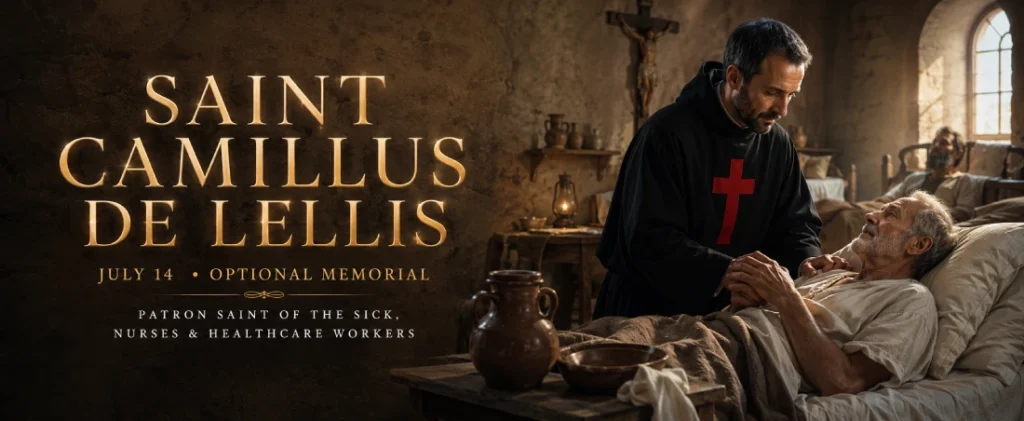
Their distinctive black habit bore a large red cross, a symbol that expressed their willingness to sacrifice themselves in service to those who suffered.
The order dedicated itself to:
- caring for hospital patients
- assisting plague victims
- serving wounded soldiers
- accompanying the dying
- providing both physical and spiritual care
This mission continues around the world today.
Serving During Plagues and Epidemics
Perhaps nothing demonstrates Saint Camillus’ holiness more than his ministry during outbreaks of plague.
When others fled contagious diseases, Camillus and his companions entered hospitals and infected neighborhoods to care for the sick.
Historical evidence confirms that the Camillians became known for their courage during epidemics throughout Italy.
Camillus insisted that every patient deserved:
- clean surroundings
- compassionate treatment
- competent nursing
- spiritual comfort
- respect for human dignity
Centuries before modern healthcare standards, he promoted practices that recognized both the body and soul of every person.
Seeing Christ in Every Patient
The heart of Saint Camillus’ spirituality came directly from the Gospel.
Jesus teaches:
“I was sick and you visited me.” (Matthew 25:36)
Camillus believed these words literally.
Every sick person represented Christ Himself.
This conviction transformed ordinary hospital work into an act of worship.
Rather than serving patients out of obligation, he encouraged his companions to care for them with the tenderness a loving mother shows her only child.
His example continues to influence Catholic hospitals and healthcare ministries worldwide.
Miracles Associated with Saint Camillus
Unlike some saints whose biographies emphasize miraculous events during their lives, Saint Camillus is remembered primarily for the miracle of heroic charity.
Historically, the Church carefully investigated miracles attributed to his intercession during the causes for his beatification and canonization.
As with all canonized saints, these approved miracles served as signs confirming God’s action through His faithful servant.
Many additional healings have traditionally been attributed to Saint Camillus through the centuries, especially by those praying for the sick. While these accounts remain part of Catholic devotional tradition, they should be distinguished from historically documented events.
Death of Saint Camillus
Years of exhausting service and lifelong illness gradually weakened him.
Even while suffering himself, Camillus continued encouraging his religious community to persevere in caring for others.
He died peacefully in Rome on July 14, 1614.
His earthly life ended as it had long been lived—in faithful service to Christ.
Burial, Relics, and Canonization
Saint Camillus was buried in the Church of Saint Mary Magdalene in Rome, which remains the mother church of the Camillian Order.
His reputation for holiness spread quickly after his death.
The Church formally recognized his sanctity through:
- Beatification (1742)
- Canonization (1746)
Later, the Church declared him:
- Patron of hospitals
- Patron of the sick
- Patron of nurses
- Patron of healthcare workers
- Patron of military medical services
These patronages reflect the historical reality of his lifelong ministry rather than symbolic associations alone.
What Is Saint Camillus the Patron Saint Of?
Saint Camillus is especially honored as the patron saint of:
- The sick
- Hospitals
- Nurses
- Healthcare workers
- Caregivers
- The dying
- Military medical personnel
His patronage arose naturally from the extraordinary charity he demonstrated throughout his life.
For anyone caring for an aging parent, working in a hospital, recovering from illness, or accompanying someone near death, Saint Camillus remains a powerful intercessor and model of Christian compassion.
Symbols of Saint Camillus
Sacred art often depicts Saint Camillus with several recognizable symbols.
The Red Cross represents the Camillian Order and sacrificial service.
A Hospital Patient recalls his lifelong ministry among the sick.
A Crucifix reminds us that he saw Christ present in every suffering person.
A Bandaged Leg refers to the chronic wound he carried throughout his life.
These symbols tell the story of a man whose personal suffering became a path to serving others.
Why Is Saint Camillus Important Today?
Modern medicine has advanced beyond anything Camillus could have imagined.
Yet the deepest needs of the human heart remain unchanged.
Patients still need compassion.
Families still need hope.
The dying still deserve dignity.
Healthcare workers still need encouragement.
Saint Camillus reminds the Church that healing involves more than treating disease. It includes recognizing the immeasurable dignity of every human person created in the image of God.
His witness is especially meaningful in a world where illness can easily become impersonal.
Lessons Catholics Can Learn from Saint Camillus
His life offers enduring lessons for every Christian.
- God’s mercy can transform even a sinful past.
- Personal suffering can become a source of compassion for others.
- Charity requires action, not merely good intentions.
- Every person deserves dignity regardless of illness or weakness.
- Holiness is often found in ordinary acts of faithful service.
- Christ is encountered in those who suffer.
- Professional excellence can itself become a work of Christian love.
Frequently Asked Questions
Who was Saint Camillus de Lellis?
Saint Camillus de Lellis was an Italian Catholic priest, founder of the Camillian Order, and the patron saint of the sick, hospitals, nurses, and healthcare workers.
What is Saint Camillus de Lellis known for?
He is best known for transforming the care of the sick by combining compassionate nursing with spiritual ministry rooted in the Gospel.
What is Saint Camillus the patron saint of?
He is the patron saint of the sick, hospitals, nurses, healthcare workers, caregivers, the dying, and military medical services.
When is Saint Camillus’ feast day?
His feast day is celebrated on July 14 in the General Roman Calendar.
How did Saint Camillus die?
After years of chronic illness and lifelong service to the sick, he died peacefully in Rome on July 14, 1614.
Why was Saint Camillus canonized?
The Church recognized his heroic virtue, his extraordinary service to the sick, and authenticated miracles attributed to his intercession during the canonization process.
Did Saint Camillus perform miracles?
Historically verified miracles are those officially examined during his canonization cause. Many additional healings through his intercession belong to Catholic devotional tradition.
Where are Saint Camillus’ relics?
His principal shrine and tomb are located in the Church of Saint Mary Magdalene in Rome.
What religious order did Saint Camillus found?
He founded the Order of the Ministers of the Sick, commonly called the Camillians.
Why do healthcare workers pray to Saint Camillus?
They look to him as a model of compassionate care, courage in times of disease, and faithful service to Christ present in every patient.
Conclusion
Saint Camillus de Lellis stands among the Church’s greatest witnesses to the Gospel of mercy. His life proves that holiness is not reserved for those with perfect beginnings but for those willing to let God’s grace transform them.
From a wounded soldier and struggling gambler, he became a priest whose compassion reshaped Catholic healthcare and inspired generations of caregivers. His legacy lives on wherever the sick are comforted, the dying are accompanied with dignity, and healthcare professionals serve with both skill and love.
More than four centuries after his death, Saint Camillus continues to remind the Church that every hospital room can become a place of grace and every act of genuine care can become an encounter with Christ Himself.