
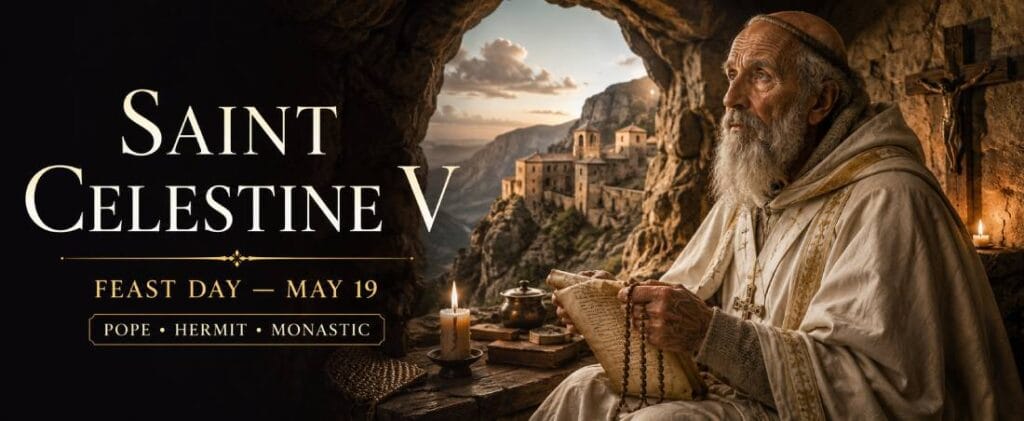
Among the many saints who shaped the history of the Catholic Church, few lives are as striking and spiritually moving as that of Saint Celestine V. Remembered as the hermit who reluctantly became pope, Saint Celestine V stands as a powerful witness to the beauty of silence, prayer, humility, and total trust in God.
His life was not marked by military victories, theological debates, or political ambition. Instead, his holiness grew in caves, forests, monasteries, and long hours of contemplative prayer. He sought solitude not to escape the world, but to belong entirely to Christ. Even when called to the highest office in the Church, Celestine longed for the hidden life of prayer above earthly power.
For modern Catholics living in a noisy and distracted world, Saint Celestine V offers an urgent spiritual lesson: holiness begins in intimacy with God. His life reminds believers that prayer is not secondary to Christian life—it is its foundation.
Early Life
Saint Celestine V was born Pietro Angelerio around the year 1215 in the Kingdom of Sicily, in what is now Italy. He came from a poor farming family and was one of many children. Despite humble beginnings, Pietro displayed a deep spiritual sensitivity from an early age. Those around him noticed his love for silence, devotion, and prayer.
As a young man, he entered the Benedictine tradition and later embraced a stricter eremitical life. Inspired by the Desert Fathers and ancient Christian hermits, Pietro desired complete union with God through solitude and penance. He eventually withdrew to remote mountains and caves, spending years in fasting, contemplation, and uninterrupted prayer.
His desire was simple: to seek God alone.
Yet even in isolation, his holiness became widely known. People traveled long distances seeking spiritual guidance from the holy hermit. Many were moved by his wisdom, humility, and visible devotion to Christ.
Conversion or Calling
Pietro’s vocation developed gradually through a profound attraction to prayer and asceticism. Unlike saints whose conversions came suddenly, his calling emerged through persistent longing for God.
He founded a religious community that later became known as the Celestines, a branch connected to the Benedictine tradition. The community emphasized poverty, strict discipline, silence, fasting, and continual prayer.
Pietro believed that prayer purified the soul and detached the heart from worldly distractions. He encouraged his followers to embrace simplicity and penance so they could hear God more clearly.
For decades he lived hidden from public life. But God had different plans.
In 1294, after a long deadlock among cardinals unable to elect a pope, Pietro unexpectedly became the focus of attention. Many believed his holiness could restore spiritual integrity to the Church during a time of corruption and political struggle.
At nearly eighty years old, the hermit was elected pope and took the name Celestine V.
The Prayer Life of Saint Celestine V
The heart of Saint Celestine V’s holiness was his extraordinary prayer life.
Unlike many public figures in Church history, Celestine’s spirituality was formed in silence. He believed deep prayer required detachment from noise, ambition, and worldly comforts. His days were structured around contemplation, liturgical prayer, fasting, and meditation on Christ.
A Life of Solitude and Contemplation
Before becoming pope, Celestine spent years living in caves and isolated mountain regions. These periods of solitude were not acts of self-punishment but expressions of love for God.
He desired uninterrupted communion with Christ.
The saint practiced prolonged silent prayer, allowing Scripture and the presence of God to shape his heart. His spirituality reflected the ancient monastic belief that silence creates space for divine grace.
Celestine understood that holiness is impossible without interior conversion. Prayer was not merely a routine for him—it was his entire way of life.
Deep Eucharistic Devotion
Though known as a hermit, Saint Celestine V possessed profound reverence for the Eucharist. The Mass was central to his spiritual life.
Like many medieval saints, he viewed the Eucharist as the sustaining presence of Christ for the soul. His penitential lifestyle flowed from this sacramental devotion. Prayer before the Blessed Sacrament strengthened his humility and dependence on God.
Even as pope, he maintained personal simplicity and devotion rather than embracing luxury or ceremonial grandeur.
Prayer Through Penance and Fasting
Celestine practiced rigorous fasting and bodily discipline. Medieval spirituality often linked penance with purification of the heart, and Celestine embraced this tradition wholeheartedly.
He slept little, fasted frequently, and lived with extreme simplicity. Yet his asceticism was not rooted in despair or harshness. Rather, it reflected his desire to love God without compromise.
For Celestine, sacrifice opened the soul to deeper prayer.
Modern Catholics may not imitate his severe practices literally, but his life challenges believers to rediscover self-discipline and spiritual focus in an age dominated by comfort and distraction.
Spiritual Practices and Devotions
Saint Celestine V cultivated several spiritual practices that shaped his holiness and influenced others.
Silence
Silence was essential to his spirituality. He believed constant noise weakens the soul’s attentiveness to God.
In solitude, Celestine learned to listen deeply—not merely with the ears, but with the heart. His example encourages Catholics today to create spaces for silence amid constant digital and cultural noise.
Poverty and Simplicity
Even after becoming pope, Celestine struggled with the wealth and complexity of papal life. His instincts remained monastic and humble.
He preferred simplicity over status and prayer over politics.
This simplicity became one of the clearest signs of his sanctity.
Humility
Perhaps the most remarkable aspect of Celestine’s spirituality was his humility. He never sought influence or power.
After only a few months as pope, he recognized that he lacked the administrative ability needed for Church governance. Rather than cling to authority, he voluntarily resigned the papacy—an extraordinarily rare decision in Church history.
His resignation shocked many, but it revealed deep self-knowledge and humility.
Celestine desired salvation more than prestige.
Trials, Sacrifices, and Faith
Saint Celestine V’s life was filled with suffering and spiritual trials.
His election as pope placed enormous pressure upon a man who had spent most of his life in silence and isolation. The political conflicts surrounding the papacy deeply burdened him.
He longed to return to prayer.
Eventually, after resigning, Celestine attempted to return to his hermit life. However, his successor, Pope Boniface VIII, feared political instability connected to the former pope’s presence. Celestine was detained and spent the remainder of his life in confinement.
Even during imprisonment, he reportedly remained peaceful and prayerful.
This final suffering purified his soul even further. Deprived of freedom, influence, and solitude, he continued trusting God completely.
His perseverance reveals a profound truth of Christian spirituality: holiness is proven not merely in comfort, but in surrender during suffering.
Legacy in the Catholic Church
Saint Celestine V died in 1296 and was canonized in 1313.
Though some historical discussions focus on his resignation from the papacy, Catholics remember him primarily for his sanctity, humility, and contemplative spirit.
He became a lasting symbol of:
- prayer before power
- humility before ambition
- holiness before prestige
His life also demonstrated that the Church venerates not only scholars and leaders, but contemplatives and hidden souls.
In many ways, Saint Celestine V stands alongside the great hermit saints who remind the Church that intimacy with God is the source of every authentic Christian mission.
What Catholics Can Learn Today
Saint Celestine V speaks powerfully to modern Catholics.
Prayer Must Come First
Many people today struggle with spiritual distraction and busyness. Celestine reminds believers that prayer cannot remain an occasional activity. It must become the center of Christian life.
His example encourages Catholics to:
- spend time in Eucharistic adoration
- cultivate silence
- pray daily with consistency
- detach from unnecessary distractions
- seek deeper communion with Christ
Holiness Requires Humility
Celestine’s resignation from the papacy remains one of history’s greatest examples of humility. He understood that worldly success means little without faithfulness to God.
Modern culture often celebrates self-promotion and ambition. Saint Celestine V teaches the opposite virtue: surrender.
Simplicity Leads to Freedom
His life demonstrates that spiritual peace often grows through simplicity. Catholics today can learn to live with greater intentionality, moderation, and trust in God’s providence.
God Works Through Hidden Souls
Celestine spent most of his life unseen by the world. Yet his hidden holiness influenced the entire Church.
Not every vocation requires public recognition. Parents, workers, religious, priests, and ordinary believers are all called to sanctity through faithful prayer and daily sacrifice.
Conclusion
Saint Celestine V remains one of the Church’s most fascinating and spiritually compelling saints. Though history remembers him as the hermit pope, his true greatness came not from occupying the Chair of Peter, but from kneeling before God in prayer.
His life reveals that intimacy with Christ matters more than status, achievement, or recognition.
In an age overwhelmed by noise, distraction, and constant activity, Saint Celestine V calls Catholics back to silence, contemplation, humility, and trust in God.
He reminds believers that holiness is born in prayer.
May his example inspire all Christians to seek deeper communion with Christ through silence, Eucharistic devotion, sacrifice, and unwavering faith.