
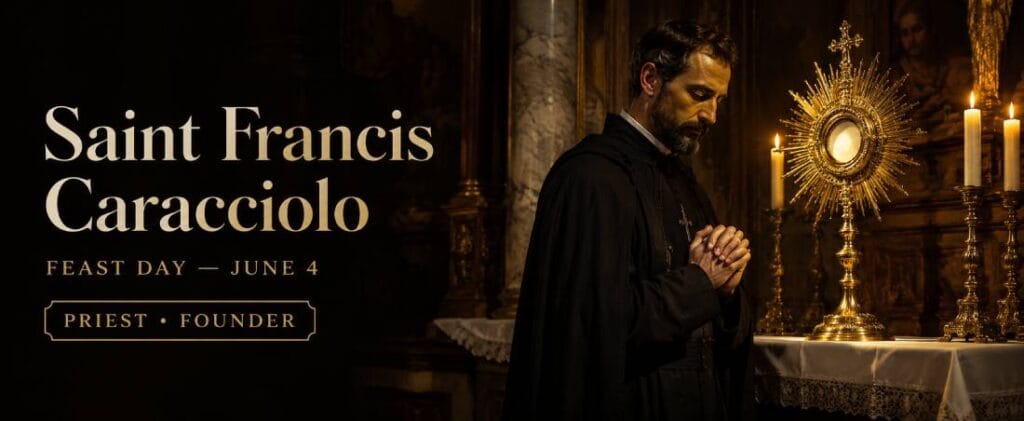
Among the great Eucharistic saints of the Catholic Church, few radiate the quiet intensity of prayer and contemplative devotion as deeply as Saint Francis Caracciolo. Living during the spiritual turbulence of the late sixteenth century, he became a model of perpetual adoration, priestly holiness, penance, and complete surrender to the will of God.
Saint Francis Caracciolo is remembered not primarily for public fame or political influence, but for his hidden life before the Blessed Sacrament. His spirituality was profoundly Eucharistic. He believed that holiness flowed from silence, prayer, fasting, humility, and loving intimacy with Christ present in the Eucharist. Through his contemplative spirit and tireless charity, he helped renew Catholic life during the Counter-Reformation and founded a religious order dedicated to perpetual Eucharistic adoration.
For modern Catholics overwhelmed by noise, distraction, and spiritual exhaustion, Saint Francis Caracciolo offers a timeless witness: holiness begins in prayer.
Early Life and Historical Background
Saint Francis Caracciolo was born Ascanio Pisquizio on October 13, 1563, in the Kingdom of Naples, in present-day Italy. He was born into a noble family in Villa Santa Maria in the Abruzzo region. The sixteenth century was a time of deep upheaval within Europe. The Protestant Reformation had challenged Catholic unity, while the Catholic Church responded with renewal through the Council of Trent, emphasizing reform, holiness, discipline, and sacramental life.
From an early age, Ascanio displayed a reflective and devout temperament. Though raised amid noble privilege, he was never strongly attached to worldly status. Historical accounts describe him as intelligent, disciplined, charitable, and deeply attracted to prayer.
At the age of twenty-two, he suffered a severe skin disease often believed to have been a form of leprosy or a serious dermatological illness. During this period of suffering, he made a vow to God that if he recovered, he would dedicate his entire life to divine service.
His recovery marked a spiritual turning point. True to his promise, he abandoned ambitions of noble advancement and began theological studies for the priesthood in Naples.
The religious climate of Naples greatly influenced him. The city had become a center of Catholic reform and spiritual renewal, shaped by saints such as Saint Philip Neri and the growing emphasis on Eucharistic devotion, confession, priestly reform, and contemplative prayer.
Ascanio was ordained a priest in 1587 and took the religious name Francis in honor of Saint Francis of Assisi.
Calling and Spiritual Transformation
A remarkable providential event helped shape Francis Caracciolo’s future mission. A letter intended for another priest named Caracciolo accidentally reached him instead. The letter invited collaboration in forming a new religious congregation dedicated to prayer, pastoral care, and Eucharistic devotion.
Rather than dismissing the mistake, Francis discerned God’s hand in it.
He soon joined Father John Augustine Adorno and Fabrizio Caracciolo in establishing the Congregation of the Minor Clerks Regular. The order received papal approval from Pope Sixtus V in 1588.
The congregation embraced several defining spiritual principles:
- Perpetual adoration of the Blessed Sacrament
- Deep personal prayer
- Simplicity of life
- Frequent fasting and penance
- Humble service to the poor and sick
- Priestly holiness
- Evangelization grounded in contemplation
Francis Caracciolo became known especially for his extraordinary devotion to Eucharistic adoration. He often spent entire nights in prayer before the tabernacle. Witnesses described him entering states of profound recollection during Mass and prolonged contemplation before the Blessed Sacrament.
His spirituality reflected the Catholic conviction that true apostolic fruitfulness comes first from union with Christ.
The Prayer Life of Saint Francis Caracciolo
The heart of Saint Francis Caracciolo’s sanctity was prayer.
He was not merely active in ministry; he was immersed in contemplation. Prayer shaped every aspect of his life, decisions, relationships, and ministry.
His deepest devotion centered on the Eucharist. Historical traditions consistently describe him as spending long hours in adoration, often late into the night. He encouraged priests and religious to approach the altar with profound reverence and purity of heart.
The Blessed Sacrament was the center of his existence.
He reportedly prayed with such intensity during Mass that tears would sometimes fill his eyes. Witnesses noted moments of visible spiritual ecstasy and profound concentration while celebrating the liturgy.
Francis also cultivated:
- Mental prayer
- Silence
- Fasting
- Examination of conscience
- Frequent confession
- Meditation on Christ’s Passion
- Devotion to the Virgin Mary
He understood prayer not as emotional comfort but as a path of purification and transformation.
One of the defining marks of his spirituality was nocturnal prayer. While others rested, Francis often remained before the Eucharist in silence. This hidden prayer life sustained his external works of charity and pastoral care.
He taught that priests especially must become men of contemplation before they can become effective shepherds.
His spirituality strongly reflected the post-Tridentine renewal of Catholic priesthood: disciplined, Eucharistic, humble, obedient, and deeply rooted in sacramental life.
Devotions, Sacrifices, and Spiritual Practices
Saint Francis Caracciolo practiced severe personal discipline, though always with balance and humility rather than outward spectacle.
He embraced fasting frequently and lived with simplicity despite his noble origins. His order adopted a spirit of poverty and detachment from worldly comfort.
He was especially devoted to:
- Eucharistic adoration
- The Passion of Christ
- Marian prayer
- Priestly sanctification
- Charity toward the sick and poor
Francis regularly visited hospitals and cared personally for the suffering. During outbreaks of disease, he ministered fearlessly to the afflicted, seeing Christ present in them.
He also emphasized obedience and humility. Despite being elected Superior General of his order, he repeatedly sought to avoid honors and leadership positions. He preferred hiddenness over recognition.
One spiritual practice associated with him was the constant repetition of short aspirations directed toward God. His heart remained fixed on divine presence throughout the day.
His life demonstrates a central Catholic truth: external works bear lasting fruit only when rooted in interior union with God.
Trials, Suffering, and Faithfulness
Like many saints, Francis Caracciolo endured hidden suffering.
He struggled physically throughout parts of his life and carried the burdens of leadership during a difficult period for the Church. Establishing a new religious order required perseverance, sacrifice, financial uncertainty, and deep trust in Providence.
The broader context of the Counter-Reformation also created enormous pressure for clergy and religious communities. The Church was seeking reform, discipline, and renewed holiness after periods of corruption and instability.
Francis responded not with harshness or ambition but with deeper prayer.
One of his greatest sufferings came from exhaustion. His intense prayer life, fasting, administrative responsibilities, preaching, and charitable works gradually weakened his health.
Yet he remained faithful to the end.
Near death, he reportedly requested to be placed near the Blessed Sacrament. Even in his final days, his heart remained fixed on Christ in the Eucharist.
Saint Francis Caracciolo died on June 4, 1608, in Agnone, Italy, at only forty-four years old.
His final words are traditionally remembered as:
“Let us go to Heaven.”
Legacy in the Catholic Church
The influence of Saint Francis Caracciolo extended far beyond his relatively short life.
His religious congregation spread throughout Italy and beyond, promoting Eucharistic devotion, priestly reform, and perpetual adoration.
He became especially known as a patron of:
- Eucharistic devotion
- Italian cooks and chefs
- Naples
- Clerks Regular
His canonization reflected the Church’s recognition of his profound holiness and spiritual influence.
Pope Clement XIV beatified him in 1769, and Pope Pius VII canonized him in 1807.
Today, Saint Francis Caracciolo remains an important model for:
- Priests
- Religious communities
- Eucharistic adorers
- Catholics seeking contemplative depth in ordinary life
His life reminds the Church that renewal begins not through activism alone but through adoration.
What Catholics Can Learn Today
Modern Catholics live amid constant distraction, anxiety, noise, and spiritual fragmentation. Saint Francis Caracciolo offers a radically different path centered on silence before God.
From his life Catholics can learn:
1. The Eucharist Must Be Central
Francis organized his entire life around Christ truly present in the Blessed Sacrament. His witness challenges Catholics to rediscover reverence, adoration, and love for the Eucharist.
2. Prayer Sustains Mission
His ministry flowed from contemplation. Without prayer, Christian service eventually becomes empty activism.
3. Holiness Requires Sacrifice
Fasting, discipline, self-denial, and simplicity remain important parts of authentic Catholic spirituality.
4. Humility Protects the Soul
Despite noble birth and leadership responsibilities, Francis avoided pride and worldly ambition.
5. Silence Is Necessary for Hearing God
In an age dominated by noise and constant stimulation, his life testifies to the spiritual power of silence and recollection.
Conclusion
Saint Francis Caracciolo stands among the Church’s great Eucharistic saints. His life was not built upon fame or dramatic public achievements but upon hidden prayer, adoration, sacrifice, and complete surrender to Christ.
He understood that holiness begins in silence before the Blessed Sacrament.
His witness continues to inspire priests, religious, and lay faithful to pursue deeper prayer, greater reverence for the Eucharist, and a life transformed by intimacy with God.
In every age, the Church needs souls like Saint Francis Caracciolo: souls who remain close to the tabernacle.