
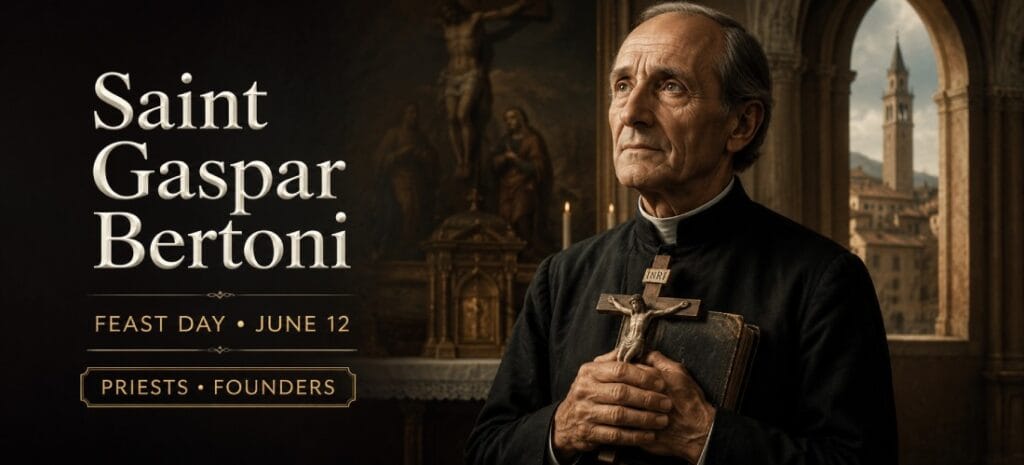
Among the great spiritual figures of nineteenth-century Italy, few exemplify perseverance in suffering and unwavering devotion to God as beautifully as Saint Gaspar Bertoni. A priest, spiritual director, educator, and founder, he spent his life helping souls grow closer to Christ while enduring extraordinary physical pain himself.
Known as the founder of the Congregation of the Sacred Stigmata of Our Lord Jesus Christ (the Stigmatines), Saint Gaspar dedicated his ministry to forming holy priests, educating young people, caring for the poor, and fostering deep devotion to the Passion of Jesus Christ. His life demonstrates that authentic holiness is not measured by worldly success but by faithful obedience to God, steadfast prayer, and joyful acceptance of suffering.
For modern Catholics seeking a deeper prayer life and greater trust in God’s providence, Saint Gaspar Bertoni remains a powerful example.
Early Life and Historical Background
Saint Gaspar Luigi Bertoni was born on October 9, 1777, in Verona, Italy, then part of the Republic of Venice. He grew up during a turbulent period marked by political instability, warfare, and the aftermath of the French Revolution.
From an early age, Gaspar displayed remarkable intelligence and piety. He received his education from the Jesuits and became active in Marian sodalities that encouraged prayer, discipline, and devotion to the Blessed Virgin Mary. These formative years laid the spiritual foundation that would guide the rest of his life.
As a young seminarian, Gaspar witnessed the suffering caused by military conflicts and foreign occupations. Rather than retreat from the needs of society, he volunteered in hospitals, helping the wounded, the sick, and those displaced by war. These experiences deepened his compassion and strengthened his conviction that Christian charity must flow from a profound life of prayer.
He was ordained to the priesthood on September 20, 1800, beginning a ministry that would leave a lasting mark on the Church.
Calling and Spiritual Transformation
Father Gaspar quickly gained a reputation as a wise confessor and spiritual guide. While many priests focused primarily on parish administration, he devoted himself to forming souls.
His spirituality centered on complete conformity to the will of God. He believed that every Christian vocation must be rooted in intimate union with Christ, especially through meditation on the Lord’s Passion.
One of the defining themes of his life was his devotion to the Five Wounds of Christ. The suffering Savior became the lens through which he viewed every aspect of Christian discipleship. He encouraged others to contemplate the wounds of Jesus not merely as historical events but as living signs of divine love.
This devotion would later inspire the foundation of the religious congregation he established in 1816: the Congregation of the Sacred Stigmata of Our Lord Jesus Christ, commonly known as the Stigmatines.
The Prayer Life of Saint Gaspar Bertoni
Prayer was the center of Saint Gaspar’s existence.
Those who knew him described a man deeply recollected in God’s presence. Even while carrying out demanding apostolic work, he cultivated an interior life characterized by silence, contemplation, and continual dependence upon divine grace.
Eucharistic Devotion
Like many saints of the nineteenth century, Gaspar found his greatest strength in the Holy Eucharist. The Mass was the heart of his day and the source of his apostolic zeal.
His meditation before the Blessed Sacrament nourished his spiritual insight and enabled him to guide countless souls. He believed that priests must first become men of prayer before they could effectively serve God’s people.
Meditation on the Passion
A defining feature of his spirituality was regular meditation on the Passion of Christ.
The wounds of Jesus were not merely devotional symbols to him; they represented the infinite love of God revealed through sacrifice. Gaspar encouraged Christians to unite their own sufferings to those of Christ and discover spiritual fruit in adversity.
Marian Devotion
Saint Gaspar’s spirituality was profoundly Marian.
Having participated in Marian associations from his youth, he maintained lifelong devotion to the Blessed Virgin Mary. He saw Mary as the perfect disciple, the model of obedience, humility, and contemplation.
Like many saints, he viewed devotion to Mary not as an end in itself but as a sure path leading souls closer to Jesus Christ.
Prayer as Apostolic Formation
Gaspar believed that effective ministry flowed from union with God.
For this reason, he devoted substantial effort to forming priests and religious who would cultivate disciplined habits of prayer, spiritual reading, examination of conscience, and Eucharistic devotion.
His vision of priestly formation remains influential within the Stigmatine congregation today.
Devotions, Sacrifices, and Spiritual Practices
Saint Gaspar practiced a spirituality marked by simplicity, discipline, and self-denial.
Love of Silence
Although he was active in ministry, he valued silence as an essential means of hearing God’s voice. Periods of recollection allowed him to remain attentive to divine inspiration.
Penance and Self-Denial
Like many saints of his era, Gaspar embraced voluntary sacrifices as acts of love toward Christ. His penances were never motivated by self-punishment but by a desire to grow in holiness and share more fully in the sufferings of the Lord.
Service to the Poor
His spirituality always expressed itself through charity.
He established schools, supported youth formation, and ministered to the needy. His service reflected the Catholic conviction that love of God and love of neighbor are inseparable.
Spiritual Direction
Many sought his guidance because of his wisdom and holiness. He became a respected spiritual director, helping seminarians, priests, religious sisters, and lay faithful discern God’s will.
His ministry demonstrates that one of the greatest forms of charity is helping another person grow in holiness.
Trials, Suffering, and Faithfulness
Perhaps the most remarkable chapter of Saint Gaspar’s life was his prolonged physical suffering.
For approximately the last two decades of his life, he endured severe illness, especially a chronic infection affecting his leg. The condition became so serious that he underwent more than three hundred medical procedures and operations. Despite constant pain, he continued serving souls from his sickbed.
Many people would have viewed such suffering as a reason to withdraw from ministry. Gaspar saw it differently.
He united his pain to the Passion of Christ.
Visitors frequently found him patient, peaceful, and spiritually attentive despite his physical agony. His endurance became a living testimony to the Christian understanding of redemptive suffering.
Rather than allowing illness to define him, he transformed it into a powerful apostolate. From his bed he continued offering counsel, encouragement, and spiritual direction.
His life reminds Catholics that holiness is often forged not during moments of strength but during seasons of weakness.
Legacy in the Catholic Church
Saint Gaspar Bertoni’s influence extends far beyond nineteenth-century Verona.
The congregation he founded, the Stigmatines, continues its mission throughout the world, serving in parishes, schools, missions, and formation ministries.
His legacy includes:
- Formation of priests and religious
- Promotion of devotion to the Passion of Christ
- Catholic education
- Spiritual direction
- Service to youth
- Evangelization through preaching and pastoral ministry
The Church officially recognized his holiness over a century after his death.
- Declared Venerable: 1966
- Beatified: November 1, 1975, by Pope Paul VI
- Canonized: November 1, 1989, by Pope Saint John Paul II
Today he is honored as a model of priestly holiness, perseverance, and trust in God.
What Catholics Can Learn Today
Saint Gaspar Bertoni offers several important lessons for modern believers.
1. Prayer Must Come First
Activity without prayer eventually becomes empty. Gaspar teaches that fruitful ministry begins in silence before God.
2. Suffering Can Become Holy
His life demonstrates that physical pain and hardship need not separate us from God. When united to Christ, suffering can become a path toward sanctification.
3. The Passion of Christ Changes Everything
Meditating on the wounds of Jesus helps Christians understand the depth of God’s love and inspires greater gratitude and conversion.
4. Holiness Is Found in Fidelity
Gaspar did not seek fame or recognition. He simply remained faithful to God’s will day after day.
5. Formation Matters
He invested heavily in educating and spiritually forming others. His example reminds Catholics that the future of the Church depends upon well-formed disciples and holy priests.
Conclusion
Saint Gaspar Bertoni lived during an era of political upheaval, social change, and personal suffering. Yet through every challenge he remained rooted in prayer, devoted to the Eucharist, faithful to the Blessed Virgin Mary, and deeply united to the Passion of Christ.
His holiness was not built upon extraordinary public achievements but upon daily fidelity to God. Whether serving the poor, guiding souls, founding a religious congregation, or enduring decades of illness, he sought only one thing: to love Christ completely.
For Catholics today, Saint Gaspar Bertoni remains a powerful witness that a life centered on prayer, sacrifice, and trust in God’s providence can bear lasting fruit for the Church and for eternity.