
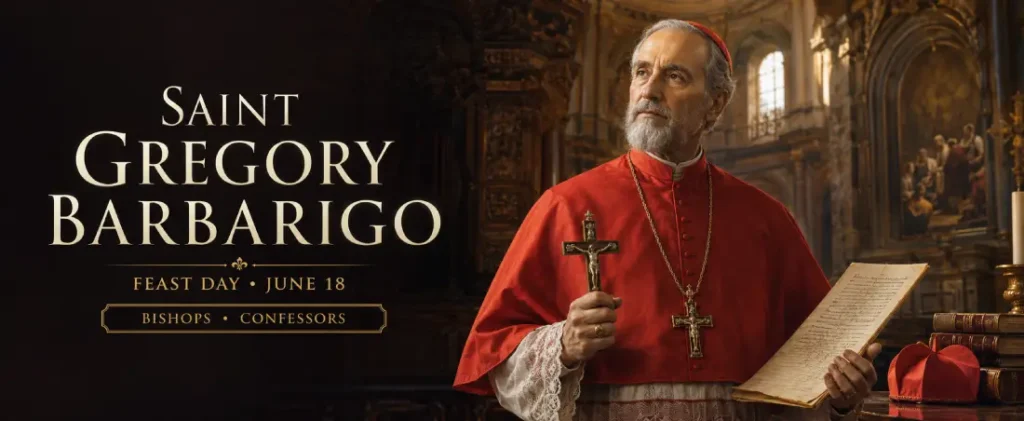
Among the great bishops produced during the post-Tridentine renewal of the Catholic Church, few shine as brightly as Saint Gregory Barbarigo. A cardinal, bishop, scholar, reformer, and servant of the poor, Gregory devoted his life to strengthening the Church through prayer, education, pastoral care, and fidelity to Christ.
Though born into Venetian nobility and destined for a promising diplomatic career, Gregory discovered that God’s call was leading him toward a deeper mission. His life demonstrates how holiness is cultivated through prayerful obedience, humble service, and unwavering trust in Divine Providence.
For modern Catholics, Saint Gregory Barbarigo stands as a powerful example of how intellectual excellence and profound spiritual devotion can work together in the service of the Gospel. His feast day is celebrated on June 18, commemorating a life completely dedicated to God and His Church.
Early Life and Historical Background
Saint Gregory Barbarigo was born Gregorio Giovanni Gasparo Barbarigo on September 16, 1625, in the Republic of Venice. He came from a distinguished noble family, and his father, Giovanni Francesco Barbarigo, served as a Venetian senator. From an early age, Gregory received an exceptional education in philosophy, mathematics, Latin, Greek, and the humanities.
As a young man, he accompanied the Venetian ambassador to the diplomatic negotiations that ultimately contributed to the Peace of Westphalia. During these travels, Gregory encountered the future Pope Alexander VII, then Archbishop Fabio Chigi. This relationship would later play a decisive role in Gregory’s spiritual and ecclesiastical journey.
The Europe Gregory witnessed was still recovering from religious conflict and political upheaval. He observed both the strengths and weaknesses of Christian society and increasingly felt drawn toward a life dedicated entirely to God.
Calling and Spiritual Transformation
Like many saints, Gregory’s path to holiness was not immediate.
After returning from diplomatic service, he considered withdrawing from the world to live as a hermit. He longed for silence, prayer, and contemplation. Seeking guidance, he consulted Cardinal Fabio Chigi.
Chigi recognized Gregory’s gifts and encouraged him not to flee the world but to sanctify it through priestly service. Gregory accepted this counsel as God’s will. Instead of pursuing solitary asceticism, he entered ecclesiastical studies and prepared for the priesthood.
In 1655, Gregory earned doctorates in theology, canon law, and civil law and was ordained a priest. His remarkable combination of learning, humility, and holiness quickly became evident. Pope Alexander VII soon entrusted him with important responsibilities in Rome, particularly during times of plague and social hardship.
Only two years after ordination, he was appointed Bishop of Bergamo, and later became Cardinal and Bishop of Padua.
The Prayer Life of Saint Gregory Barbarigo
The secret of Gregory’s effectiveness was not merely his intelligence or administrative skill. It was his profound life of prayer.
Those who knew him recognized that his pastoral zeal flowed directly from his relationship with God. He devoted significant time each day to meditation, the Divine Office, Eucharistic prayer, and spiritual reading.
Gregory believed that a bishop could not effectively guide souls unless he himself remained deeply united to Christ.
His episcopal ministry reflected a contemplative heart. He frequently withdrew into prayer before making important decisions. His leadership was marked by discernment rather than impulsiveness, humility rather than ambition.
The Eucharist occupied the center of his spiritual life. Like many saints formed by the reforms of the Council of Trent, Gregory viewed the Holy Mass as the source and summit of Christian existence. His devotion to the Blessed Sacrament strengthened his pastoral charity and sustained him through decades of demanding service.
Prayer also cultivated within him a deep spirit of obedience. Rather than pursuing personal prestige, Gregory consistently sought God’s will. Whether serving in Rome, Bergamo, or Padua, he viewed every assignment as a sacred trust.
His prayer life produced an interior peace that enabled him to face enormous responsibilities without losing sight of eternity.
Devotions, Sacrifices, and Spiritual Practices
Saint Gregory practiced a disciplined spiritual life characterized by simplicity and self-denial.
Despite his noble birth and high ecclesiastical rank, he embraced personal austerity. He avoided luxury and sought to imitate Christ’s humility.
His spiritual practices included:
- Daily celebration and devotion to the Holy Eucharist
- Faithful recitation of the Divine Office
- Meditation on Sacred Scripture
- Frequent examination of conscience
- Personal penance and fasting
- Devotion to the Blessed Virgin Mary
- Acts of charity toward the poor and sick
Gregory viewed education as a sacred ministry. He expanded seminaries and worked tirelessly to improve priestly formation. He understood that holy priests are formed through both intellectual rigor and spiritual discipline.
In Padua, he established and enriched libraries and promoted Catholic scholarship, believing that truth ultimately leads souls to God.
His sacrifices were not dramatic acts of public heroism but rather the daily offering of himself in service to the Church. This hidden fidelity became one of the hallmarks of his sanctity.
Trials, Suffering, and Faithfulness
Every saint encounters the Cross.
Gregory’s challenges arose primarily through the burdens of leadership.
The seventeenth century presented numerous difficulties for the Church. The implementation of Tridentine reforms required perseverance, wisdom, and courage. Resistance often came from entrenched customs and local interests.
As bishop, Gregory conducted extensive pastoral visitations, personally overseeing the spiritual health of his dioceses. These journeys demanded physical endurance and constant sacrifice.
He also devoted himself to caring for the sick and poor during times of crisis. Rather than remaining distant from suffering, he entered into it.
One of the spiritual principles associated with Gregory is reflected in a saying attributed to him:
“Be shepherds, not overlords; be teachers, not judges; be servants, not masters.”
This pastoral vision shaped his response to every challenge. He did not govern through fear but through charity.
His faithfulness during decades of service demonstrates that true holiness often consists not in extraordinary experiences but in persevering love.
Legacy in the Catholic Church
Saint Gregory Barbarigo became one of the most respected churchmen of his era.
His greatest achievements include:
- Reforming diocesan administration
- Strengthening seminary education
- Promoting priestly formation
- Encouraging Catholic scholarship
- Expanding libraries and learning centers
- Supporting the poor and sick
- Conducting extensive pastoral visitations
His influence extended well beyond his own lifetime. The seminaries and institutions he strengthened helped shape generations of clergy and faithful Catholics.
His reputation for holiness continued to grow after his death on June 18, 1697, in Padua. He was beatified in the eighteenth century and canonized by Pope John XXIII on May 26, 1960.
Pope John XXIII held Gregory in particularly high esteem and considered him a model bishop.
What Catholics Can Learn Today
Saint Gregory Barbarigo offers timeless lessons for modern believers.
Prayer Must Come First
His life reminds us that effective Christian service begins with union with God. Activity without prayer eventually becomes empty.
Holiness and Learning Belong Together
Gregory demonstrates that intellectual excellence and spiritual devotion are not enemies. The Church needs faithful Catholics who pursue both wisdom and holiness.
Leadership Is Service
Whether in families, parishes, workplaces, or communities, authentic Christian leadership is rooted in humility.
Charity Requires Action
Gregory did not merely speak about helping the poor. He organized practical assistance and personally cared for those in need.
Obedience Leads to Fruitfulness
Had Gregory followed only his personal desires, he might have become a hermit. Instead, obedience to God’s call allowed him to transform countless lives.
Conclusion
Saint Gregory Barbarigo stands among the great reforming bishops of Catholic history. Through prayer, scholarship, pastoral charity, and unwavering fidelity to Christ, he helped renew the Church during a crucial period.
His life teaches that holiness is not reserved for monasteries or secluded places. It can flourish in leadership, administration, education, and daily service when these are offered to God.
May Saint Gregory Barbarigo inspire us to deepen our prayer life, serve others generously, and seek God’s will above our own ambitions. Like this holy bishop of Padua, may we become faithful shepherds who lead others toward Christ through wisdom, humility, and love.