
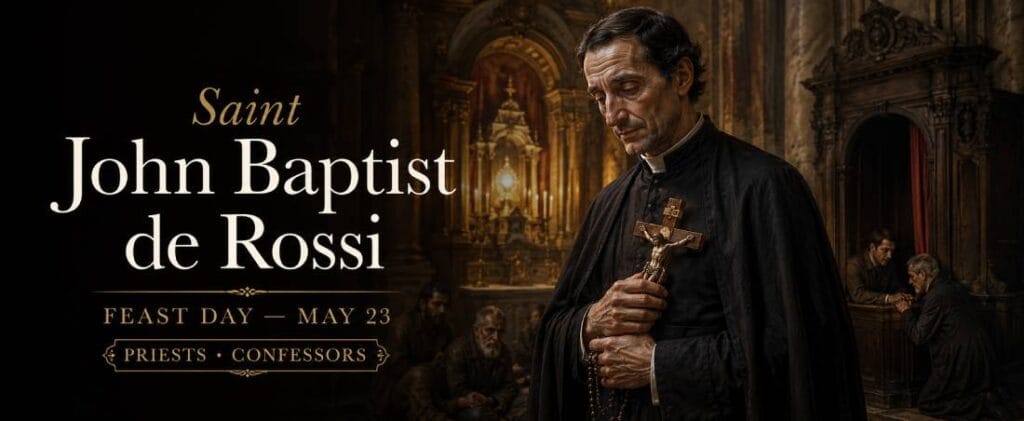
Among the many saints who transformed the Church not through fame or political power but through hidden holiness, Saint John Baptist de Rossi stands as a radiant example of priestly charity rooted in deep prayer. Known for his tireless ministry among the poor, the sick, prisoners, and the abandoned of Rome, he lived a life completely surrendered to Christ in the Eucharist.
His sanctity was not built upon dramatic visions or public miracles alone, but upon daily fidelity to prayer, sacramental devotion, penance, and compassionate service. He understood that authentic Christian charity flows first from union with God. Every act of mercy in his ministry was nourished by silence before the Blessed Sacrament and profound trust in Divine Providence.
For Catholics today, Saint John Baptist de Rossi offers a powerful witness in a distracted and noisy age. His life teaches that holiness is found not in extraordinary status, but in extraordinary love sustained through prayer.
Early Life
Saint John Baptist de Rossi was born on February 22, 1698, in Voltaggio, near Genoa in Italy. Raised in a devout Catholic family, he showed signs of unusual piety from an early age. His parents formed him carefully in the faith, teaching him reverence for prayer, obedience to God, and love for the Church.
As a young boy, John developed a strong attraction to the priesthood. He was known for seriousness beyond his years and for spending long periods in prayer. Unlike many ambitious young men of his era who sought advancement or recognition, he desired only to serve God faithfully.
At the age of thirteen, he moved to Rome under the care of a noble relative so he could pursue studies for the priesthood. Rome at the time was a city of both grandeur and deep suffering. Beneath the beauty of churches and basilicas existed poverty, homelessness, illness, and moral decay. These realities deeply affected the young seminarian and would later shape his priestly mission.
During his studies, John suffered severe health problems, including epilepsy and nervous disorders. These afflictions interrupted his education and caused periods of discouragement. Yet suffering became one of the greatest schools of prayer in his life. Rather than becoming bitter, he learned deeper dependence upon Christ.
Conversion and Priestly Calling
Although John Baptist de Rossi was always devout, his understanding of priesthood matured profoundly during his years of illness and weakness. Physical suffering purified his heart and stripped away self-reliance.
He realized that priestly ministry was not about prestige but sacrifice.
After recovering sufficiently to continue his studies, he was ordained a priest in 1721. His priesthood quickly became marked by humility and extraordinary pastoral charity. He refused comfortable positions and instead devoted himself to those most neglected by society.
He became especially known for ministering to:
- the homeless
- prisoners
- hospital patients
- workers
- prostitutes seeking repentance
- the poor abandoned in the streets of Rome
Yet what distinguished him most was not simply social concern, but the spiritual foundation beneath it. He approached every suffering soul as someone loved by Christ and redeemed by the Cross.
His apostolate flowed from contemplation.
The Prayer Life of Saint John Baptist de Rossi
The heart of Saint John Baptist de Rossi’s holiness was his intense interior life. Those who knew him testified that prayer was as necessary to him as breathing.
He rose early for meditation and frequently spent long hours in silent prayer before the Blessed Sacrament. Even amid exhausting ministry, he protected time for recollection and communion with God.
Eucharistic Devotion
The Eucharist stood at the center of his spirituality. He celebrated Mass with profound reverence and visible devotion. Witnesses recalled that he often became deeply moved while offering the Holy Sacrifice.
For Saint John Baptist de Rossi, the Eucharist was not merely ritual—it was an encounter with the living Christ.
He encouraged frequent Communion and Eucharistic adoration among the faithful long before such practices became widespread in many places. He believed spiritual renewal in society could occur only through renewed love for Jesus in the Blessed Sacrament.
His hours before the tabernacle strengthened him for difficult ministry among the suffering and morally broken.
Prayer as Union With Christ
Saint John Baptist de Rossi understood prayer not merely as reciting words but as friendship with Christ.
He frequently meditated on the Passion of Jesus. The suffering of Christ shaped his understanding of mercy and compassion. Because he contemplated the wounds of Christ deeply, he recognized Christ present in wounded humanity.
His prayer life included:
- meditation on Scripture
- Eucharistic adoration
- examination of conscience
- devotional prayers
- contemplation of Christ’s Passion
- Marian devotion
- penitential practices
Even during illness, exhaustion, and emotional struggles, he remained faithful to daily prayer.
Love for Silence and Recollection
Despite living in busy Rome, he cultivated interior silence. He avoided useless conversation and distractions whenever possible. He believed recollection protected the soul from spiritual mediocrity.
This habit of interior prayer gave him remarkable peace. People were often struck by his gentleness and calm presence even in chaotic situations.
He carried silence within him because he carried Christ within him.
Spiritual Practices and Devotions
Devotion to the Blessed Virgin Mary
Saint John Baptist de Rossi had deep filial devotion to the Virgin Mary. He frequently prayed the Rosary and encouraged others to seek Mary’s intercession.
He saw Mary as the perfect model of humility, purity, and surrender to God’s will.
His Marian devotion was deeply Christ-centered. He believed Mary always leads souls closer to Jesus and teaches believers how to pray with trust and simplicity.
Confession and Mercy
One of the defining aspects of his priesthood was his ministry in the confessional. He spent countless hours hearing confessions with patience and compassion.
He never treated sinners harshly. Instead, he reflected the merciful heart of Christ.
His prayer life formed him into a confessor who understood both justice and mercy. Many penitents who feared condemnation found healing and conversion through his gentle counsel.
Care for the Poor
Unlike charity performed for appearance, his service to the poor flowed from genuine spiritual conviction.
He often visited hospitals personally, cared for the sick, and comforted the dying. He established shelters and organized assistance for vulnerable people in Rome.
Yet even while active in ministry, he never allowed activism to replace contemplation. Prayer remained the source of all his works.
Trials, Sacrifices, and Faith
Saint John Baptist de Rossi suffered greatly throughout his life from fragile health. Epileptic episodes, nervous exhaustion, and physical weakness often limited him.
At times he feared he would never complete his priestly vocation.
Yet these sufferings became instruments of sanctification.
He united his pain to the sufferings of Christ and accepted weakness with humility. Rather than seeking comfort or recognition, he embraced hidden sacrifice.
His ministry among difficult populations also brought emotional burdens. Working with prisoners, the poor, and the spiritually wounded required enormous patience.
Still, he persevered because he believed every soul mattered to God.
One of the most inspiring aspects of his spirituality was his refusal to separate prayer from suffering. He understood that trials could deepen communion with Christ when accepted in faith.
Legacy in the Catholic Church
Saint John Baptist de Rossi died on May 23, 1764. His reputation for holiness spread quickly throughout Rome.
The Church recognized not only his charitable works but the profound spiritual life that sustained them. He was canonized in 1881 by Pope Leo XIII.
Today he is remembered especially as a model priest devoted to mercy, prayer, and pastoral care.
His life anticipated many themes later emphasized strongly in the Church:
- compassionate evangelization
- pastoral mercy
- Eucharistic spirituality
- care for the marginalized
- holiness through ordinary fidelity
In a world often tempted toward superficial spirituality, Saint John Baptist de Rossi reminds Catholics that authentic renewal begins in prayer.
What Catholics Can Learn Today
Holiness Begins in Daily Prayer
Saint John Baptist de Rossi teaches that consistent daily prayer transforms the soul gradually. Holiness is not built overnight but through faithful communion with God.
Modern Catholics surrounded by distraction can learn from his commitment to silence, recollection, and Eucharistic devotion.
Mercy Flows From Union With Christ
His compassion toward sinners was not sentimental permissiveness. It came from contemplating the mercy of Christ.
Catholics today are called to imitate this balance of truth and charity.
Suffering Can Become Holy
Rather than wasting suffering in bitterness, Saint John Baptist de Rossi united his trials to Jesus. His example encourages believers facing illness, anxiety, discouragement, or weakness.
God often sanctifies souls through hidden crosses.
The Eucharist Must Remain Central
His life powerfully demonstrates that devotion to the Eucharist changes hearts. Frequent Mass, Eucharistic adoration, and reverence for Christ’s Presence remain essential for spiritual growth.
Conclusion
The life of Saint John Baptist de Rossi reveals the beauty of a soul entirely given to God through prayer. Though physically weak and often burdened by suffering, he became spiritually powerful because he remained close to Christ.
His holiness did not come from public acclaim but from hidden fidelity—hours before the Blessed Sacrament, compassion toward sinners, love for the poor, and unwavering trust in Divine Providence.
For Catholics seeking deeper prayer lives today, Saint John Baptist de Rossi offers a timeless path: remain close to Jesus, love the Eucharist, embrace humility, and allow prayer to shape every action.
His witness reminds the Church that true sanctity is born not from worldly success, but from communion with God.