| Fast Facts | Details |
| Papacy | August 13, 523 – May 18, 526 AD |
| Feast Day | May 18 (Roman Rite) |
| Title | Pope and Martyr |
| Key Historical Conflict | Resisting Arian subjugation under Ostrogothic King Theodoric |
| Key Magisterial References | CCC 1808 (Fortitude), CCC 2473 (Martyrdom), CCC 465 (Nicene Orthodoxy) |
Elected Bishop of Rome on August 13, 523 AD, Pope Saint John I governed the Universal Church during one of the most volatile political and theological crises of late antiquity. His brief pontificate culminated in fatal imprisonment under the Arian Ostrogothic King Theodoric, making him an enduring model of Petrine fortitude, liturgical devotion, and uncompromising fidelity to orthodox Catholic truth.
Historical Context: The Arian Threat and Ostrogothic Rule
Saint John I was born in Tuscany during the late fifth century. Following the collapse of the Western Roman Empire in 476 AD, the Italian peninsula fell under the control of Germanic tribes. By the time of John’s elevation to the Chair of Peter, Italy was ruled by Theodoric the Great, an Ostrogothic monarch who adhered strictly to Arianism.
Arianism, a fourth-century Christological heresy condemned by the First Council of Nicaea (325 AD) and the First Council of Constantinople (381 AD), denied that Jesus Christ was consubstantial (homoousios) with the Father. As the Catechism of the Catholic Church states:
“The Arian heresy had denied that Jesus is true God and is of the same substance as the Father” (CCC 465).
While King Theodoric initially tolerated the Catholic population of Rome, his domestic and foreign policies grew hostile as tensions escalated between his court at Ravenna and the orthodox Byzantine Empire in Constantinople. The Catholic clergy and the Bishop of Rome faced mounting pressure to compromise ecclesiastical autonomy to appease an Arian monarch.
Vocation and Elevation to the Papacy
John served the Roman Church for decades as a faithful deacon and archdeacon prior to his election. Historical chronicles describe him as a frail, elderly cleric respected for his theological prudence, administrative integrity, and deep prayer life.
Following the death of Pope Hormisdas in 523 AD, the clergy and Roman faithful elected John to the papacy. His elevation was not a result of political ambition, but a recognition of his supernatural charity and spiritual steadfastness.
From the beginning of his pontificate, Pope John I inherited the delicate task of preserving the distinction between temporal power and spiritual authority. This division had been famously defined three decades earlier by Pope Saint Gelasius I in his letter Famuli Vestrae Pietatis (the Duo Sunt doctrine), which declared that the sacred authority of bishops (auctoritas sacrata) outweighs royal power (regalis potestas) in matters of eternal salvation.
The Coerced Diplomatic Mission to Constantinople
The defining crisis of Saint John I’s papacy erupted around 524 AD when the Byzantine Emperor Justin I issued a severe imperial edict against Arian Christians in the East, closing their basilicas and excluding them from public office.
Enraged by the emperor’s actions, King Theodoric summoned Pope John to Ravenna. The king commanded the elderly, ailing Pontiff to lead a diplomatic delegation to Constantinople. Theodoric demanded that the Pope persuade Emperor Justin I to rescind the anti-Arian decrees and allow baptized Arians who had converted to the Catholic faith to return to their heretical sect without penalty.
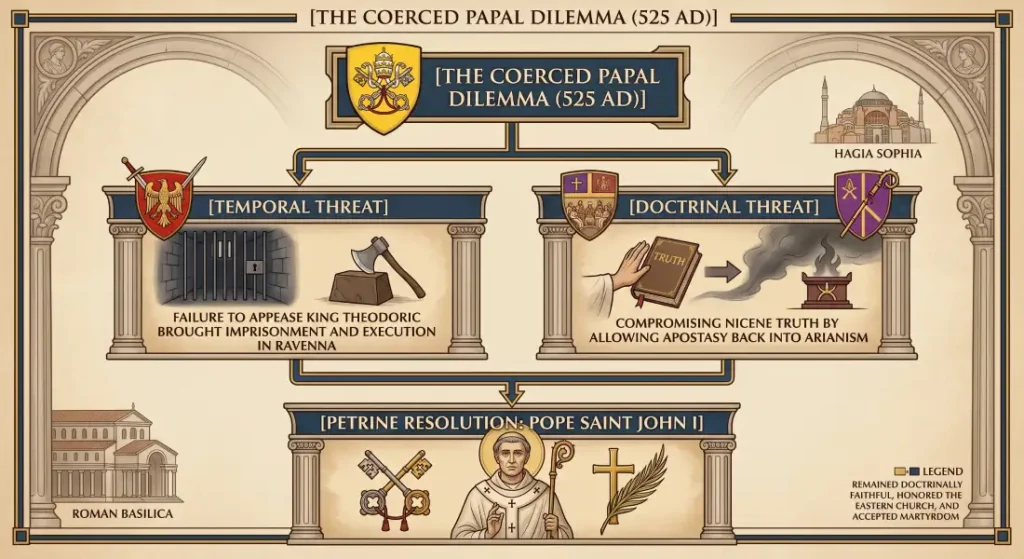
This coerced mission presented a severe theological and moral dilemma:
- If the Pope failed to satisfy King Theodoric, he faced severe retaliation, imprisonment, or death upon returning to Italy.
- If the Pope encouraged reconciled Catholics to return to Arian heresy, he would commit grave apostasy and lead souls into spiritual ruin.
Accepting the mission to protect Italian Catholics from retaliatory massacres, Pope John sailed for Constantinople in late 525 AD.
The Witness in the East: Liturgical Primacy and Communion
When Pope John I arrived in Constantinople, he was received with immense reverence by Emperor Justin I, Patriarch Epiphanius, and the faithful of the Eastern Empire. He was the first reigning Bishop of Rome to set foot in the imperial capital.
John upheld the primacy of the Apostolic See throughout the visit. He refused to sit beside the Patriarch of Constantinople, insisting instead on occupying an elevated throne as the successor of Saint Peter, a precedence the Eastern Church fully acknowledged.
On Easter Sunday (April 19, 526 AD), Pope Saint John I presided over the Holy Sacrifice of the Mass in the Hagia Sophia. He celebrated the Sacred Liturgy in the Latin rite and personally crowned Emperor Justin I.
While John successfully negotiated the return of seized Arian churches to the control of the civil state, he steadfastly refused to endorse Theodoric’s demand that Catholic converts be permitted to revert to Arianism. He defended dogmatic orthodoxy and the integrity of Catholic baptism (CCC 1269).
Imprisonment and True Martyrdom in Ravenna
Upon his return to Italy in May 526 AD, Pope John I arrived in Ravenna to report to King Theodoric. The paranoid king, suspecting that the Pontiff had allied with Emperor Justin I against the Ostrogothic kingdom, placed the Pope and his accompanying senators under immediate arrest.
Already weakened by age, illness, and the arduous voyage, Saint John was thrown into a squalid dungeon in Ravenna and denied adequate food, water, and medical care.
The Pontiff endured this brutal confinement with quiet, patient endurance. He refused to compromise the rights of the Church or barter orthodox doctrine for his physical survival.
On May 18, 526 AD, Pope Saint John I died in his cell as a direct consequence of this severe abuse.
Theological Definition of Martyrdom:
“Martyrdom is the supreme witness given to the truth of the faith:
it means bearing witness even unto death.”
— Catechism of the Catholic Church, paragraph 2473
The Catholic Church formally recognized John’s death as true martyrdom, because he endured lethal deprivation inflicted out of hatred for the orthodox Catholic faith (in odium fidei) and the Petrine office (CCC 2473; St. Thomas Aquinas, Summa Theologiae II-II, q. 124, a. 5). His body was later transferred from Ravenna to Rome and solemnly interred within the nave of Saint Peter’s Basilica.
The Spiritual Life of Saint John I: A Sacramental Foundation
The supernatural courage demonstrated by Pope Saint John I was rooted in a lifelong habit of interior prayer, ascetical discipline, and liturgical fidelity.
1. The Holy Sacrifice of the Mass
As a priest and bishop, Saint John’s life was centered on the daily celebration of the Holy Eucharist. Catholic theology teaches that the Eucharist is the “source and summit of the Christian life” (Lumen Gentium §11; CCC 1324). In offering the Eucharistic sacrifice, John was united to Christ’s self-oblation, which prepared his soul to offer his own life in sacrificial martyrdom.
2. The Liturgy of the Hours and the Psalter
The regular recitation of the Psalms formed the core of clerical prayer in the ancient Church. The Psalms provided John with the spiritual vocabulary of lament, trust, and fortitude during his captivity (CCC 2586):
- “The Lord is my light and my salvation; whom shall I fear?” (Psalm 27:1).
- “In you, O Lord, do I take refuge; let me never be put to shame” (Psalm 31:1).
3. The Cardinal Virtue of Fortitude
Saint Thomas Aquinas defines fortitude as the moral virtue that ensures firmness in difficulties and constancy in the pursuit of the good (Summa Theologiae II-II, q. 123, a. 2; CCC 1808). Fortitude consists not merely in attacking evil, but primarily in enduring hardship patiently for the sake of God. John’s calm demeanor in the face of royal threats reflected this theological virtue perfected by grace.
Timeless Lessons for Modern Catholics
The witness of Pope Saint John I offers practical and spiritual lessons for Christians navigating contemporary challenges:
- Uncompromising Fidelity to Catholic Truth: When pressured by earthly rulers to compromise dogmatic teaching, John chose imprisonment rather than doctrinal betrayal. Catholics are called to remain faithful to the Magisterium regardless of social or cultural pressure (CCC 2471–2472).
- Sanctification Through Hidden Suffering: Holiness does not require worldly recognition. Saint John’s hidden sufferings in a dark Ravenna cell possessed immense supernatural value because they were united to the Cross of Jesus Christ (CCC 618).
- Spiritual Fortitude Over Human Respect: Saint John demonstrated that true shepherds of the Church must seek to please God rather than temporal powers. As Saint Peter declared before the Sanhedrin: “We must obey God rather than men” (Acts 5:29).
Through his prayerful life and sacrificial death, Pope Saint John I remains an enduring beacon of holy endurance, teaching the faithful that the peace of Christ transcends all earthly tribulations.
Frequently Asked Questions
The Catholic Church recognizes Pope Saint John I as a martyr because he died in 526 AD from lethal neglect and harsh confinement in a Ravenna prison, suffered directly in odium fidei (in hatred of the faith) after refusing to compromise orthodox Catholic doctrine for King Theodoric (CCC 2473).
The Ostrogothic King Theodoric, an Arian, forced Pope John I to travel to Constantinople to demand that Emperor Justin I stop restricting Arianism. When John successfully defended the faith and preserved Catholic unity without promoting heresy, Theodoric threw the Pontiff into prison.
Arianism denied the eternal divinity of Jesus Christ, claiming the Son was a created being. Condemned by the Council of Nicaea (325 AD), orthodox Catholic doctrine affirms that Jesus is true God, consubstantial (homoousios) with the Father (CCC 465), a truth Saint John defended.
In the Roman Rite of the Catholic Church, the feast day of Pope Saint John I is celebrated on May 18, commemorating the anniversary of his martyrdom in Ravenna in 526 AD.