
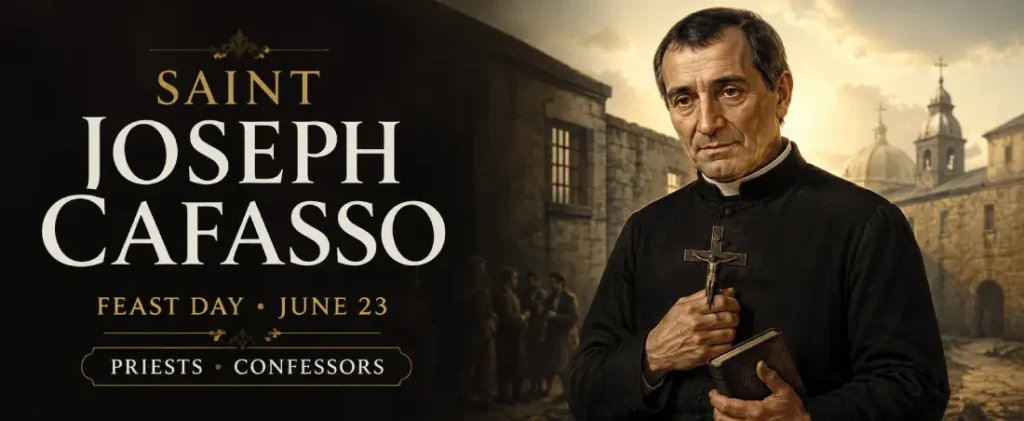
Among the great saints of nineteenth-century Italy, few shine with the quiet brilliance of Saint Joseph Cafasso. Known as the “Priest of the Gallows,” he became famous not because of dramatic miracles or public preaching, but because of his extraordinary life of prayer, humility, and charity. He guided priests, comforted prisoners facing execution, formed future saints, and spent countless hours before the Blessed Sacrament.
In an age marked by political upheaval, poverty, and spiritual confusion, Joseph Cafasso demonstrated that authentic holiness is rooted in intimate union with God. His life reveals how deep prayer, Eucharistic devotion, and sacrificial love can transform not only individual souls but entire communities.
For Catholics today, Saint Joseph Cafasso remains a powerful model of priestly holiness, mercy toward sinners, and unwavering trust in Divine Providence.
Early Life and Historical Background
Saint Joseph Cafasso was born on January 15, 1811, in Castelnuovo d’Asti, Piedmont, in northern Italy. This same region would later produce another giant of Catholic history, Saint John Bosco, who regarded Cafasso as one of his greatest spiritual mentors.
Born into a devout Catholic family, Joseph displayed unusual piety from childhood. He was physically frail and suffered from a spinal condition that left him small in stature throughout his life. Yet his physical weakness became an opportunity for spiritual strength.
The Italy of his youth was undergoing significant social and political change. Anti-clerical movements, poverty, and growing secularization challenged the Church’s mission. Amid these circumstances, Joseph felt called to become a priest dedicated to the salvation of souls.
After completing his studies, he entered the seminary and was ordained in 1833.
Calling and Spiritual Transformation
After ordination, Father Joseph Cafasso joined the Ecclesiastical College in Turin, an institution dedicated to the continuing formation of priests.
Here he came under the influence of the spiritual tradition of Saint Francis de Sales and Saint Alphonsus Liguori. This formation shaped his pastoral approach: firm in doctrine yet overflowing with mercy.
His priestly ministry quickly became known for wisdom, holiness, and spiritual discernment. Priests sought his counsel. Bishops trusted his judgment. Ordinary people came to him for confession and spiritual guidance.
Yet despite his growing reputation, Cafasso remained profoundly humble. He avoided attention and preferred hidden service. His holiness was not built upon public recognition but upon countless hidden hours spent with God.
This interior life became the foundation of everything he accomplished.
The Prayer Life of Saint Joseph Cafasso
The heart of Saint Joseph Cafasso’s sanctity was prayer.
Contemporaries frequently observed that his effectiveness in ministry flowed directly from his intimate union with Christ. He was convinced that no priest could guide others unless he first spent significant time in prayer.
The Eucharist occupied the center of his spiritual life. Daily Mass was not merely an obligation but the source from which he drew strength, wisdom, and charity. His devotion before the Blessed Sacrament was profound and constant.
Witnesses described him as recollected and deeply attentive during prayer. Even amid busy pastoral responsibilities, he maintained an interior spirit of communion with God.
He taught priests to cultivate silence, meditation, and frequent examination of conscience. Rather than relying solely on academic learning, he encouraged them to become men of prayer whose ministry flowed from personal holiness.
One of his frequently cited spiritual principles was:
“The worth of a priest is measured by the way he celebrates Holy Mass.”
This conviction shaped his entire life.
Prayer for Cafasso was not merely a practice. It was a relationship. Through prayer he encountered Christ, discovered God’s will, and received the grace necessary to serve the most neglected souls of society.
Devotions, Sacrifices, and Spiritual Practices
Saint Joseph Cafasso embraced a disciplined spiritual life marked by sacrifice and devotion.
His practices included:
- Daily meditation
- Frequent Eucharistic adoration
- Regular fasting and self-denial
- Devotion to the Blessed Virgin Mary
- Spiritual reading
- Long hours hearing confessions
Like many saints, Cafasso understood that self-denial was not an end in itself but a means of growing closer to Christ.
He lived simply despite opportunities for comfort and prestige. He willingly accepted physical discomfort and embraced hidden sacrifices.
His Marian devotion was especially important. He entrusted his priesthood and ministry to the Blessed Mother and encouraged others to seek her maternal protection.
At the same time, he avoided excessive rigorism. Influenced by Saint Alphonsus Liguori, he emphasized God’s mercy and encouraged penitents to trust in divine forgiveness.
This balance between discipline and mercy became one of the defining characteristics of his spirituality.
Trials, Suffering, and Faithfulness
One of the most remarkable aspects of Saint Joseph Cafasso’s ministry was his work among prisoners condemned to death.
Many people feared these criminals or regarded them as beyond redemption. Cafasso saw them differently.
He saw souls loved by Christ.
For years he visited prisons throughout Turin, hearing confessions, offering spiritual counsel, and preparing condemned prisoners for death.
Because he frequently accompanied prisoners to their executions, he became known as the “Priest of the Gallows.”
This ministry demanded extraordinary courage and compassion. He encountered hardened criminals, murderers, and individuals abandoned by society.
Yet he never lost hope in God’s mercy.
Many prisoners experienced profound conversions under his guidance. Numerous accounts describe condemned men approaching execution with repentance, peace, and trust in God because of Cafasso’s ministry.
These encounters revealed the depth of his faith.
He believed no sinner was beyond redemption.
His work among prisoners reflected the Gospel itself: Christ seeking the lost, comforting the condemned, and extending mercy even at the final hour.
Legacy in the Catholic Church
Saint Joseph Cafasso’s influence extended far beyond his own lifetime.
Perhaps his most famous spiritual son was Saint John Bosco, whom he guided, encouraged, and supported during crucial years of formation.
Don Bosco later credited Cafasso with helping shape his vocation and apostolic vision. Through Bosco’s work among youth, Cafasso’s influence would spread throughout the world.
Beyond this, he became one of the most respected spiritual directors of nineteenth-century Italy. Countless priests benefited from his wisdom and guidance.
His example of priestly holiness inspired generations of clergy. His emphasis on mercy anticipated themes that would continue to shape Catholic pastoral ministry in later centuries.
Recognizing his heroic virtue, Pope Pius XI beatified him in 1925.
Pope Pius XII canonized him in 1947.
In 1948, Pope Pius XII declared him the Patron of Italian Prisons and Prisoners.
Today he remains a beloved model of priestly charity, spiritual direction, and mercy toward sinners.
What Catholics Can Learn Today
The life of Saint Joseph Cafasso offers profound lessons for modern Catholics.
1. Prayer Must Come First
Cafasso teaches that effective Christian living begins with prayer. Without regular communion with God, even good works can lose their spiritual foundation.
2. The Eucharist Is the Source of Strength
His devotion to the Mass reminds Catholics that holiness flows from Christ present in the Eucharist.
3. No Soul Is Beyond Redemption
His ministry among condemned prisoners demonstrates the limitless reach of God’s mercy.
4. Hidden Holiness Matters
Cafasso never sought fame. Much of his sanctity developed through unseen acts of faithfulness.
5. Mercy and Truth Belong Together
He combined doctrinal fidelity with compassion, offering a model for authentic Catholic evangelization.
6. Spiritual Direction Is Valuable
His role as a guide to priests and saints highlights the importance of wise spiritual mentorship.
In a culture often marked by judgment, division, and distraction, Saint Joseph Cafasso reminds believers that holiness grows through prayer, humility, mercy, and love.
Conclusion
Saint Joseph Cafasso stands among the great spiritual masters of modern Catholic history. Though physically weak and outwardly unremarkable, he became a giant of holiness through prayer, Eucharistic devotion, sacrificial charity, and unwavering trust in God’s mercy.
His life demonstrates that true greatness is found not in worldly success but in fidelity to Christ.
Whether ministering to priests, guiding future saints, or accompanying condemned prisoners to their final moments, Cafasso reflected the compassionate heart of Jesus.
His witness continues to inspire Catholics to deepen their prayer lives, trust in God’s mercy, and seek holiness through humble service.
May Saint Joseph Cafasso intercede for all priests, prisoners, spiritual directors, and those seeking a deeper union with Christ.