
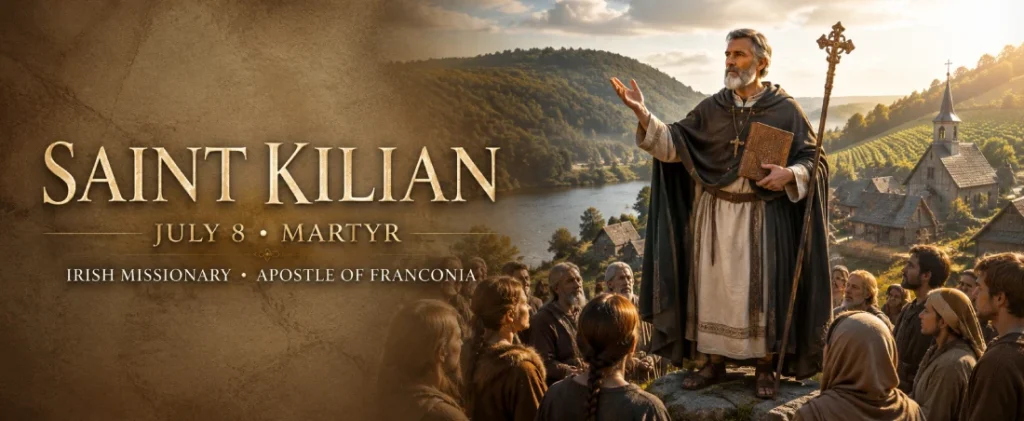
Who Was Saint Kilian?
Saint Kilian was a seventh-century Irish missionary bishop and martyr who gave his life for the Gospel while evangelizing the region of Franconia in present-day Germany. Remembered as the Apostle of Franconia, he is honored for preaching Christ with courage, defending the sanctity of Christian marriage, and remaining faithful to the teachings of the Church even when doing so cost him his life.
More than thirteen centuries after his martyrdom, Catholics continue to celebrate Saint Kilian because his witness speaks to every generation. He reminds us that authentic evangelization requires both charity and truth. His life demonstrates that following Christ sometimes demands great personal sacrifice, but that faithful witness bears fruit far beyond one’s own lifetime.
His feast day is celebrated on July 8, and he remains the patron saint of Würzburg, Franconia, missionaries, and several regional communities in Germany.
Historical Background: Europe in Saint Kilian’s Time
Saint Kilian lived during the late seventh century, when much of western Europe was undergoing profound religious and political change. Christianity had become firmly established throughout the Frankish kingdoms, yet many regions still required deeper evangelization and stronger ecclesiastical organization.
This was also the great age of the Irish missionary movement. Inspired by Christ’s command to proclaim the Gospel to all nations (Matthew 28:19–20), numerous Irish monks left their homeland to preach throughout Europe. Among the most famous were Saint Columbanus and, later, Saint Boniface. Saint Kilian belongs to this remarkable tradition of missionary saints whose dedication helped strengthen the Christian faith across the continent.
Franconia, where Kilian would spend the final years of his life, was governed by local Frankish rulers under the Merovingian dynasty. While Christianity was present, the moral and religious life of the region still required renewal.
Early Life and Formation
Little is known with certainty about Saint Kilian’s childhood. Tradition places his birth around A.D. 640 in what is now County Cavan, Ireland, although the precise location cannot be verified historically.
Likewise, no reliable records survive concerning his parents or family.
What historians do consider highly probable is that Kilian received his education within the flourishing Irish monastic tradition. Irish monasteries were renowned throughout Europe for their devotion to Sacred Scripture, rigorous spiritual discipline, learning, and missionary zeal. It was here that Kilian likely developed the deep love for Christ that would shape the rest of his life.
Answering God’s Call to Become a Missionary
Rather than remain in Ireland, Kilian answered a greater calling.
Accompanied by the priest Saint Colman and the deacon Saint Totnan, he set out to evangelize the peoples of continental Europe.
According to longstanding tradition, the three missionaries first traveled to Rome to receive papal approval before beginning their mission. While this journey cannot be established with complete historical certainty, it reflects the strong relationship that Irish missionaries maintained with the See of Peter.
Their destination eventually became Franconia, centered around the city of Würzburg, where Kilian would spend the remainder of his earthly life.
Saint Kilian’s Missionary Work in Franconia
Upon arriving in Franconia, Kilian began preaching the Gospel with remarkable success.
He instructed converts, baptized new believers, and encouraged Christians to live according to the teachings of Christ. His ministry combined compassionate pastoral care with unwavering fidelity to Catholic doctrine.
Over time, Kilian became recognized as the bishop leading the missionary community in the region. Although many details of his ministry remain unknown, his reputation for holiness and fearless preaching quickly spread.
His greatest success, according to early tradition, was the conversion of Duke Gozbert, one of the region’s most powerful rulers.
Why Saint Kilian Became a Martyr
Saint Kilian is remembered not only because he converted many people, but because he refused to compromise the truth.
After Duke Gozbert accepted Christianity, Kilian confronted him regarding his marriage to Geilana, who had previously been married to the duke’s deceased brother. According to the Church’s canonical discipline, this union was not considered lawful.
Rather than remain silent for political convenience, Kilian fulfilled his duty as a shepherd of souls by teaching what the Church believed to be morally right.
This courageous act ultimately led to his death.
Early Christian tradition states that while Duke Gozbert was away, Geilana ordered the murder of Kilian and his companions, Colman and Totnan.
Although some details of this account come from later hagiographical sources, historians regard Kilian’s martyrdom itself as highly probable and central to his historical identity.
His witness reflects Christ’s own teaching:
“Blessed are those who are persecuted for righteousness’ sake, for theirs is the kingdom of heaven.” (Matthew 5:10)
How Did Saint Kilian Die?
Saint Kilian died around A.D. 689 in Würzburg.
He was martyred alongside Saints Colman and Totnan after refusing to abandon the Church’s teaching concerning marriage.
The exact manner of execution is described differently in later accounts, but the essential historical tradition remains consistent: Kilian willingly accepted death rather than betray the Gospel.
For Catholics, his martyrdom is not remembered simply as a tragic event but as the ultimate witness of faithful discipleship.
Burial, Relics, and Early Veneration
According to early tradition, the bodies of the three martyrs were buried secretly after their execution.
Their relics remained hidden until the eighth century, when they were rediscovered during the missionary reforms associated with Saint Boniface.
This rediscovery greatly strengthened devotion to Saint Kilian throughout Germany.
Today, his relics are venerated in Würzburg, where he continues to be honored as the city’s principal patron and one of Germany’s most beloved missionary saints.
His cult was firmly established by the eighth century, making his veneration one of the earliest enduring traditions of the German Church.
Miracles Associated with Saint Kilian
Unlike many saints, Saint Kilian is not primarily remembered for dramatic miracles performed during his lifetime.
Instead, the miracles associated with him belong mainly to the long history of devotion surrounding his relics.
Throughout the Middle Ages, pilgrims reported healings and favors received through his intercession at his shrine. These accounts formed an important part of local Christian devotion, although they belong to the Church’s traditional testimony rather than historically verifiable events.
The greatest miracle connected with Saint Kilian may be the enduring Christian faith that his missionary work helped establish in Franconia.
What Is Saint Kilian the Patron Saint Of?
Saint Kilian is honored as the patron saint of:
- Würzburg
- Franconia
- Missionaries
- Certain regional winegrowers in Franconia
His patronage of Würzburg and Franconia arises naturally from his missionary work and martyrdom there.
His association with local winegrowers developed through longstanding regional devotion rather than specific events during his lifetime.
Saint Kilian’s Symbols and Iconography
Christian art often depicts Saint Kilian with distinctive symbols that communicate his life and witness.
He is commonly shown wearing a bishop’s vestments, representing his pastoral office.
A sword symbolizes his martyrdom.
A palm branch signifies victory through faithful witness to Christ.
He frequently carries a Gospel book, emphasizing his ministry of preaching.
Many artistic depictions also include Saints Colman and Totnan, reminding viewers that the three missionaries shared both their mission and their martyrdom.
Lessons Catholics Can Learn from Saint Kilian
Saint Kilian’s life offers timeless lessons for every Christian.
Courage to Speak the Truth
He proclaimed God’s law respectfully but without compromise, even before powerful rulers.
Evangelization Begins with Holiness
Kilian’s effectiveness flowed from his own deep spiritual formation before he ever became a missionary.
Fidelity Is More Important Than Popularity
He chose obedience to Christ rather than personal safety or political approval.
The Gospel Changes Lives
His mission transformed communities and laid foundations that endured long after his death.
Every Christian Is Called to Witness
Most believers will never face martyrdom, yet every Catholic is called to bear faithful witness through daily life, charity, and fidelity to Christ.
Saint Kilian’s Enduring Legacy
Although relatively little is known about Saint Kilian’s personal life, his influence has endured for more than thirteen centuries.
He helped establish Christianity more firmly in Franconia.
His witness prepared the way for later missionary work throughout Germany.
His feast continues to be celebrated each year on July 8, especially in Würzburg, where festivals, liturgical celebrations, and pilgrimages commemorate his sacrifice.
Above all, Saint Kilian remains a powerful example of missionary courage rooted in love for Jesus Christ and unwavering fidelity to the Church.
Frequently Asked Questions
Who was Saint Kilian?
Saint Kilian was a seventh-century Irish missionary bishop and martyr who evangelized Franconia in present-day Germany and became known as the Apostle of Franconia.
What is Saint Kilian known for?
He is best known for preaching the Gospel, converting many people in Franconia, defending the Church’s teaching on marriage, and accepting martyrdom rather than compromise his faith.
When is Saint Kilian’s feast day?
The Catholic Church celebrates Saint Kilian on July 8.
What is Saint Kilian the patron saint of?
He is the patron saint of Würzburg, Franconia, missionaries, and certain regional winegrowers.
How did Saint Kilian die?
Around A.D. 689, he was martyred in Würzburg together with Saints Colman and Totnan after opposing an unlawful marriage involving the local ruling family.
Was Saint Kilian Irish?
Yes. Historical tradition consistently identifies him as an Irish missionary who left his homeland to preach the Gospel in continental Europe.
Where are Saint Kilian’s relics?
His relics are venerated in Würzburg, Germany, where his shrine has been a center of pilgrimage and devotion for centuries.
Why is Saint Kilian called the Apostle of Franconia?
He earned this title because his missionary work played a foundational role in spreading and strengthening Christianity throughout the Franconian region.
Did Saint Kilian perform miracles?
No miracles from his lifetime are historically established. Later Christian tradition records healings and favors received through his intercession at his shrine.
What can Catholics learn from Saint Kilian today?
Saint Kilian teaches that authentic discipleship requires courage, fidelity to Christ, love for the truth, and a willingness to proclaim the Gospel with both charity and conviction.
Conclusion
Saint Kilian’s story is not one of earthly success measured by power or longevity, but of faithful perseverance in the service of Christ. Leaving the security of his homeland, he embraced the demanding work of evangelization, preached the Gospel without compromise, and ultimately sealed his witness with his blood.
History remembers him as the Apostle of Franconia, but the Church honors him above all as a faithful disciple whose life reflected the words of Christ: “Whoever loses his life for my sake will find it” (Matthew 16:25).
His example continues to inspire missionaries, clergy, catechists, and lay faithful throughout the world. In an age when speaking the truth can still carry great personal cost, Saint Kilian reminds us that holiness is found not in comfort but in faithful obedience to Jesus Christ. His legacy endures in the Church he helped strengthen, in the faithful who continue to seek his intercession, and in every Christian who chooses courage over compromise in living the Gospel.