
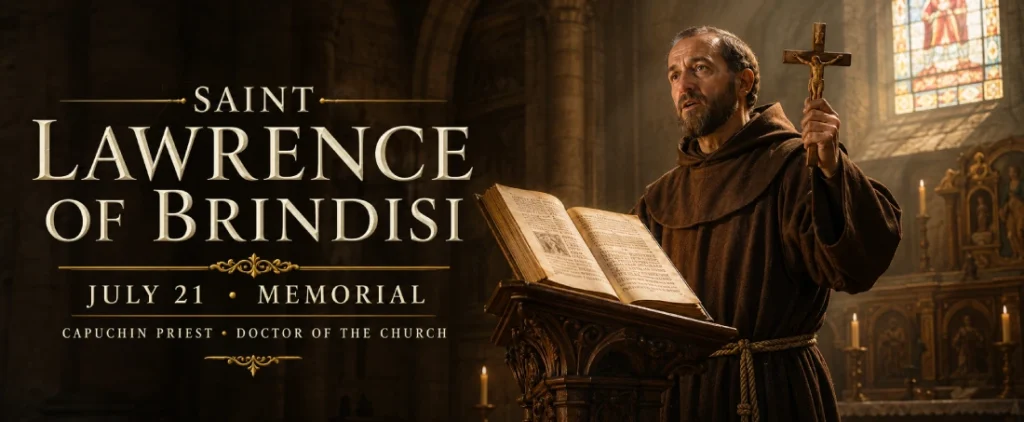
Few saints combined profound holiness with remarkable intellectual gifts as completely as Saint Lawrence of Brindisi. A gifted preacher, biblical scholar, diplomat, and Capuchin friar, he dedicated his life to proclaiming Christ during one of the most turbulent periods in Christian history. His extraordinary knowledge of Scripture, deep love for the Eucharist, and unwavering loyalty to the Catholic Church earned him a lasting place among the Church’s greatest teachers. In 1959, Pope St. John XXIII declared him a Doctor of the Church, recognizing the enduring value of his theological writings and preaching.
Although he lived more than four centuries ago, Saint Lawrence continues to inspire Catholics with his example of faith, humility, courage, and devotion to God’s Word.
Who Was Saint Lawrence of Brindisi?
Saint Lawrence of Brindisi was born Giulio Cesare Russo on July 22, 1559, in the port city of Brindisi in southern Italy, then part of the Kingdom of Naples. After entering the Capuchin branch of the Franciscan Order, he received the religious name Lawrence.
He lived during the Counter-Reformation, when the Catholic Church was responding to the Protestant Reformation while also facing political upheaval and the expanding Ottoman Empire. In this challenging era, Lawrence became one of the Church’s most respected preachers and theologians.
His feast day is celebrated on July 21 in the General Roman Calendar.
Early Life and Religious Formation
Lawrence lost his father while still a child, and his mother died a few years later. Despite these early hardships, he received an excellent education in Brindisi and later in Venice.
Even as a young man, he displayed an extraordinary aptitude for languages. In addition to Italian and Latin, he became proficient in Greek, Hebrew, German, Spanish, French, and several other languages. His knowledge of Hebrew was particularly unusual for a Christian scholar of his time and enabled him to study the Old Testament in its original language.
At the age of sixteen, he entered the Capuchin Franciscans, embracing a life of poverty, prayer, and preaching inspired by Saint Francis of Assisi.
A Preacher Rooted in Scripture
Ordained a priest in 1582, Lawrence quickly became known as one of Europe’s finest Catholic preachers.
His sermons were remarkable not because of dramatic rhetoric but because they flowed directly from Sacred Scripture. He frequently quoted lengthy biblical passages from memory and explained them with clarity and fidelity to Catholic teaching.
His preaching reflected the words of Saint Paul:
“Preach the word; be persistent whether it is convenient or inconvenient.” (2 Timothy 4:2)
Lawrence believed that every Catholic should know Christ through the Scriptures while remaining faithful to the teaching authority of the Church. His ministry demonstrated that Scripture and Sacred Tradition belong together rather than standing in opposition.
Defending the Catholic Faith
The sixteenth century was marked by intense theological debate following the Protestant Reformation. Lawrence became one of the Church’s most effective defenders of Catholic doctrine.
Rather than relying on personal attacks, he answered objections through careful biblical explanation. His deep familiarity with both the Old and New Testaments allowed him to engage Jews, Protestants, and Catholics with remarkable confidence and charity.
He also helped establish new Capuchin communities across Europe, strengthening Catholic renewal in regions where the Church faced significant challenges.
Leader of the Capuchin Order
Lawrence’s wisdom and leadership led to his election as Minister General of the Capuchin Order in 1602.
As the Order’s highest superior, he traveled extensively, visiting friars, encouraging faithful observance of Franciscan life, and promoting sound theological formation. He insisted that intellectual excellence should always be accompanied by humility, prayer, and charity.
His leadership contributed significantly to the growth and stability of the Capuchins during the Counter-Reformation.
Diplomat and Servant of Peace
Lawrence’s abilities extended beyond preaching. Several popes entrusted him with delicate diplomatic missions involving Catholic rulers throughout Europe.
He sought reconciliation where political conflicts threatened both peace and the unity of the Church. His work required courage, wisdom, and impartiality, qualities that earned him widespread respect.
In 1601, he accompanied Christian forces during a campaign against the Ottoman Empire in Hungary. Historical sources confirm that he served as a chaplain and spiritual leader, encouraging soldiers through prayer and the proclamation of Christ. Later traditions credit his presence with inspiring the army’s victory, although these accounts should be understood as devotional tradition rather than established historical fact.
Spiritual Life
At the center of Lawrence’s life was a profound relationship with Jesus Christ.
His spirituality rested on several pillars:
- Deep love for Sacred Scripture
- Devotion to the Holy Eucharist
- Prayer rooted in Franciscan simplicity
- Great love for the Blessed Virgin Mary
- Complete obedience to the Church
For Lawrence, theological knowledge was never merely academic. Every study of Scripture was intended to deepen love for Christ and strengthen the faith of others.
Writings and Legacy
Saint Lawrence left behind an extensive collection of sermons, biblical commentaries, and theological works.
His writings reveal an extraordinary command of Scripture and demonstrate how Catholics can interpret the Bible faithfully within the living tradition of the Church.
Because of these lasting contributions, Pope Saint John XXIII proclaimed him a Doctor of the Church in 1959, affirming that his teaching continues to benefit the entire Church.
Death and Burial
While serving on another diplomatic mission, Lawrence became ill and died in Lisbon, Portugal, on July 22, 1619, his sixtieth birthday.
His body was later transferred to the Monastery of the Annunciation of the Poor Clares in Villafranca del Bierzo, Spain, where his relics continue to be honored.
His reputation for holiness spread rapidly after his death, leading to his beatification in 1783 and canonization by Pope Leo XIII in 1881.
Patronage and Symbols
Saint Lawrence of Brindisi is especially associated with his hometown of Brindisi and is honored throughout the Capuchin Franciscan family.
In sacred art, he is commonly depicted with:
- A Capuchin habit, symbolizing Franciscan poverty.
- A Bible, representing his mastery of Sacred Scripture.
- A crucifix, reflecting his Christ-centered preaching.
- A lily, symbolizing purity.
- A book or scroll, recalling his theological writings.
What Can Catholics Learn from Saint Lawrence of Brindisi?
Saint Lawrence offers timeless lessons for modern Christians.
He reminds us that faith and reason work together rather than against one another. He shows that studying Scripture should lead to a deeper love for Christ, not merely greater knowledge. His life demonstrates that defending the faith requires charity as much as conviction.
His example also challenges Catholics to unite prayer with action. Whether preaching, writing, leading religious communities, or serving as a diplomat, Lawrence never separated his public work from his personal holiness.
In an age often marked by division and confusion, his life encourages believers to remain firmly rooted in Christ, faithful to the Church, and confident in the transforming power of God’s Word.
Frequently Asked Questions
Who was Saint Lawrence of Brindisi?
Saint Lawrence of Brindisi was a Capuchin Franciscan priest, biblical scholar, preacher, diplomat, and Doctor of the Church who lived from 1559 to 1619.
Why is Saint Lawrence of Brindisi important?
He played a major role in the Catholic Counter-Reformation through his preaching, theological writings, diplomatic service, and leadership of the Capuchin Order.
What is Saint Lawrence of Brindisi known for?
He is especially known for his extraordinary knowledge of Sacred Scripture, his multilingual scholarship, his powerful preaching, and his defense of the Catholic faith.
When is Saint Lawrence of Brindisi’s feast day?
His feast day is celebrated on July 21 in the General Roman Calendar.
What is Saint Lawrence of Brindisi the patron saint of?
He is closely associated with the city of Brindisi and is especially honored within the Capuchin Franciscan tradition.
What miracles are associated with Saint Lawrence of Brindisi?
The Church investigated miracles attributed to his intercession during his beatification and canonization. Traditional accounts also associate him with inspiring Christian soldiers during the Hungarian campaign of 1601, though this should be understood as pious tradition rather than certain historical fact.
Why was Saint Lawrence of Brindisi declared a Doctor of the Church?
He received the title because of the exceptional theological depth of his sermons, biblical scholarship, and enduring contribution to Catholic doctrine.
Conclusion
Saint Lawrence of Brindisi stands among the Church’s greatest examples of scholarship placed at the service of holiness. He showed that a brilliant mind reaches its highest purpose when devoted to Christ and His Church. Through his preaching, writings, diplomacy, and humble Franciscan witness, he helped strengthen the Catholic faith during one of history’s most difficult periods.
His legacy continues to inspire priests, religious, scholars, catechists, and lay faithful alike. In every generation, Saint Lawrence reminds us that the deepest knowledge of Scripture is found not merely in study, but in a life transformed by Jesus Christ and lived in faithful service to the Gospel.