Few saints have been as widely misunderstood—and yet as deeply loved—as Saint Mary Magdalene. Mention her name, and many people immediately think of myths, novels, or mistaken traditions. Yet the woman revealed in Sacred Scripture is far more remarkable than the legends that later surrounded her.
Saint Mary Magdalene was one of Jesus Christ’s most faithful disciples. She stood near the Cross when many others fled. She witnessed His burial. On Easter morning, she became the first person recorded in the Gospel of John to encounter the risen Lord. Christ Himself entrusted her with announcing the Resurrection to the Apostles, earning her the ancient Christian title “Apostle to the Apostles” (Apostola Apostolorum).
For nearly two thousand years, Catholics have honored Mary Magdalene as a model of faithful discipleship, courageous witness, and unwavering hope. Her feast is celebrated on July 22, and in 2016 Pope Francis elevated her liturgical celebration to a Feast, highlighting the importance of her role in salvation history.
Her story reminds every Christian that no past is beyond Christ’s mercy and that every believer is called to proclaim the Good News.
Who Was Saint Mary Magdalene?
Mary Magdalene was a Jewish woman from Magdala, a prosperous town on the western shore of the Sea of Galilee. The Gospels identify her by her hometown rather than by a husband or father, distinguishing her from the other women named Mary.
The first clear biblical description appears in Luke’s Gospel:
Jesus had cast seven demons out of her, after which she became one of the women who accompanied Him and helped support His ministry.
The expression “seven demons” demonstrates the completeness of Christ’s healing. Scripture does not explain the exact nature of her affliction, and the Church does not speculate beyond what the Gospel reveals.
After experiencing Christ’s healing, Mary devoted herself completely to following Him.
The Historical World of Mary Magdalene
Mary Magdalene lived during the first century under Roman rule.
Galilee and Judea were governed by local rulers such as Herod Antipas while remaining under the authority of the Roman Empire. Religious life centered on the Temple in Jerusalem, and many Jews longed for the coming of the Messiah.
Within this world, women generally held limited public authority. Yet the Gospels repeatedly show women among Christ’s closest followers. Luke specifically records that Mary Magdalene, together with other holy women, helped provide financial support for Jesus and His disciples.
This historical setting makes her later role as the first witness of the Resurrection all the more extraordinary.
Was Mary Magdalene a Prostitute?
One of the most common questions people ask is whether Mary Magdalene was a prostitute.
The answer is no—not according to Sacred Scripture.
The Bible never identifies Mary Magdalene as a prostitute.
For centuries in Western Christianity, she was commonly associated with the unnamed sinful woman in Luke 7 and with Mary of Bethany, the sister of Martha and Lazarus. This identification became widespread after a sixth-century homily by Pope Gregory the Great.
Today, the Catholic Church distinguishes these women because Scripture itself does not identify them as the same person.
Rather than diminishing Mary Magdalene, this clarification allows the biblical portrait to shine more clearly: she is honored because of her faithful discipleship and witness to the Resurrection, not because of a presumed past that Scripture never attributes to her.
Following Christ
After Christ freed her from demonic oppression, Mary Magdalene became one of His devoted followers.
Luke tells us that she accompanied Jesus throughout His public ministry alongside several other women who helped provide for His mission.
This simple detail reveals much about her character.
She did not merely admire Jesus from a distance. She followed Him, served Him, and remained faithful even when discipleship became dangerous.
Mary Magdalene at the Cross
The Passion of Christ tested every disciple.
Many fled in fear.
Mary Magdalene did not.
All four Gospels place her among the women who remained faithful during Christ’s suffering or immediately afterward. She stood near Calvary, witnessing His Crucifixion with profound sorrow yet unwavering fidelity.
Her presence at the Cross demonstrates one of the defining virtues of Christian discipleship: remaining with Christ even when hope seems lost.
Witness of the Burial
Following Jesus’ death, Mary Magdalene witnessed His burial.
This detail is historically important.
Because she observed where Jesus was laid, her discovery of the empty tomb cannot reasonably be dismissed as confusion over the burial location.
The Gospel narratives intentionally connect these events through eyewitness testimony.
The First Witness of the Resurrection
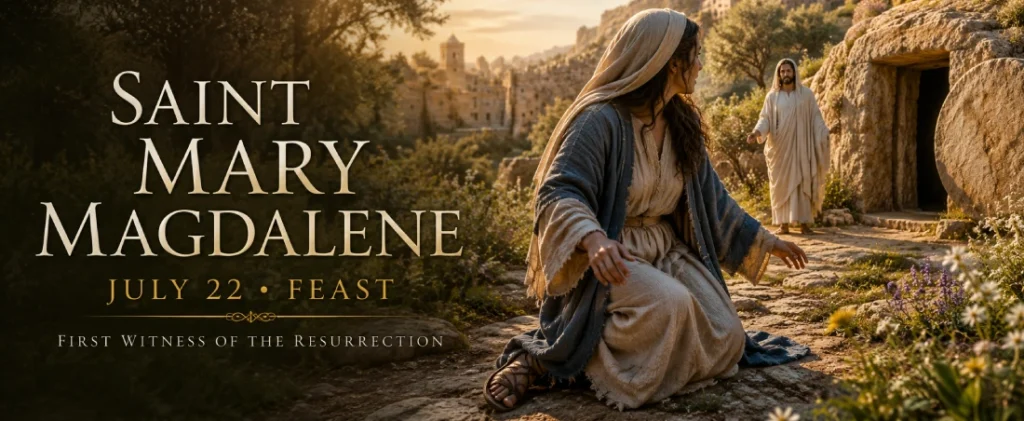
Early on the first day of the week, Mary Magdalene returned to the tomb.
Instead of finding Christ’s body, she found the stone rolled away.
In John’s Gospel, after Peter and the beloved disciple departed, Mary remained outside weeping.
Then came one of the most moving moments in all of Scripture.
The risen Jesus simply spoke her name:
“Mary.”
Immediately she recognized Him.
This encounter transformed grief into joy.
Christ then entrusted her with a mission:
Go and tell the disciples that He had risen.
For this reason, the Church has long called Mary Magdalene the Apostle to the Apostles—not because she belonged to the Twelve, but because she became the first messenger of Easter.
Why Is Saint Mary Magdalene Important?
Mary Magdalene occupies a unique place in Christian history because she was:
- healed personally by Christ,
- one of His faithful disciples,
- present during His Passion,
- witness to His burial,
- among the first at the empty tomb,
- and the first person commissioned by the risen Christ to proclaim His Resurrection.
Without her witness, one of Christianity’s central historical events would lack one of its earliest recorded eyewitnesses.
What Happened to Mary Magdalene After the Resurrection?
The New Testament says nothing further about Mary’s life after Easter.
Several traditions developed over the centuries.
One tradition places her in Ephesus, where she is associated with Saint John.
Another, especially popular in medieval France, claims she traveled to Provence, lived as a hermit, and was later buried there.
These traditions have inspired centuries of devotion but cannot be confirmed historically.
The Church distinguishes these pious traditions from the historically certain events recorded in Scripture.
Miracles Associated with Saint Mary Magdalene
The Biblical Miracle
The only miracle directly associated with Mary Magdalene during her earthly life is Christ’s deliverance of her from seven demons.
Her greatest privilege, however, was not performing miracles but witnessing the greatest miracle in history—the Resurrection of Jesus Christ.
Traditional Accounts
Later traditions describe miraculous events connected with her missionary activity and later life.
These accounts have devotional value but should not be presented as established historical fact.
Did Mary Magdalene Write a Gospel?
Another frequently asked question concerns the Gospel of Mary.
This ancient text is not part of Sacred Scripture.
It was written centuries after Christ and does not belong to the canonical books recognized by the Catholic Church.
The Church bases its understanding of Mary Magdalene on the four canonical Gospels and Apostolic Tradition rather than on later apocryphal writings.
Burial and Relics
The exact location of Mary Magdalene’s burial remains historically uncertain.
Two principal traditions exist:
- Ephesus, associated with early Eastern Christian tradition.
- Saint-Maximin-la-Sainte-Baume in France, associated with medieval Western tradition.
Because no contemporary historical evidence definitively confirms either location, the Church does not present one as historically certain.
Why Is Saint Mary Magdalene Called the Apostle to the Apostles?
This beautiful title reflects Christ’s own commission.
After His Resurrection, Jesus entrusted Mary Magdalene with announcing the Good News to the Apostles before anyone else.
She was not one of the Twelve Apostles.
Rather, she became the first herald of the Resurrection.
The title recognizes the dignity of her mission and the trust Christ placed in her faithful witness.
Feast Day of Saint Mary Magdalene
The Church celebrates Saint Mary Magdalene on July 22.
In 2016, Pope Francis elevated her liturgical observance from a Memorial to a Feast, emphasizing the importance of women in the Church’s mission and recognizing Mary’s unique role as the first witness of the Resurrection.
What Is Saint Mary Magdalene the Patron Saint Of?
Saint Mary Magdalene is traditionally invoked as the patron saint of:
- penitents,
- converts,
- contemplatives,
- women,
- perfumers,
- hairdressers,
- and those seeking freedom from temptation.
Some of these patronages arise directly from her biblical witness, while others developed through centuries of Christian devotion.
Symbols of Saint Mary Magdalene
Christian art often portrays Mary Magdalene with symbols that express her spiritual significance.
The most common include:
- An alabaster jar, recalling burial spices and later devotional tradition.
- A cross, representing her fidelity during Christ’s Passion.
- A garden, recalling her encounter with the risen Christ near the tomb.
- A book or scroll, symbolizing her proclamation of the Resurrection.
- A red egg in Eastern Christianity, representing the triumph of the Resurrection.
These symbols teach theological truths even when they are not direct historical descriptions.
What Catholics Can Learn from Saint Mary Magdalene
Mary Magdalene speaks powerfully to Christians today.
She teaches us that Christ’s mercy can completely transform a life.
She shows that authentic discipleship means remaining faithful even during suffering.
She reminds us that grief can become hope through the Resurrection.
Her example encourages every Christian to become a witness to Christ rather than merely an admirer of Him.
Above all, she demonstrates that those who remain close to Jesus often become the first to recognize His presence.
Frequently Asked Questions
Who was Saint Mary Magdalene?
Saint Mary Magdalene was one of Jesus Christ’s closest female disciples. After Christ delivered her from seven demons, she followed Him faithfully, witnessed His Crucifixion and burial, and became the first witness of His Resurrection according to the Gospel of John.
Why is Mary Magdalene important?
She is important because Christ entrusted her with announcing His Resurrection to the Apostles, making her the Church’s first witness of Easter.
Was Mary Magdalene a prostitute?
No. Scripture never identifies Mary Magdalene as a prostitute. The Catholic Church today distinguishes her from the unnamed sinful woman in Luke 7 and from Mary of Bethany.
What is Saint Mary Magdalene the patron saint of?
She is traditionally the patron saint of penitents, converts, contemplatives, women, perfumers, hairdressers, and those seeking strength against temptation.
When is Saint Mary Magdalene’s feast day?
Her feast is celebrated each year on July 22.
How did Saint Mary Magdalene die?
The New Testament does not record her death. Later traditions place her either in Ephesus or southern France, but no historical evidence definitively confirms either account.
Where are Saint Mary Magdalene’s relics?
Several churches claim relics associated with Saint Mary Magdalene, particularly in France, but historians cannot verify the exact location of her burial.
Did Mary Magdalene write a Gospel?
No canonical Gospel was written by Mary Magdalene. The later Gospel of Mary is an apocryphal text and is not recognized as Sacred Scripture by the Catholic Church.
Why is she called the Apostle to the Apostles?
Because the risen Jesus commissioned her to announce His Resurrection to the Apostles before anyone else.
What can Catholics learn from Saint Mary Magdalene?
Her life teaches the power of Christ’s mercy, steadfast faith in times of suffering, perseverance in seeking the Lord, and the courage to proclaim the Gospel.
Conclusion
Saint Mary Magdalene stands at the heart of the Gospel story—not because of worldly status or extraordinary power, but because of her unwavering love for Jesus Christ. He healed her, she followed Him faithfully, remained at the Cross when others fled, and became the first witness entrusted with proclaiming the Resurrection. Her life bridges Good Friday and Easter morning, reminding the Church that hope is born through fidelity to Christ.
The historical Mary Magdalene is even more inspiring than the legends that later surrounded her. She is a real disciple whose life is firmly rooted in the Gospel accounts and whose witness continues to strengthen believers across the world. Every July 22, the Church honors her not only for what she received from Christ, but for what she courageously shared with others.
In every generation, her voice still echoes the first Easter proclamation: the Lord is risen. And through her example, Catholics are invited to seek Christ with the same faithful heart, recognize Him when He calls them by name, and carry the joy of the Resurrection into the world.