
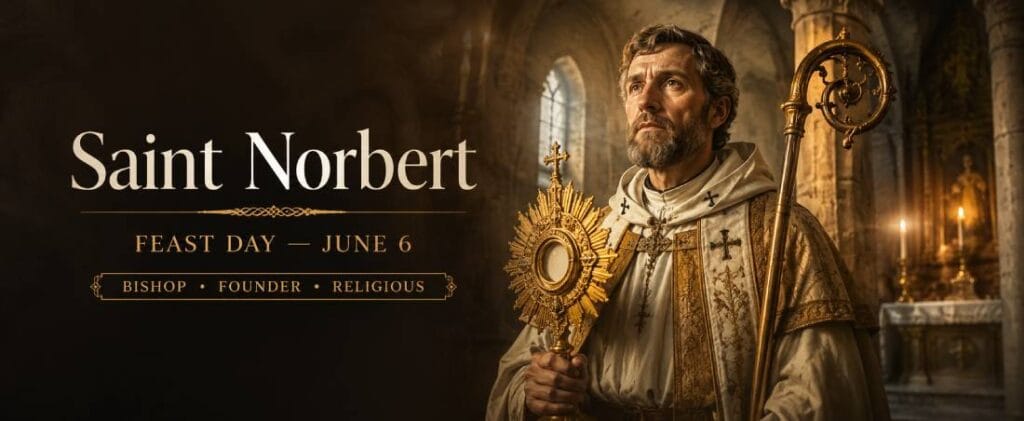
Among the great reformers of the medieval Church, few saints combined deep contemplative prayer with courageous public action as powerfully as Saint Norbert of Xanten. Known for his fiery preaching, intense Eucharistic devotion, radical poverty, and unwavering defense of Church unity, Saint Norbert stands as one of the most influential spiritual figures of the 12th century.
His life was not one of instant sanctity. Before becoming a saint, Norbert lived comfortably within aristocratic society and enjoyed the privileges of wealth and influence. Yet God called him away from worldly ambition into a life of penance, prayer, and total surrender. His transformation became so profound that he would later found the Premonstratensian Order, reform clergy, confront heresy, and lead countless souls back to reverence for the Holy Eucharist.
For Catholics today, Saint Norbert offers a compelling witness that holiness begins in conversion, deepens through prayer, and flourishes through sacrificial love. His life reminds believers that true reform in the Church always starts with personal sanctity before public mission.
Early Life and Historical Background
Saint Norbert was born around the year 1080 in Xanten, in the Rhineland region of the Holy Roman Empire, in present-day Germany. Born into noble aristocratic society, Norbert was raised amid wealth, privilege, and political influence. His family was connected to the imperial court, and as a young man he enjoyed opportunities unavailable to ordinary people of his era.
Rather than immediately pursuing a deeply spiritual life, Norbert initially embraced many comforts associated with noble culture. He became a canon attached to the collegiate church of Xanten and later served at the imperial court of Emperor Henry V. Historical records suggest that although he held ecclesiastical positions, he did not yet live with the radical holiness that would later define him.
The medieval Church during Norbert’s lifetime faced significant corruption and spiritual decline in many regions. Clerical worldliness, lax discipline, and political interference weakened ecclesiastical life. God would raise saints like Norbert to renew holiness from within.
A dramatic moment changed his life forever.
While traveling on horseback near the German village of Vreden, Norbert was caught in a violent thunderstorm. A lightning bolt struck near him, throwing him from his horse. Believing himself near death, he cried out to God for mercy. Much like the conversion of Saint Paul the Apostle on the road to Damascus, this terrifying experience became the turning point of Norbert’s soul.
He abandoned his former worldly ambitions and began a life of deep repentance, prayer, fasting, and evangelical zeal.
Calling and Spiritual Transformation
After his conversion, Norbert embraced a far stricter and holier form of Christian living. He renounced much of his wealth and dedicated himself to reforming his soul through prayer and penance.
He sought spiritual direction and eventually received priestly ordination. Unlike many clergy of his era who enjoyed social status and luxury, Norbert chose simplicity and austerity. He often walked barefoot, wore humble clothing, fasted rigorously, and spent long hours in prayer.
His preaching quickly gained attention because it flowed from authentic holiness rather than mere intellectual skill. People saw in Norbert a man transformed by grace. His sermons called Christians to repentance, Eucharistic reverence, and obedience to the Church.
Around 1120, Norbert founded the Premonstratensian Order at Prémontré in France. The community combined contemplative prayer with active pastoral ministry. Members lived according to the Rule of Saint Augustine while emphasizing communal poverty, liturgical prayer, missionary preaching, and Eucharistic devotion.
The order spread rapidly across Europe because people hungered for genuine spiritual renewal. Norbert’s reform was never merely administrative; it was deeply sacramental and rooted in prayer before God.
The Prayer Life of Saint Norbert
The heart of Saint Norbert’s holiness was his intense life of prayer.
Historical traditions consistently portray him as a man deeply devoted to the Holy Eucharist. He spent long hours before the Blessed Sacrament and encouraged priests to celebrate Mass with reverence, purity, and humility. At a time when Eucharistic faith was being challenged in some regions, Norbert boldly defended the Real Presence of Christ.
His spirituality centered on the conviction that authentic renewal comes only through intimacy with God.
Norbert’s prayer life included:
- prolonged meditation
- chanting of the Divine Office
- Eucharistic adoration
- fasting
- silence
- penitential disciplines
- contemplation of Christ’s Passion
Unlike purely academic reformers, Norbert believed holiness required interior transformation. He understood that prayer purified the soul and strengthened the heart for sacrifice.
His devotion to the liturgy was especially significant. The Premonstratensians became known for solemn communal worship and fidelity to the Church’s liturgical tradition. Norbert saw sacred worship not merely as ritual obligation but as participation in heavenly realities.
He also practiced severe fasting and bodily discipline. Medieval saints often embraced penance as a means of sharing spiritually in Christ’s sufferings and overcoming attachment to worldly comforts. Norbert’s asceticism was never self-centered; it was directed toward deeper love for God.
His life illustrates a timeless Catholic truth: prayer is not escape from mission but preparation for mission.
Devotions, Sacrifices, and Spiritual Practices
Saint Norbert’s spirituality was deeply Eucharistic and pastoral.
One of the most famous aspects of his ministry was his defense of the Blessed Sacrament against heretical teachings that denied Christ’s true presence in the Eucharist. Norbert courageously confronted these errors publicly, helping preserve orthodox Catholic doctrine during a period of theological confusion.
His sacrifices were immense.
He traveled constantly throughout Europe preaching reform, often enduring exhaustion, opposition, and physical hardship. Roads were dangerous in the 12th century, and missionary journeys involved real personal risk. Yet Norbert willingly embraced discomfort for the salvation of souls.
He also accepted administrative burdens reluctantly but obediently. In 1126 he became Archbishop of Magdeburg, a difficult and politically troubled diocese. Rather than seeking power, Norbert viewed episcopal leadership as a form of sacrificial service.
As bishop, he continued advocating clerical reform, discipline, and reverent worship. His leadership frequently angered powerful figures who resisted change. Yet he remained steadfast because his loyalty belonged first to Christ and His Church.
Norbert also demonstrated profound charity toward the poor. Medieval accounts emphasize his generosity and personal simplicity even while holding high ecclesiastical office.
Though explicit Marian writings from Norbert are limited, the spirituality of his order reflected traditional medieval devotion to the Blessed Virgin Mary, especially through liturgical prayer and Marian feasts.
Trials, Suffering, and Faithfulness
Like many reforming saints, Norbert encountered severe opposition.
Clergy resistant to reform criticized him. Political leaders viewed his influence with suspicion. Some even attempted violence against him during his preaching missions. Yet these sufferings purified his mission rather than weakening it.
As Archbishop of Magdeburg, Norbert faced intense political conflict involving Church authority and imperial influence. The broader Investiture Controversy still affected relations between secular rulers and ecclesiastical leadership during his lifetime.
Norbert’s response to suffering reflected deep spiritual maturity. He did not seek conflict for its own sake, but neither did he compromise truth for comfort.
His endurance came from prayer.
The saint understood that fidelity to Christ often requires perseverance through misunderstanding, rejection, and sacrifice. His life mirrored the Gospel principle that authentic shepherds must sometimes suffer for the protection of the flock.
Near the end of his life, Norbert continued working tirelessly despite declining health. He died on June 6, 1134, in Magdeburg.
His reputation for holiness spread rapidly after his death.
Legacy in the Catholic Church
Saint Norbert’s influence on the Catholic Church remains profound centuries later.
The Premonstratensian Order, also called the Norbertines, expanded throughout Europe and continues serving the Church today through parish ministry, education, missionary work, and liturgical life.
Norbert’s reform efforts strengthened Eucharistic devotion during a critical period of Church history. His witness helped preserve reverence for the Blessed Sacrament and inspired future generations of clergy and religious.
He was canonized by Pope Gregory XIII in 1582.
Today, Saint Norbert is especially remembered as:
- a defender of the Eucharist
- a reformer of clergy
- a founder of religious life
- a preacher of repentance
- a model of pastoral holiness
- a witness to sacrificial leadership
Churches, abbeys, schools, and religious communities around the world continue bearing his name.
His relics are venerated in Prague at the Abbey of Strahov, where pilgrims still honor his memory.
What Catholics Can Learn Today
Modern Catholics can learn much from Saint Norbert’s life.
First, his conversion reminds believers that holiness can begin at any stage of life. Even those attached to worldly success can be transformed by grace.
Second, Norbert teaches that Eucharistic devotion must shape Christian living. Reverence toward the Blessed Sacrament is not optional sentimentality but the center of Catholic spirituality.
Third, he demonstrates that authentic reform begins with personal repentance. Rather than merely criticizing problems in the Church, Norbert first purified his own life through prayer and sacrifice.
His example also challenges Catholics to rediscover silence and contemplation. Modern culture often promotes distraction, noise, and superficiality. Norbert’s life shows the spiritual power of disciplined prayer.
Finally, he reveals that courage and charity must remain united. He defended truth firmly without abandoning pastoral concern for souls.
Saint Norbert’s witness remains especially relevant in an age when many Catholics seek deeper reverence, stronger Eucharistic faith, and authentic spiritual renewal.
Conclusion
Saint Norbert was far more than a medieval administrator or religious founder. He was a man radically transformed by encounter with God.
His life flowed from prayer into mission, from Eucharistic devotion into courageous reform, and from personal sacrifice into lasting spiritual renewal for the Church.
In an era marked by confusion and compromise, Norbert became a beacon of holiness because he allowed grace to reshape every aspect of his life.
For Catholics seeking deeper faith today, Saint Norbert offers a timeless example of what happens when prayer becomes the center of existence. His witness continues calling believers toward reverence, repentance, sacrificial love, and unwavering devotion to Christ truly present in the Holy Eucharist.