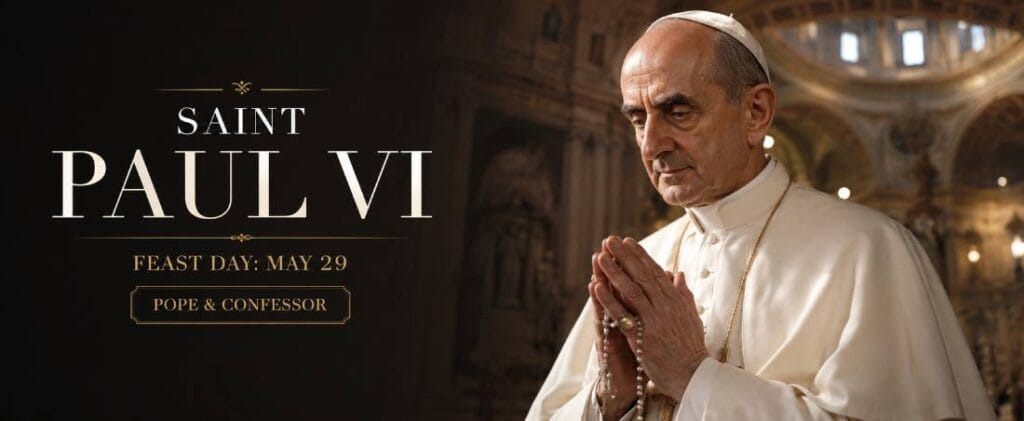
Among the modern successors of Saint Peter, few figures shaped the spiritual and historical life of the Catholic Church as profoundly as Saint Paul VI. Remembered as the pope who courageously guided the Church through the completion and implementation of the Second Vatican Council, Paul VI was far more than a reformer or diplomat. He was a deeply prayerful man whose interior life sustained him through years of controversy, suffering, loneliness, and immense responsibility.
Born Giovanni Battista Montini, Saint Paul VI devoted his life to Christ and His Church with remarkable humility and sacrifice. Behind the public image of a thoughtful intellectual pope was a soul profoundly rooted in contemplation, Eucharistic devotion, Marian spirituality, and obedience to God. His pontificate unfolded during one of the most turbulent periods in modern Catholic history, yet he remained steadfast in prayer, convinced that holiness and fidelity—not popularity—must guide the Church.
For Catholics today, Saint Paul VI stands as a witness to courageous faithfulness in difficult times. His life teaches the importance of prayerful discernment, perseverance under criticism, devotion to Christ in the Eucharist, and unwavering trust in divine providence.
Early Life and Historical Background
Saint Paul VI was born Giovanni Battista Enrico Antonio Maria Montini on September 26, 1897, in Concesio near Brescia in northern Italy. He was born into a devout Catholic family deeply involved in public service and Catholic social action. His father, Giorgio Montini, was a journalist, lawyer, and member of the Italian parliament, while his mother, Giuditta Alghisi, nurtured the spiritual life of the family with quiet devotion.
From a young age, Giovanni Battista demonstrated intellectual brilliance and deep sensitivity. Frail health prevented him from participating fully in ordinary childhood activities, leading him instead toward study, prayer, and contemplation. This physical weakness would remain with him throughout life and shaped his disciplined spiritual character.
He entered the seminary in Brescia and was ordained a priest in 1920. Soon afterward, he pursued studies in philosophy, canon law, and diplomacy. His talents led him into the Vatican diplomatic service, where he became known for prudence, intelligence, and deep spiritual seriousness.
Father Montini eventually served closely under Pope Pius XII and became one of the Vatican’s most trusted collaborators. In 1954, he was appointed Archbishop of Milan, where he dedicated himself to workers, the poor, and the spiritual renewal of the faithful in an increasingly industrialized society.
In 1963, following the death of Pope John XXIII, Cardinal Montini was elected pope and took the name Paul VI in honor of the Apostle Paul, whose missionary zeal he deeply admired.
Calling and Spiritual Transformation
The life of Saint Paul VI reveals a man continually transformed by prayer and surrender to God’s will. Though gifted intellectually and politically, he never viewed the priesthood or papacy as positions of prestige. He regarded them as burdens of service entrusted to him by Christ.
His spirituality centered on profound interior examination. Those who knew him often described him as reserved, introspective, and deeply contemplative. Unlike naturally charismatic figures, Paul VI carried the cross of leadership with visible seriousness. He frequently wrestled spiritually with the immense responsibilities placed upon him.
As pope, he faced ideological divisions, cultural upheaval, declining religious practice, confusion following the Council, and criticism from both progressives and traditionalists. Yet through these storms, he consistently returned to prayer.
Paul VI believed that authentic renewal in the Church could never come merely through structures or policies. It had to emerge from holiness, conversion, and intimacy with Christ.
His spiritual life was marked by silence, reflection, and disciplined devotion. He spent long hours in private prayer despite overwhelming responsibilities. Even amid global travel and diplomatic engagements, he remained fundamentally a man of contemplation.
The Prayer Life of Saint Paul VI
The heart of Saint Paul VI’s holiness was his prayer life. Prayer was not merely part of his routine; it was the source from which his entire ministry flowed.
He maintained profound devotion to the Holy Eucharist and frequently emphasized Eucharistic adoration as essential for the life of the Church. He believed modern humanity suffered from spiritual emptiness because it had lost the sense of God’s presence.
Paul VI often spoke about the necessity of silence before God. In an increasingly noisy and distracted modern world, he urged Catholics to rediscover contemplation and interior recollection.
One of his most significant teachings on prayer came through his apostolic writings and homilies, where he repeatedly called the faithful to personal holiness. He encouraged priests, religious, and laypeople alike to cultivate daily prayer, meditation on Scripture, sacramental life, and fidelity to Christ.
His devotion to Christ crucified shaped his entire spirituality. The suffering he endured during his pontificate became united with the Passion of Jesus. Those close to him testified that criticism deeply wounded him personally, yet he accepted these sufferings with humility and restraint.
Paul VI also possessed strong Marian devotion. He promoted the Blessed Virgin Mary as Mother of the Church during the Second Vatican Council and consistently entrusted the Church’s future to her maternal intercession.
The Rosary, Marian feasts, and contemplation of Mary’s obedience to God remained central to his spirituality. He viewed Mary as the perfect model of faithful discipleship and interior prayer.
Devotions, Sacrifices, and Spiritual Practices
Saint Paul VI practiced a spirituality rooted in discipline and sacrifice. Though living in the modern era, his personal asceticism reflected traditional Catholic devotion.
He lived simply despite occupying the highest office in the Church. Witnesses often remarked on his modest personal habits, restrained lifestyle, and spirit of detachment. He carried immense emotional burdens quietly and accepted personal suffering as participation in Christ’s Cross.
Fasting, self-denial, and sacrifice remained part of his spiritual life. He believed modern Catholics risked losing the understanding of penance and redemptive suffering.
Paul VI also emphasized missionary charity. He became the first pope in modern history to travel extensively across the world, visiting the Holy Land, Asia, Africa, the Americas, and other regions. These journeys were not political tours but spiritual pilgrimages intended to strengthen the faithful and proclaim Christ to the nations.
His encyclical Humanae Vitae in 1968 demonstrated extraordinary courage and fidelity. Despite immense pressure from secular culture and even dissent within the Church, Paul VI upheld the sanctity of marriage and human life according to Catholic moral teaching.
The backlash was severe. Many criticized him publicly, yet he accepted this suffering in fidelity to conscience and Church teaching. His steadfastness revealed the depth of his obedience to God over public approval.
Trials, Suffering, and Faithfulness
The pontificate of Saint Paul VI unfolded during cultural revolutions, political unrest, secularization, and confusion within the Church. Few popes have carried such heavy burdens.
He completed the Second Vatican Council and then faced the monumental task of implementing its teachings faithfully. Misinterpretations, divisions, and experimentation caused widespread turmoil in Catholic life during the late 1960s and 1970s.
Paul VI often spoke sorrowfully about the spiritual crisis of the age. In one of his most famous reflections, he lamented that the “smoke of Satan” seemed to have entered the Church through confusion and loss of faith.
Yet even amid discouragement, he never abandoned hope.
His suffering became deeply personal after the tragic murder of his close friend Aldo Moro in 1978 by terrorists in Italy. Paul VI publicly pleaded for Moro’s release and was devastated by his death.
Throughout these trials, the pope continued to pray intensely for the Church and the world. He remained convinced that Christ would never abandon His Church despite periods of darkness and suffering.
His perseverance demonstrated heroic virtue. He continued to teach, travel, write, and shepherd souls even while enduring loneliness and misunderstanding.
Legacy in the Catholic Church
Saint Paul VI left an enduring spiritual and historical legacy.
He completed the Second Vatican Council and carefully guided the Church into the modern age while striving to preserve doctrinal fidelity. He strengthened ecumenical dialogue, promoted evangelization, encouraged Scripture study, and emphasized the universal call to holiness.
His apostolic exhortation Evangelii Nuntiandi remains one of the Church’s foundational documents on evangelization. In it, he taught that modern people listen more willingly to witnesses than to teachers, and that authentic evangelization requires holiness.
Paul VI also defended human dignity and Catholic moral teaching with courage during periods of intense cultural rebellion.
Pope Francis canonized him on October 14, 2018, recognizing his heroic virtue and faithful service to the Church.
Today, Saint Paul VI is remembered not simply as a historical figure but as a spiritual father who carried the Church through immense turmoil with prayerful endurance and fidelity to Christ.
What Catholics Can Learn Today
Modern Catholics can learn many profound lessons from Saint Paul VI.
1. Prayer Must Sustain Every Mission
Paul VI teaches that no apostolic work can bear fruit without deep interior prayer. Activism without contemplation eventually becomes spiritually empty.
2. Fidelity Matters More Than Popularity
His defense of Catholic teaching despite intense criticism reminds believers that truth is not determined by public opinion.
3. Suffering Can Be United to Christ
Paul VI accepted misunderstanding and loneliness as participation in the Cross. Catholics today can learn to offer suffering to God with trust.
4. Silence and Contemplation Are Necessary
In an age of constant distraction, his example calls believers back to silence, Eucharistic adoration, and spiritual recollection.
5. Holiness Requires Courage
Saint Paul VI demonstrates that authentic holiness often involves perseverance through confusion, criticism, and uncertainty.
Conclusion
Saint Paul VI was a pope of profound prayer, deep suffering, intellectual brilliance, and unwavering fidelity. Beneath the historical events of his pontificate stood a humble soul striving continually to follow Christ with obedience and love.
He guided the Church through one of the most difficult periods in modern history not through political power or charisma alone, but through prayer, sacrifice, contemplation, and trust in God.
For Catholics today, Saint Paul VI remains a powerful example of courageous holiness. His life reminds the faithful that true renewal in the Church begins not with worldly success, but with prayerful union with Jesus Christ.
As modern believers face confusion, secularism, and spiritual challenges, the witness of Saint Paul VI continues to inspire deeper faith, fidelity, and devotion to God.