
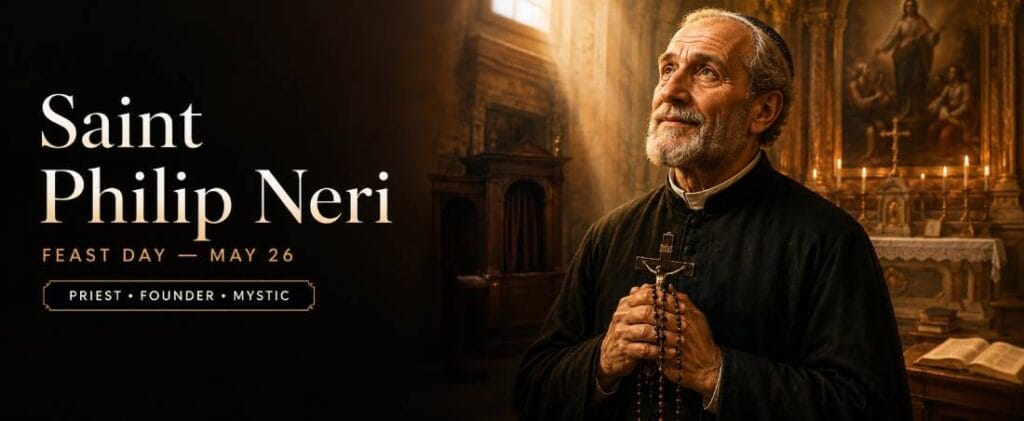
Every year on May 26, the Catholic Church celebrates Saint Philip Neri, one of the most beloved saints in Christian history. Known as the “Apostle of Rome,” Saint Philip Neri transformed countless lives not through political power or dramatic preaching alone, but through joy, humility, prayer, and deep personal holiness.
Behind his cheerful personality and humor was a soul profoundly united to God. His life was marked by intense prayer, devotion to the Eucharist, love for the Holy Spirit, penance, and compassion for sinners. Though many remember him as the joyful saint who laughed easily and charmed the streets of Rome, his joy came from a heart consumed with divine love.
Saint Philip Neri’s spirituality offers modern Catholics a powerful lesson: holiness does not make a person cold or distant. True holiness fills the soul with peace, warmth, charity, and joyful trust in God.
His witness remains especially important today in a world burdened by anxiety, discouragement, and spiritual emptiness. Saint Philip reminds believers that intimacy with Christ can renew both the soul and the world around it.
Early Life
Saint Philip Neri was born on July 21, 1515, in Florence, Italy, during a period of great political and religious upheaval in Europe. His father worked as a notary, and Philip grew up in a modest but faithful Catholic home.
As a young boy, Philip was known for his cheerful disposition and gentle nature. Even in childhood, he displayed a love for prayer and kindness toward others. Friends affectionately called him “Pippo Buono,” meaning “Good Little Philip.”
At eighteen years old, Philip left Florence and traveled south to live with a relative who hoped he would enter business and inherit wealth. Instead, Philip experienced a deeper spiritual calling. After a period of reflection and prayer, he chose to leave worldly ambitions behind and dedicate himself entirely to God.
He eventually moved to Rome, where he would spend the rest of his life serving the Church.
The Calling of Saint Philip Neri
Rome in the sixteenth century was spiritually wounded. Corruption, poverty, and moral decline affected many parts of society. Philip felt called not to withdraw from the world completely, but to evangelize the people living around him.
For many years, he lived very simply as a layman devoted to prayer, study, and acts of charity. He visited hospitals, cared for the sick, helped pilgrims, and engaged people in conversations about God in the streets and public places of Rome.
His approach to evangelization was deeply personal. He listened patiently, spoke gently, and led people toward holiness through friendship and authentic joy.
Eventually, under the guidance of his spiritual director, Philip was ordained a priest in 1551. His priesthood would become one of the most fruitful spiritual missions in Church history.
The Prayer Life of Saint Philip Neri
The prayer life of Saint Philip Neri was extraordinary. Beneath his joyful exterior burned an intense interior love for God.
Deep Contemplative Prayer
Philip spent long hours in silent prayer and contemplation. He frequently prayed late into the night, especially in the Roman catacombs where early Christians had worshipped and suffered for the faith.
One of the most famous moments in his spiritual life occurred during Pentecost in 1544. While praying in the Catacomb of Saint Sebastian, Philip experienced a powerful mystical encounter with the Holy Spirit.
According to witnesses and tradition, he felt a divine fire enter his heart so intensely that his chest physically enlarged. Doctors later noted that several of his ribs had been expanded or broken outward. Philip himself spoke very little about this experience, but those close to him recognized it as a profound moment of mystical union with God.
From that point onward, he was often overwhelmed during prayer by intense spiritual emotion and love for Christ.
Devotion to the Holy Eucharist
The Eucharist stood at the center of Philip’s spiritual life. He celebrated Mass with extraordinary devotion and reverence.
At times, his love for God during Mass became so intense that he visibly trembled or wept. Witnesses described him becoming spiritually absorbed during the liturgy.
Philip encouraged frequent confession and regular reception of Holy Communion long before these practices became common among ordinary Catholics. He believed the sacraments were essential for spiritual renewal.
His confessional became one of the most important places of spiritual transformation in Rome. People from every social class came seeking his counsel and prayers.
Prayer Rooted in Joy
Unlike some saints known for severe outward austerity, Philip’s spirituality radiated joy. He believed sadness and excessive seriousness could become obstacles to spiritual growth.
This did not mean he lacked discipline or sacrifice. Rather, his prayer life produced interior freedom and peace.
Philip often used humor to teach humility and protect himself from pride. He sometimes acted in deliberately unusual ways to avoid admiration from others. Behind these actions was a sincere desire to remain humble before God.
Spiritual Practices and Devotions
Love for the Holy Spirit
Saint Philip Neri had a particularly strong devotion to the Holy Spirit. The mystical experience he received during prayer shaped the rest of his life.
He constantly encouraged believers to open their hearts to God’s grace and divine love.
His spirituality emphasized transformation of the heart rather than merely external religious observance.
Frequent Confession and Spiritual Direction
Philip became widely known as an exceptional confessor and spiritual guide. He understood human weakness deeply and treated sinners with compassion rather than harshness.
Many people experienced conversion through his patient counsel.
He believed spiritual growth required honesty, humility, and regular examination of conscience. His approach to confession reflected the mercy of Christ.
Simplicity and Humility
Although admired throughout Rome, Philip lived simply and avoided honors. He rejected opportunities for high ecclesiastical positions, including becoming a cardinal.
His humility was genuine and consistent.
He once shaved off half of his beard and walked publicly through Rome simply to combat vanity and pride. Though humorous, such actions reflected his sincere desire to belong entirely to God rather than seek human praise.
Community Prayer and the Oratory
Philip eventually founded the Congregation of the Oratory, a community of priests dedicated to prayer, preaching, spiritual conversation, and pastoral care.
The Oratory became known for joyful spirituality, beautiful liturgical worship, sacred music, and accessible teaching.
Philip understood that Christian community strengthens faith and encourages holiness.
Trials, Sacrifices, and Faith
Although remembered as joyful, Saint Philip Neri endured many trials.
Spiritual Burdens
As a confessor and spiritual father, Philip carried the emotional and spiritual burdens of many souls. He spent countless hours hearing confessions, counseling troubled individuals, and praying for conversion.
This work required enormous patience and spiritual strength.
Misunderstanding and Opposition
Not everyone understood Philip’s methods. Some viewed his humor and unconventional behavior with suspicion.
Yet Philip remained obedient to Church authority and patient during criticism. His humility protected him from bitterness.
Physical Weakness
In later years, Philip suffered physically from the effects of age and his mystical experiences. Despite this, he continued ministering faithfully to others.
Even in illness, his joy and trust in God remained visible.
Legacy in the Catholic Church
Saint Philip Neri’s influence on the Catholic Church remains profound.
He played an important role during the Counter-Reformation by helping renew spiritual life in Rome through personal holiness, joyful evangelization, and sacramental devotion.
His example inspired priests, religious communities, and lay Catholics alike.
Today, the Congregation of the Oratory continues his mission throughout the world.
Philip is especially remembered for demonstrating that sanctity and joy belong together. He showed that holiness is attractive when rooted in love, humility, and authentic friendship with Christ.
He was canonized in 1622 by Pope Gregory XV alongside several other great saints of the Catholic Reformation era.
What Catholics Can Learn Today
Saint Philip Neri offers timeless spiritual lessons for modern Catholics.
Joy Is a Fruit of Holiness
Philip teaches believers that Christian joy is not superficial happiness. True joy flows from trust in God and freedom from selfishness.
In a culture marked by anxiety and discouragement, his witness is deeply needed.
Prayer Changes the Heart
Philip’s long hours of prayer transformed him into a man of extraordinary compassion and peace. Catholics today can learn the importance of daily prayer, silence, Eucharistic devotion, and openness to the Holy Spirit.
Holiness Can Be Warm and Human
Saint Philip Neri reminds believers that holiness does not require becoming cold, harsh, or disconnected from others.
His warmth, humor, and kindness drew countless people closer to Christ.
Humility Protects the Soul
Philip constantly fought pride through humility and self-awareness. His example encourages Catholics to seek God’s approval rather than human recognition.
Conclusion
Saint Philip Neri remains one of the Church’s most joyful and beloved saints because his life reflected the beauty of a soul deeply united to God.
His prayer life was intense, contemplative, Eucharistic, and Spirit-filled. Yet it also overflowed into compassion, humor, humility, and love for others.
In every stage of his life, Philip pointed people toward Christ—not through fear, but through friendship, mercy, and authentic holiness.
For Catholics seeking peace in a restless world, Saint Philip Neri offers a timeless invitation: pray deeply, trust God completely, love others generously, and never lose the joy that comes from belonging to Christ.