
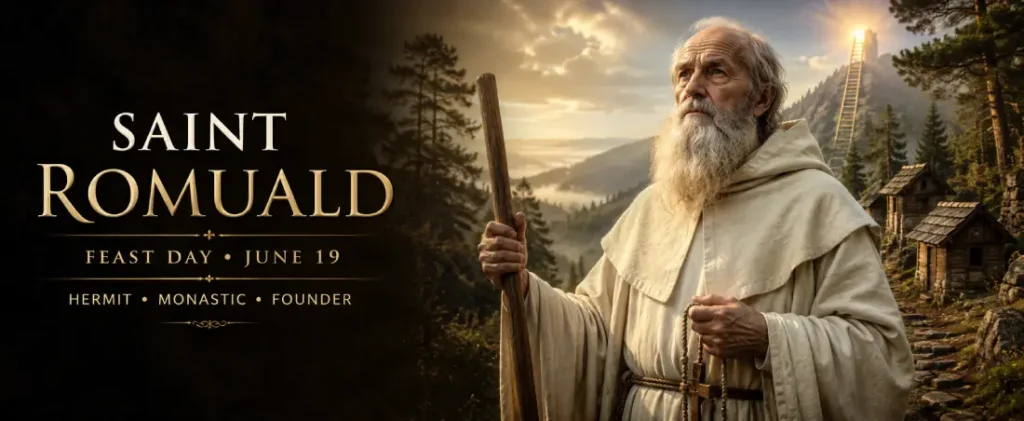
Among the great saints who renewed Christian life during the turbulent Middle Ages, few stand as prominently as Saint Romuald, founder of the Camaldolese Order and one of the most influential promoters of contemplative prayer in Western monasticism.
Born into wealth and nobility, Romuald abandoned worldly ambitions to pursue a life centered entirely on God. Through solitude, fasting, silence, penance, and unceasing prayer, he became a spiritual father to countless monks and hermits. His life demonstrates that true reform in the Church begins not with programs or politics, but with holiness.
Today, Saint Romuald remains a powerful example for Catholics seeking deeper prayer, greater interior silence, and a more intimate relationship with Christ.
Early Life and Historical Background
Saint Romuald was born around 951 AD in Ravenna, Italy, into an aristocratic family during a period marked by political instability and moral decline throughout much of Europe. Historical sources indicate that he enjoyed the privileges of noble life in his youth, yet he was also exposed to violence and corruption.
A defining moment occurred when his father, Sergius, became involved in a deadly duel that resulted in the death of a relative. Though Romuald was not directly responsible, witnessing the tragedy deeply affected his conscience.
Seeking penance and spiritual healing, he entered the Benedictine monastery of Sant’Apollinare in Classe near Ravenna for what was intended to be a temporary stay. There he encountered the beauty of monastic prayer and discovered God’s call upon his life.
This experience transformed him forever.
Calling and Spiritual Transformation
Although Romuald entered monastic life, he quickly realized that many monasteries of his era had grown spiritually lax. Rather than accepting mediocrity, he sought a more radical pursuit of holiness.
He placed himself under the guidance of holy hermits and spiritual masters who taught him the disciplines of:
- Solitude
- Silence
- Continuous prayer
- Asceticism
- Meditation on Scripture
- Fasting and penance
For years he lived as a wandering monk and hermit throughout Italy, seeking places where God could be loved with greater purity and devotion. His desire was not merely personal sanctity but the renewal of religious life itself.
Through decades of prayer and spiritual struggle, Romuald became convinced that both communal monastic life and solitary contemplative life had important roles within the Church.
This insight would eventually shape one of the most important monastic reforms of the Middle Ages.
The Prayer Life of Saint Romuald
The heart of Saint Romuald’s holiness was prayer.
He believed that the soul’s greatest task was to seek God continually and remove every obstacle that prevented union with Him.
His spirituality emphasized:
Silence Before God
Romuald taught that silence was not emptiness but a privileged place of encounter with the Lord.
He encouraged his disciples to withdraw from unnecessary conversation so they could listen more attentively to God’s voice.
His famous spiritual instruction remains one of the treasures of Christian contemplation:
“Sit in your cell as in paradise. Put the whole world behind you and forget it.”
This teaching captures the essence of his spirituality: interior recollection and complete focus on God.
Prayer with Sacred Scripture
Saint Romuald urged monks to pray slowly with the Psalms and Sacred Scripture.
Rather than reading quickly, he encouraged meditation that allowed God’s Word to penetrate the heart.
The Psalms became the language of his soul.
Constant Conversion
Romuald understood that prayer requires perseverance.
He experienced distractions, temptations, and spiritual dryness like every Christian.
Rather than becoming discouraged, he taught that every return to prayer is itself an act of love for God.
A tradition associated with his spiritual teaching advises:
“If your mind wanders, do not give up. Bring it back gently.”
This practical wisdom remains remarkably relevant today.
Contemplation of God
The ultimate goal of prayer for Saint Romuald was loving union with God.
His life demonstrates the Catholic understanding that contemplation is not reserved for a select few but is the vocation of every baptized Christian according to his or her state in life.
Devotions, Sacrifices, and Spiritual Practices
Saint Romuald embraced severe asceticism throughout much of his life.
His spiritual disciplines included:
Fasting
He frequently fasted to discipline the body and focus the heart on God.
For Romuald, fasting was not self-punishment but a means of spiritual freedom.
Solitude
He spent extensive periods living in hermitages, caves, forests, and remote monasteries.
Solitude enabled deeper prayer and greater detachment from worldly concerns.
Penance
Romuald practiced acts of penance to atone for sin and grow in humility.
Like the Desert Fathers before him, he believed spiritual growth required self-denial and vigilance.
Liturgical Prayer
Despite his love for solitude, Romuald remained deeply committed to the Church’s liturgical life.
His vision united:
- Common prayer
- The Divine Office
- Eucharistic worship
- Personal contemplation
This balance became a defining characteristic of Camaldolese spirituality.
Eucharistic Devotion
Although detailed records are limited, the monastic tradition he established was profoundly centered on the Holy Eucharist.
The Mass remained the center of community life, and personal prayer flowed from sacramental union with Christ.
Trials, Suffering, and Faithfulness
Saint Romuald’s path to holiness was far from easy.
Throughout his ministry he encountered:
- Opposition from monks resistant to reform
- Misunderstanding from Church leaders
- Personal disappointments
- Physical hardships
- Spiritual struggles
Several times he attempted to reform monasteries only to face fierce resistance.
Rather than abandoning his mission, he responded with patience and perseverance.
One of the greatest tests came from the constant tension between active reform and contemplative solitude. Romuald longed for silence, yet God repeatedly called him to lead others.
His holiness consisted not in doing what he preferred but in obeying God’s will.
This obedience became a hallmark of his sanctity.
Legacy in the Catholic Church
Around 1012, Romuald established what became the famous Camaldoli Hermitage in Tuscany. Here he successfully united the hermit life with Benedictine community life.
The resulting Camaldolese Order became one of the most influential contemplative movements in the Church.
His reforms emphasized:
- Solitude
- Silence
- Liturgical prayer
- Manual labor
- Scriptural meditation
- Holiness of life
Romuald spent approximately three decades founding monasteries and hermitages across Italy. His influence extended far beyond his lifetime and contributed significantly to the spiritual renewal of medieval Europe.
He died on June 19, 1027, at Val di Castro in Italy after a lifetime dedicated entirely to God.
What Catholics Can Learn Today
Saint Romuald offers powerful lessons for modern believers.
1. Silence Is Essential
In a world filled with constant noise, his example reminds us that God often speaks most clearly in silence.
2. Prayer Must Be Intentional
Romuald teaches that spiritual growth requires discipline and perseverance.
Prayer cannot thrive without commitment.
3. Holiness Requires Conversion
His life began with worldly distractions but ended in extraordinary sanctity.
No one is beyond God’s transforming grace.
4. Solitude Has Value
Even busy Catholics benefit from moments of intentional silence and reflection.
5. Reform Begins With Personal Holiness
Romuald changed the Church not through controversy but through sanctity.
The most powerful witness remains a life fully surrendered to God.
Conclusion
Saint Romuald stands among the greatest contemplative saints of Western Christianity. Through prayer, silence, fasting, obedience, and profound love for Christ, he rekindled the ancient spirit of the Desert Fathers and gave new life to monasticism.
His witness reminds Catholics that intimacy with God is worth every sacrifice. In an age of distractions, his call to silence and contemplation remains more relevant than ever.
May Saint Romuald intercede for all who seek a deeper prayer life and a closer union with Jesus Christ.