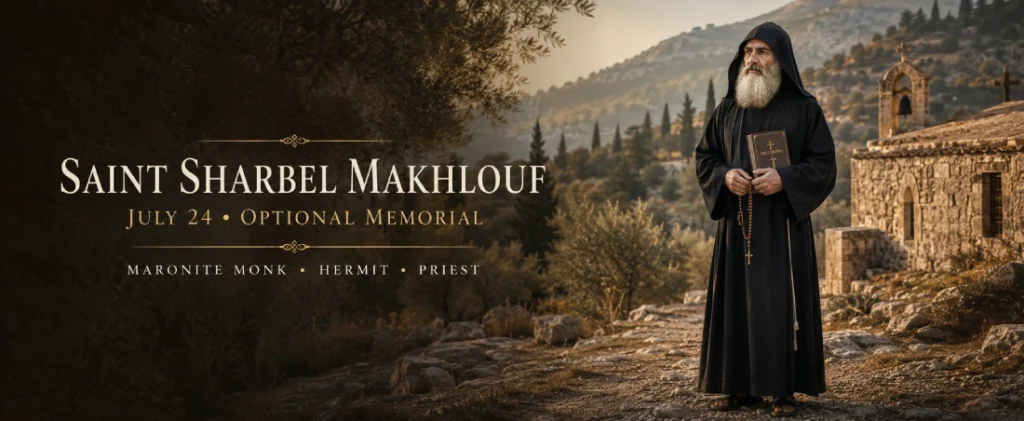
Some saints change history through powerful preaching. Others lead armies, found religious orders, or defend the faith before kings. Saint Sharbel Makhlouf chose a very different path. He spent most of his life in silence, hidden away in a small hermitage on a mountain in Lebanon, far from public attention. Yet today, millions of people around the world know his name and seek his intercession, especially those praying for healing.
How did a humble monk who rarely left his monastery become one of the most beloved Catholic saints of modern times? The answer lies not in extraordinary public achievements, but in an extraordinary life of prayer, humility, and complete surrender to God.
A Child Raised Among Lebanon’s Mountains
Saint Sharbel was born as Youssef Antoun Makhlouf on May 8, 1828, in the mountain village of Bekaa Kafra in northern Lebanon, then part of the Ottoman Empire. Nestled high in the mountains, the village was home to deeply faithful Maronite Catholic families whose lives revolved around prayer, work, and the liturgical seasons of the Church.
Youssef’s family was poor, but rich in faith. His father died while he was still a young child, leaving his mother to raise the family through difficult years. Although historical records preserve only limited details of his childhood, it is highly probable that these early hardships helped shape the quiet resilience and dependence on God that would define his entire life.
He was known for spending long hours alone in prayer. Local tradition recalls that he often sought solitude in the hills surrounding his village, using a small cave as a place to speak with God. While this particular detail belongs to pious tradition rather than documented history, it reflects the deep desire for contemplation that would eventually lead him to become a hermit.
A Call That Could Not Be Ignored
As Youssef grew older, his attraction to monastic life became impossible to resist. In 1851, at the age of twenty-three, he quietly left home and entered the Monastery of Our Lady of Mayfouq, beginning his journey as a Maronite monk.
Soon afterward, he transferred to the Monastery of Saint Maron at Annaya, where he would spend almost the rest of his earthly life.
Upon entering religious life, he received the name Sharbel, honoring an early Christian martyr of Edessa. The new name symbolized a new identity: a life entirely dedicated to Christ.
Monastic life in the Maronite tradition was demanding. Days were filled with communal prayer, manual labor, study, fasting, and obedience. Sharbel embraced every task without complaint. Whether working in the fields or praying in the chapel, he approached each duty with the same quiet devotion.
Those who lived beside him noticed that he never sought recognition. He spoke little, obeyed promptly, and treated every person with kindness. Holiness, for Sharbel, was found not in dramatic moments but in daily faithfulness.
A Priest Whose Greatest Sermon Was His Life
After years of formation, Sharbel was ordained a priest in 1859.
Unlike many priests, he did not become widely known for preaching or missionary work. His ministry unfolded mostly within the monastery, where he celebrated the Divine Liturgy, heard confessions when assigned, and continued the ordinary rhythm of prayer and labor.
The Eucharist stood at the center of his life. Fellow monks recalled the profound reverence with which he celebrated the Holy Mysteries. Every Mass seemed to draw him more deeply into the mystery of Christ’s sacrifice.
His life echoed the words of Jesus:
“Abide in me, and I in you.” (John 15:4)
Rather than seeking the world, Sharbel sought union with Christ. Ironically, this hidden pursuit would one day draw the entire world to him.
Twenty-Three Years of Sacred Silence
In 1875, Sharbel received permission to enter the monastery’s hermitage, where he would live as a hermit for the remaining twenty-three years of his life.
The hermitage consisted of only a few simple rooms overlooking the mountains. Here he embraced one of the most demanding vocations in the Christian tradition.
His daily routine was remarkably simple.
He rose before dawn.
He prayed for long hours.
He celebrated the Divine Liturgy.
He fasted.
He performed manual labor.
He read Sacred Scripture.
He remained largely silent.
This was not silence born of loneliness but of communion. Sharbel believed that every moment belonged to God.
Visitors rarely encountered lengthy conversations. Instead, they remembered his peaceful presence, humble manner, and deep recollection in prayer.
He became a living reminder that holiness is often hidden from human eyes but never hidden from God.
His Final Christmas
In December 1898, while celebrating the Divine Liturgy, Father Sharbel suddenly suffered what historians believe was a stroke.
Unable to continue, he was carried from the altar.
After several days of suffering, he died peacefully on December 24, 1898—Christmas Eve.
There is something profoundly fitting about the timing of his death. The monk who had spent his entire life preparing his heart for Christ entered eternal life on the very night the Church celebrated the birth of the Savior.
His fellow monks buried him in the monastery cemetery at Annaya, believing they were laying to rest another faithful monk.
God had other plans.
A Saint the World Could Not Ignore
Soon after his burial, reports began to spread that mysterious lights had been seen near his grave. These reports belong to longstanding tradition rather than established historical fact, but they inspired growing devotion among local Christians.
More significant were the events that followed.
Years later, when his tomb was examined, Church authorities documented unusual conditions associated with his remains. These observations became part of later ecclesiastical investigations but should not automatically be interpreted as miracles in themselves.
Far more important were the many reports of healing attributed to his intercession.
Over the decades, thousands of people from different countries testified that they had experienced physical, emotional, or spiritual healing after praying through Saint Sharbel’s intercession.
As with all canonization causes, the Catholic Church carefully distinguished between personal testimony and miracles worthy of official recognition. Only after rigorous medical and theological investigations were selected miracles approved for his beatification and canonization.
Canonized for a Life of Holiness
Recognizing both his heroic virtue and authenticated miracles, Pope Paul VI beatified Sharbel in 1965 during the Second Vatican Council.
Twelve years later, on October 9, 1977, Pope Paul VI declared him a saint of the universal Church.
Today, Saint Sharbel’s feast day is celebrated on July 24 in the General Roman Calendar, while the Maronite Church also preserves its own liturgical traditions connected to his heavenly birth.
His monastery in Annaya, Lebanon, has become one of the world’s most important Christian pilgrimage sites, welcoming visitors from every continent.
Why Do Catholics Pray to Saint Sharbel?
Many people first hear about Saint Sharbel because of stories of healing.
While the Church encourages the faithful to seek his intercession, Catholic teaching reminds us that every grace comes ultimately from God alone. The saints do not replace Christ; they pray with us and for us as members of the Communion of Saints.
For this reason, countless Catholics ask Saint Sharbel to intercede for those facing serious illness, difficult surgeries, family struggles, or impossible situations.
His life gives credibility to those prayers because he first spent decades placing every part of his own life into God’s hands.
What Made Saint Sharbel So Extraordinary?
Sharbel performed no famous missionary journeys.
He founded no religious order.
He wrote no theological masterpieces.
He held no high office within the Church.
His greatness came from something far more accessible—and far more challenging.
He was faithful.
Day after day.
Year after year.
In hiddenness.
In silence.
In prayer.
He reminds modern Christians that the deepest spiritual victories are often invisible to the world.
Lessons for Catholics Today
Saint Sharbel’s life speaks powerfully to an age filled with constant noise and distraction.
He teaches that silence is not emptiness but an opportunity to hear God’s voice.
He reminds us that the Eucharist is the heart of Christian life.
His humility shows that true greatness is measured not by public success but by fidelity to Christ.
His devotion to prayer demonstrates that intimacy with God transforms ordinary people into saints.
Most importantly, he proves that holiness does not require fame. One hidden life, completely surrendered to God, can inspire generations across the world.
A Legacy That Continues
More than a century after his death, pilgrims continue to travel to Annaya. Churches dedicated to Saint Sharbel can now be found across every continent, and his witness has become a bridge between Eastern and Western Catholics.
His story is ultimately not about extraordinary phenomena but about extraordinary faithfulness. The miracles associated with his intercession have drawn many people to his shrine, but it is his life that keeps them there.
In an age that often celebrates visibility, success, and constant activity, Saint Sharbel offers a different vision of greatness. He reminds us that a life rooted in prayer, nourished by the Eucharist, shaped by humility, and entrusted entirely to Christ can bear fruit far beyond what any human eye can see.
The silent hermit of Lebanon never sought the world’s attention. Yet through God’s grace, his hidden life became a light that continues to guide countless souls toward Christ.