Few saints are as misunderstood as Saint Thomas the Apostle. For many people, he is simply “Doubting Thomas,” the disciple who refused to believe that Jesus had risen from the dead until he saw the wounds of Christ for himself. Yet that single moment does not tell the whole story.
Saint Thomas was one of the Twelve Apostles chosen by Jesus, a courageous follower who was willing to risk his life for his Master and who later became one of Christianity’s greatest missionaries. According to ancient Christian tradition, he carried the Gospel far beyond the Roman world and brought the Christian faith to India, where millions of Christians still honor him today.
His story is deeply human. He struggled with uncertainty, asked difficult questions, and sought understanding. Yet it was Thomas who made one of the most profound professions of faith in the entire New Testament when he fell before the risen Christ and declared, “My Lord and my God!” (John 20:28).
For Catholics today, Saint Thomas remains a powerful witness that honest questions can lead to deeper faith and that even moments of doubt can become moments of grace.
Who Was Saint Thomas the Apostle?
Saint Thomas the Apostle was one of the original Twelve Apostles of Jesus Christ. His name comes from the Aramaic word Ta’oma, meaning “twin.” The Gospel of John also calls him “Didymus,” the Greek word for “twin.”
The New Testament tells us very little about his family, occupation, or early life. Unlike Saint Peter or Saint Matthew, Thomas appears only occasionally in the Gospel narratives. Yet each time he speaks, his words reveal something important about his character.
He was thoughtful, practical, loyal, and deeply sincere.
The Historical World of Saint Thomas
Thomas lived during the first century under Roman rule. Judea was governed by Roman authorities and local rulers descended from Herod the Great. The Jewish people longed for the coming of the Messiah and lived amid political tensions and religious divisions.
This was also a remarkably connected world. Roman roads, sea routes, and trade networks linked the Mediterranean with Arabia, Persia, and even India. These connections would later make it possible for the Gospel to spread far beyond Jerusalem.
The ministry of Jesus unfolded within this complex world, and Thomas would eventually become one of its great missionaries.
The Calling of Thomas
Like the other apostles, Thomas was personally chosen by Jesus to follow Him. The Gospels do not describe the moment of his calling, but they clearly identify him as one of the Twelve.
Although Thomas does not appear frequently in Scripture, the passages that mention him reveal a disciple of remarkable courage.
When Jesus decided to return to Judea after hearing of Lazarus’s illness, the disciples feared for His safety because the authorities had recently tried to stone Him. It was Thomas who said:
“Let us also go, that we may die with him” (John 11:16).
This is hardly the statement of a coward or skeptic. It shows a man willing to suffer and even die for Christ.
Thomas at the Last Supper
Thomas appears again during the Last Supper.
When Jesus told His disciples that He was going to prepare a place for them and that they knew the way, Thomas openly admitted his confusion:
“Lord, we do not know where you are going; how can we know the way?” (John 14:5).
His question prompted one of Jesus’ most beloved teachings:
“I am the way, and the truth, and the life” (John 14:6).
Thomas’s willingness to ask difficult questions became an occasion for one of the clearest revelations of Christ’s identity.
Why Is He Called “Doubting Thomas”?
The event that made Thomas famous occurred after the Resurrection.
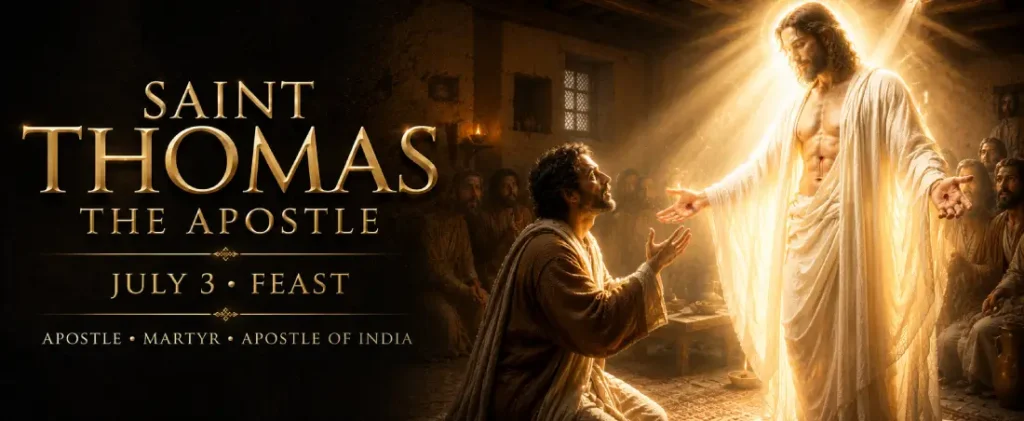
On Easter Sunday, Jesus appeared to the apostles, but Thomas was absent. When the others told him that they had seen the Lord, he replied that he would not believe unless he saw the wounds of Jesus and touched them himself.
Eight days later, Jesus appeared again and invited Thomas to do exactly that.
The Gospel does not actually say that Thomas touched Christ’s wounds. Instead, it immediately records Thomas’s response:
“My Lord and my God!”
This is one of the most important declarations of faith in the New Testament. Thomas recognized not only that Jesus had risen from the dead but also that He is truly Lord and truly God.
For this reason, Thomas should be remembered not merely for his doubt but for his extraordinary faith.
What Can We Learn from Thomas’s Doubt?
Thomas teaches that sincere questions are not enemies of faith.
Many believers struggle with uncertainty, suffering, and unanswered questions. Thomas reminds us that Christ does not reject those who seek the truth honestly.
His journey moves from doubt to worship, from uncertainty to one of the strongest confessions of faith ever recorded in Scripture.
Because of this, Saint Thomas has become a patron and inspiration for those who struggle with doubt and seek a deeper relationship with God.
The Missionary Journey of Saint Thomas
The New Testament says little about Thomas after the Resurrection and Pentecost.
Early Christian traditions, however, consistently remember him as a missionary to the East.
Ancient sources suggest that he preached in regions such as Parthia and Mesopotamia. An even older and stronger tradition, preserved by the ancient Christians of India, holds that Thomas traveled to the Indian subcontinent and preached the Gospel there.
Although historians cannot verify every detail of these traditions, the continuous memory of the Christians of India gives the tradition significant historical weight.
According to this ancient tradition, Thomas arrived on the Malabar Coast around AD 52 and established Christian communities that later became known as the Saint Thomas Christians.
These communities still exist today and remain one of the world’s oldest Christian traditions.
Saint Thomas in India
The tradition of Thomas’s mission to India has been preserved for nearly two thousand years.
Indian Christians honor him as the Apostle of India and regard him as the founder of their ancient Christian heritage.
Whether every detail of the tradition can be historically proven is uncertain, but the existence of an ancient and enduring memory of Thomas’s ministry in India is itself a remarkable historical fact.
His mission demonstrates how quickly Christianity spread beyond the Roman Empire and became a truly global faith.
The Miracles of Saint Thomas
The Bible does not record miracles performed by Thomas himself.
Later Christian traditions and ancient writings attribute healings, conversions, and other miraculous events to him. These accounts belong to sacred tradition and devotional history rather than firmly established historical evidence.
The greatest miracle associated with Thomas may not be a physical healing at all.
It is the transformation of a doubting disciple into a fearless apostle who carried the Gospel to distant lands.
How Did Saint Thomas Die?
Ancient Christian tradition holds that Thomas died as a martyr in India.
According to this tradition, he was pierced with spears near Mylapore around AD 72.
The precise historical details cannot be established with certainty, but the tradition of his martyrdom is ancient and widespread throughout both Eastern and Western Christianity.
As with many of the apostles, Thomas appears to have sealed his witness to Christ with his blood.
Burial and Relics of Saint Thomas
The traditional site of Thomas’s tomb is in Mylapore, near present-day Chennai, India.
Early Christians also associated his relics with the city of Edessa in Mesopotamia, where devotion to Saint Thomas became especially strong.
Centuries later, some of his relics were transferred to Italy, where they continue to be venerated.
Pilgrims from around the world still visit places connected with the apostle and honor his memory.
Why Is Saint Thomas a Saint?
Saint Thomas was never formally canonized in the modern sense because he lived long before the Church developed today’s canonization procedures.
He has been honored as a saint since the earliest centuries of Christianity because he was:
- One of the Twelve Apostles.
- A witness to the Resurrection.
- A missionary of the Gospel.
- A martyr who gave his life for Christ.
His sanctity was recognized by the universal Church from ancient times.
What Is Saint Thomas the Patron Saint Of?
Saint Thomas is the patron saint of:
- India
- Architects
- Builders
- Construction workers
- Surveyors
- People who struggle with doubt
His patronage of builders comes from an ancient tradition describing him as constructing a heavenly palace through acts of charity rather than through earthly wealth.
His connection with those who struggle with doubt arises naturally from his encounter with the risen Christ.
Feast Day of Saint Thomas the Apostle
The Catholic Church celebrates the Feast of Saint Thomas the Apostle on July 3.
For centuries, his feast was observed on December 21, but the Roman Calendar later moved the celebration to July 3 to coincide with the ancient translation of his relics to Edessa.
Each year, Catholics throughout the world honor his witness, his missionary zeal, and his profound confession of faith.
Symbols and Iconography of Saint Thomas
Christian art often depicts Saint Thomas with:
- A spear, symbolizing his martyrdom.
- A builder’s square, representing his patronage of architects and builders.
- A church building, symbolizing the Christian communities associated with his mission in India.
- A scroll or book, representing his preaching of the Gospel.
- His hand reaching toward Christ’s side, recalling the Resurrection appearance.
These symbols help tell the story of his life and mission.
Lessons Catholics Can Learn from Saint Thomas Today
Saint Thomas remains surprisingly relevant in the modern world.
Faith Can Grow Through Honest Questions
Thomas reminds us that asking sincere questions can deepen our relationship with God.
Doubt Does Not Have the Final Word
Many believers experience uncertainty. Thomas shows that Christ meets us in those moments and invites us to greater faith.
Courage Matters
Thomas was willing to follow Jesus even into danger. His example challenges Christians to remain faithful despite fear.
The Gospel Is for Every Nation
The traditions surrounding Thomas’s mission to India remind us that Christianity was meant for the entire world from the beginning.
Jesus Is Truly Lord and God
Thomas’s confession remains one of the clearest declarations of Christ’s divinity in all of Scripture.
Frequently Asked Questions
Who was Saint Thomas the Apostle?
Saint Thomas was one of the Twelve Apostles chosen by Jesus Christ and is best known for his confession of faith after encountering the risen Lord.
Why is he called Doubting Thomas?
He initially refused to believe the Resurrection until he saw the wounds of Jesus, though he later proclaimed, “My Lord and my God.”
Did Saint Thomas really go to India?
Ancient and enduring Christian tradition says that he preached in India. While not every detail can be historically verified, the tradition is extremely ancient and widely accepted.
How did Saint Thomas die?
According to ancient tradition, he was martyred by being pierced with spears near Mylapore, India.
What is Saint Thomas the patron saint of?
He is the patron saint of India, architects, builders, construction workers, surveyors, and people struggling with doubt.
When is Saint Thomas’s feast day?
The Catholic Church celebrates his feast on July 3.
Where are the relics of Saint Thomas?
Traditions associate his relics with Mylapore in India and later with Edessa and Italy.
Why is Saint Thomas important?
He was a witness to the Resurrection, one of the Twelve Apostles, and a missionary whose influence helped spread Christianity far beyond the Roman world.
Conclusion
Saint Thomas the Apostle was far more than the disciple who doubted.
He was a courageous follower of Christ, a man who sought the truth with sincerity, and a missionary whose witness reached distant lands. His journey from uncertainty to profound faith has inspired Christians for nearly two thousand years.
When Thomas stood before the risen Jesus and declared, “My Lord and my God,” he gave the Church one of its most beautiful professions of faith.
His story reminds every believer that questions can lead to deeper trust, that Christ meets us in our struggles, and that genuine faith ultimately leads us to worship the Lord who conquered death and sent His apostles to proclaim the Gospel to the ends of the earth.