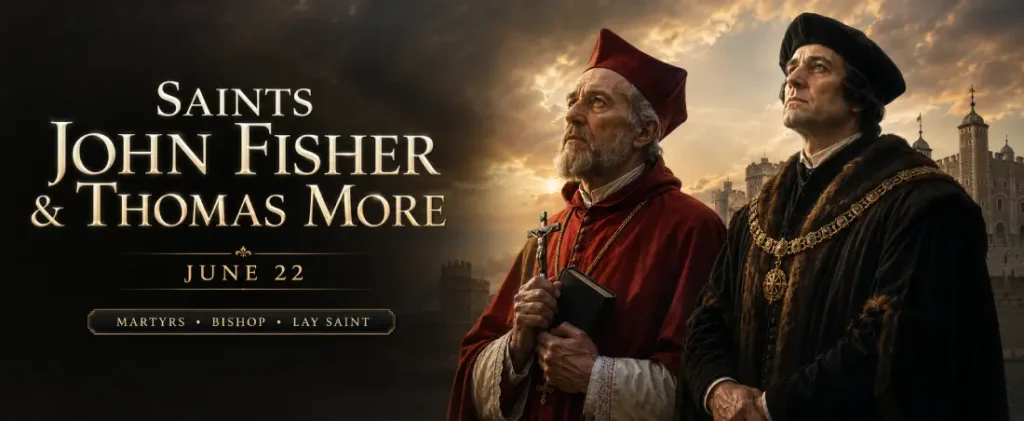
Every generation of Catholics faces moments when faith demands courage. Few saints embody that courage more powerfully than Saints John Fisher and Thomas More. Though one was a bishop and the other a husband, father, lawyer, and statesman, both men shared an unwavering commitment to Christ, the Catholic Church, and the truth.
Their feast day on June 22 commemorates two English martyrs who refused to compromise their faith during one of the most turbulent periods in Church history. Faced with imprisonment, public disgrace, and execution, they remained steadfast because their lives had been deeply rooted in prayer, sacramental devotion, and obedience to God. Their witness continues to inspire Catholics seeking to remain faithful amid political pressure, cultural opposition, and moral confusion.
Early Life and Historical Background
Saint John Fisher
John Fisher was born in Beverley, Yorkshire, England, around 1469. An exceptionally gifted scholar, he studied at the University of Cambridge, where he later became Chancellor. His intellectual brilliance was matched by profound holiness. Ordained a priest and eventually appointed Bishop of Rochester in 1504, he became renowned throughout England for his preaching, pastoral care, and defense of Catholic doctrine.
Unlike many bishops of his era, Fisher lived simply and devoted himself wholeheartedly to the spiritual care of his flock. He promoted education, encouraged frequent preaching, and worked tirelessly to strengthen the faith of ordinary Catholics.
Saint Thomas More
Thomas More was born in London in 1478. Trained in law, he became one of the most respected intellectuals and public servants of Renaissance England. He married, raised a family, and eventually became Lord Chancellor under King Henry VIII—the highest legal office in the kingdom.
Though immersed in politics and public life, More never separated faith from daily responsibilities. His home was known as a center of learning, prayer, and Christian virtue. He demonstrated that holiness is not reserved only for clergy and religious but is attainable within marriage, family life, and professional service.
Calling and Spiritual Transformation
Both saints lived during a period when England was beginning to experience religious upheaval.
John Fisher recognized that the greatest danger facing the Church was not merely political but spiritual. He dedicated himself to defending Catholic teaching and preserving fidelity to Christ.
Thomas More experienced a profound interior struggle regarding his vocation. As a young man, he spent time discerning a possible monastic calling and practiced rigorous spiritual disciplines. Although he eventually embraced marriage and public service, he carried monastic habits into lay life through regular prayer, fasting, examination of conscience, and devotion to Scripture.
Their holiness did not emerge suddenly. It was cultivated through years of prayer, self-denial, and obedience to God.
The Prayer Life of Saints John Fisher and Thomas More
The foundation of their martyrdom was not political conviction but prayer.
John Fisher’s Interior Life
Fisher was known for deep personal devotion and contemplation. His writings reveal a bishop profoundly centered on Christ’s Passion. He frequently preached repentance, conversion, and the necessity of grace.
He spent long hours in prayer and meditation, particularly on the sufferings of Christ. His sermons on the Penitential Psalms became widely respected throughout Europe and reflected his desire to lead souls toward holiness.
His episcopal ministry flowed from his interior union with God. Fisher understood that authentic reform begins in the heart before it transforms institutions.
Thomas More’s Daily Prayer Discipline
Despite immense public responsibilities, More maintained a structured prayer life.
Historical accounts describe his commitment to:
- Daily Mass whenever possible
- Regular confession
- Meditation on Scripture
- Eucharistic devotion
- Spiritual reading
- Frequent examination of conscience
Even as Lord Chancellor, one of the busiest men in England, he protected time for prayer and family devotions.
His famous serenity before execution was not the result of personality but the fruit of decades spent cultivating friendship with Christ.
While imprisoned in the Tower of London, More composed spiritual reflections and prayers that reveal remarkable peace and trust in God’s providence.
Devotions, Sacrifices, and Spiritual Practices
Both saints embraced practices common to Catholic spirituality:
Eucharistic Devotion
The Holy Eucharist stood at the center of their spiritual lives.
For Fisher, the Mass was the heart of episcopal ministry. His theological writings consistently emphasized Christ’s presence and the Church’s sacramental life.
For More, participation in the Eucharist strengthened his ability to live faithfully within the challenges of public life.
Fasting and Penance
Both men practiced forms of voluntary self-denial.
More was known to wear a hair shirt beneath his clothing, a hidden act of penance practiced not for display but for spiritual discipline. His family reportedly knew little about these sacrifices during his lifetime.
Fisher preached regularly on repentance and personal conversion, emphasizing the need to unite oneself to Christ through humility and sacrifice.
Love for Truth
Perhaps their greatest spiritual discipline was obedience to truth.
Neither man sought conflict with King Henry VIII. Both desired peace. Yet they understood that conscience must be formed by divine truth rather than political convenience.
This fidelity ultimately became their path to sanctity.
Trials, Suffering, and Faithfulness
The defining trial of their lives emerged when King Henry VIII sought annulment of his marriage to Catherine of Aragon and later declared himself Supreme Head of the Church in England.
John Fisher courageously defended the Church’s teaching on marriage and papal authority. He stood virtually alone among England’s bishops in resisting the king’s demands.
Thomas More resigned as Lord Chancellor rather than support policies contrary to his faith. He remained silent whenever possible, hoping to avoid direct conflict, but eventually his refusal to swear the required oath led to imprisonment.
Both men spent many months in the Tower of London.
There they endured:
- Isolation
- Physical hardship
- Uncertainty
- Pressure from authorities
- Threats of execution
Yet neither abandoned prayer.
Their imprisonment became a prolonged retreat in which they united themselves more completely to Christ crucified.
John Fisher was executed on June 22, 1535.
Thomas More followed on July 6, 1535.
Both died professing loyalty to the Catholic faith and the authority of the Church.
Legacy in the Catholic Church
The Church has long regarded John Fisher and Thomas More as among the greatest witnesses of conscience in Christian history.
Their martyrdom demonstrated that:
- Political power is temporary.
- Truth is eternal.
- Conscience must be formed according to God’s law.
- Faithfulness may require sacrifice.
Pope Pius XI canonized both saints on May 19, 1935, recognizing them as heroic martyrs who defended the faith even unto death.
Today, Thomas More is especially honored as the patron saint of statesmen, politicians, lawyers, and public servants, while John Fisher is invoked by those facing persecution and challenges to the faith.
What Catholics Can Learn Today
The witness of Saints John Fisher and Thomas More remains urgently relevant.
1. Prayer Must Come Before Public Witness
Their courage was born from years of hidden prayer.
2. Holiness Is Possible in Every Vocation
A bishop and a married layman reached the same glory through different paths.
3. Conscience Must Be Formed by Truth
Modern Catholics often face pressure to conform. These saints remind us that conscience is not personal preference but obedience to God.
4. Suffering Can Become a Path to Sanctity
Neither saint sought martyrdom. Yet when suffering came, they embraced it with trust in Christ.
5. Christ Is Worth Everything
Career, reputation, freedom, and even life itself became secondary to faithfulness.
Conclusion
Saints John Fisher and Thomas More stand among the Church’s greatest examples of prayerful courage. Their lives reveal that authentic holiness begins not in public action but in private communion with God. Through prayer, sacrifice, devotion to the Eucharist, and unwavering fidelity to truth, they became powerful witnesses whose influence continues nearly five centuries later.
In an age of compromise and confusion, their example calls every Catholic to deeper prayer, stronger faith, and greater trust in Christ.
May their witness strengthen us to remain faithful in all circumstances and to seek holiness above every earthly success.