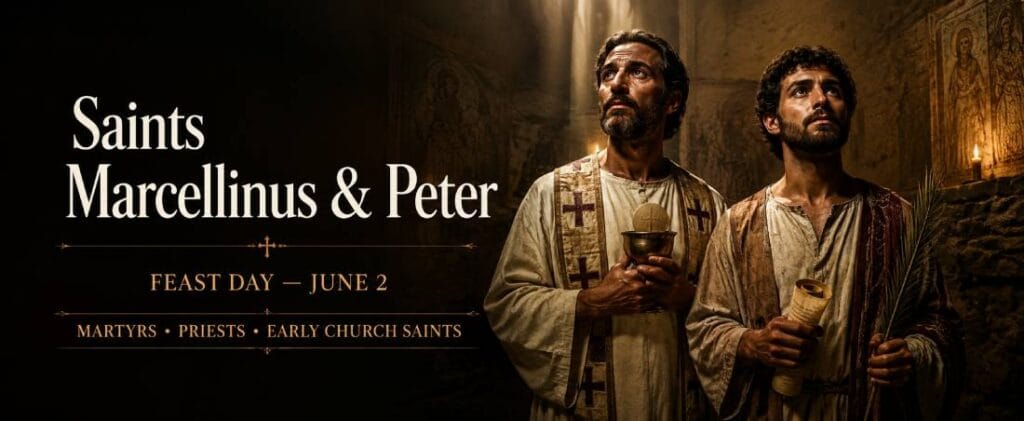
Among the great martyrs of the early Church, the names of Saints Marcellinus and Peter shine with quiet but powerful holiness. Living during one of the fiercest persecutions against Christians in the Roman Empire, these two saints gave everything for Christ — not through military conquest or public fame, but through steadfast prayer, sacramental ministry, and unwavering fidelity to God even unto death.
Their witness reminds Catholics today that holiness is often hidden in ordinary faithfulness. A priest quietly offering the sacraments. A faithful Christian strengthening souls through prayer. A believer refusing to deny Christ despite fear and suffering. Saints Marcellinus and Peter became pillars of the early Church because they understood that prayer, sacrifice, and obedience to God mattered more than earthly security.
The Church has honored them for centuries as heroic martyrs whose lives reflected deep Eucharistic devotion, courage under persecution, and total trust in divine providence. Their names were even included in the ancient Roman Canon of the Mass, a distinction given only to the most venerated saints of early Christianity.
Their story is not merely historical. It is spiritual. It is a lesson in perseverance, sacramental faithfulness, and courageous Catholic witness.
Early Life and Historical Background
Saints Marcellinus and Peter lived during the late third and early fourth centuries, a turbulent period in Roman history when Christians frequently faced imprisonment, torture, and execution. Their martyrdom is traditionally dated around AD 304 during the persecution of Emperor Diocletian, one of the harshest assaults ever launched against the Christian Church.
Marcellinus served as a priest in Rome, while Peter was an exorcist — an important ministry in the early Church dedicated to assisting those suffering spiritual oppression and preparing catechumens for baptism. Though less is historically known about their early lives, ancient Christian sources consistently describe them as deeply faithful servants of Christ who ministered courageously despite constant danger.
The Roman persecutions sought not merely to punish Christians but to eradicate Christianity entirely. Churches were destroyed, sacred texts burned, clergy imprisoned, and believers pressured to renounce Christ publicly. Yet amid this climate of fear, Marcellinus and Peter continued their ministries openly.
Their courage was not rooted in political rebellion or human ambition. It flowed from prayer and supernatural conviction. They believed Christ was truly risen, truly present in the Eucharist, and worthy of complete surrender.
Ancient accounts preserved by Christian tradition describe how they encouraged imprisoned believers, strengthened the fearful, and continued administering the sacraments even when discovery could lead to execution. Their lives embodied the early Church’s understanding that prayer and sacramental grace were stronger than imperial power.
Calling and Spiritual Transformation
The priesthood of Saint Marcellinus and the ministry of Saint Peter reveal men profoundly transformed by grace. In the early Church, clergy lived under constant risk, especially during persecution. To continue serving openly required extraordinary spiritual discipline and trust in God.
Marcellinus dedicated himself to the sacred duties of the priesthood: celebrating the Eucharist, preaching the Gospel, reconciling sinners, and shepherding persecuted Christians. His vocation was not ceremonial. It was sacrificial.
Peter’s role as an exorcist reflected the Church’s early understanding of spiritual warfare. Exorcists prayed intensely, fasted, and ministered to those afflicted spiritually. Their work demanded deep holiness, discernment, and dependence on Christ’s authority.
Tradition recounts that while imprisoned, the two saints converted their jailer and even some fellow prisoners through their witness, prayer, and peace amid suffering. This detail reflects a recurring truth throughout Christian history: authentic holiness evangelizes powerfully.
Even chained and condemned, they remained spiritually free because their hearts belonged entirely to Christ.
Their transformation into fearless witnesses was not instantaneous heroism. It was the fruit of years of prayer, discipline, sacramental devotion, and fidelity to God in ordinary ministry.
The Prayer Life of Saints Marcellinus & Peter
The deepest strength of Saints Marcellinus and Peter came from prayer. Like many martyrs of the early Church, they understood prayer not as a mere practice but as continual communion with God.
The Eucharist stood at the center of their spiritual lives. As a priest, Marcellinus would have celebrated the Holy Sacrifice of the Mass often in secret, especially during persecution. Early Christians risked death simply to gather for worship, yet they believed no earthly threat could compare to the grace received through Christ’s Body and Blood.
Prayer gave them supernatural courage.
Historical Christian tradition consistently emphasizes that martyrs approached suffering with serenity because they were deeply united to Christ interiorly before they faced persecution externally. Saints Marcellinus and Peter exemplified this truth.
Peter’s ministry as an exorcist also required intense prayer and fasting. The early Church viewed spiritual warfare as inseparable from holiness. Exorcists spent long hours in prayer, invoking the authority of Christ against demonic oppression while remaining rooted in humility and sacramental grace.
The saints likely practiced:
- daily liturgical prayer
- fasting and penance
- Scripture meditation
- intercessory prayer
- Eucharistic devotion
- vigil prayer during persecution
Their imprisonment itself became a place of prayer. Rather than surrender to despair, they transformed suffering into worship.
This profound interior life enabled them to remain faithful when many others compromised under fear. Their example teaches Catholics that perseverance during trials is built long before suffering arrives. Holiness is forged in hidden prayer.
Devotions, Sacrifices, and Spiritual Practices
The spirituality of Saints Marcellinus and Peter reflected the disciplined devotional life common among early Christians. Their sacrifices were not dramatic performances. They were daily acts of fidelity.
Fasting formed an essential part of early Christian spirituality. Believers practiced self-denial to strengthen the soul against temptation and to deepen dependence upon God. Saints Marcellinus and Peter likely embraced rigorous fasting, especially during periods of persecution and imprisonment.
They also practiced sacrificial charity. Ancient Christian communities survived persecution through mutual care. Clergy risked their lives to bring the Eucharist to prisoners, bury martyrs, and care for widows and the poor.
Their devotion to Christ was inseparable from love for souls.
Tradition also suggests that the saints faced opportunities to save themselves by denying the faith. Yet they chose suffering rather than betrayal. Such fidelity reflects profound interior detachment from worldly comfort and complete confidence in eternal life.
Martyrdom in the early Church was never viewed as reckless fanaticism. It was understood as the ultimate act of love and union with Christ crucified.
The witness of these saints reveals that holiness is not built through emotional experiences alone. It grows through sacrifice, discipline, obedience, and perseverance.
Trials, Suffering, and Faithfulness
The final suffering of Saints Marcellinus and Peter reveals the depth of their faith.
According to ancient accounts, the Roman authorities attempted to execute them secretly to prevent public Christian veneration. They were reportedly taken into a forested area and ordered to dig their own graves before being beheaded.
Even in death, the authorities feared the spiritual influence of these holy men.
What is remarkable is not merely the brutality of their execution but the peace with which they endured it. Christian tradition consistently portrays the martyrs as entering death prayerfully, trusting completely in Christ’s promise of eternal life.
Their martyrdom reflects the words of Christ:
“Do not fear those who kill the body but cannot kill the soul.”
The early Christians saw martyrdom as participation in the Passion of Christ. Saints Marcellinus and Peter did not seek suffering for its own sake. They accepted it because they refused to abandon the Lord they loved.
Their courage strengthened the persecuted Church enormously. Christians who heard their story recognized that grace could overcome even the fear of death.
Pope Saint Damasus I later honored them greatly and helped preserve their memory within the Roman Church. Their tomb became a place of Christian devotion and pilgrimage.
Legacy in the Catholic Church
The legacy of Saints Marcellinus and Peter endured for centuries because their witness reflected the heart of Christian discipleship.
They were honored in ancient liturgies, and their names entered the Roman Canon — one of the Eucharistic prayers of the Mass. This inclusion demonstrates the immense reverence the Church held for them.
Churches were dedicated in their honor throughout Europe. Sacred art frequently depicted them together as companions in martyrdom, often holding palms of victory or standing in prayerful serenity.
Their example particularly inspired:
- persecuted Christians
- priests and clergy
- exorcists and spiritual ministers
- Catholics facing trials for their faith
The saints remind the Church that spiritual strength does not come from political power or cultural acceptance. It comes from intimacy with Christ.
Even today, their witness remains relevant in a world where many Christians experience ridicule, hostility, or pressure to compromise moral truth.
What Catholics Can Learn Today
Modern Catholics can learn several profound lessons from Saints Marcellinus and Peter.
1. Prayer Is the Foundation of Courage
Their martyrdom was possible because prayer shaped their souls long before persecution arrived. Catholics today cannot withstand spiritual trials without deep prayer lives rooted in the Eucharist and Scripture.
2. Holiness Requires Sacrifice
The saints embraced fasting, discipline, and self-denial. Modern culture often avoids sacrifice, yet the Gospel consistently calls believers to take up the cross.
3. Fidelity Matters More Than Comfort
Marcellinus and Peter chose eternal truth over temporary safety. Their witness challenges Catholics to remain faithful even when obedience to Christ becomes costly.
4. The Sacraments Sustain the Soul
As a priest and exorcist, these saints devoted themselves to sacramental ministry. Their lives remind Catholics never to neglect the grace found in the Mass, Confession, and prayer.
5. Martyrdom Begins in Daily Faithfulness
Most Catholics will not face physical martyrdom, but all Christians are called to die daily to sin, pride, selfishness, and compromise.
Conclusion
Saints Marcellinus and Peter remain powerful witnesses to the transforming grace of God. In an age of persecution and fear, they chose prayer over panic, fidelity over compromise, and Christ over earthly life itself.
Their holiness was rooted not in worldly greatness but in sacramental devotion, disciplined prayer, and courageous obedience to God.
The Church continues to honor them because their witness reveals the true path to sanctity: loving Christ completely, remaining faithful in suffering, and trusting that eternal life is worth every sacrifice.
For Catholics today, their lives offer both inspiration and challenge. The same grace that strengthened these martyrs remains available through prayer, the Eucharist, repentance, and faithful perseverance.
May Saints Marcellinus and Peter intercede for the Church, strengthen persecuted Christians, and help all believers remain steadfast in holiness.