Every year on June 29, Catholics throughout the world celebrate two men whose lives changed the course of history. One was a humble fisherman from Galilee. The other was a brilliant Jewish scholar who once persecuted Christians. Humanly speaking, they could not have been more different. Yet God united them in one mission and one witness.
Saints Peter and Paul stand at the very foundation of Christianity. Peter was chosen by Christ to strengthen His brethren and shepherd His Church. Paul became the great missionary who carried the Gospel far beyond the borders of Judea into the Gentile world. Together, they helped establish the Church in Rome and ultimately sealed their faith with martyrdom.
Their story is one of weakness transformed by grace. Peter knew failure and repentance. Paul knew conversion and redemption. Their lives remind Christians that holiness does not belong only to the naturally gifted or the morally perfect. It belongs to those who allow Christ to change them.
Nearly two thousand years after their deaths, millions of Christians still honor Saints Peter and Paul because the Church they helped build continues to proclaim the same Gospel they preached: Jesus Christ, crucified and risen from the dead.
The World of Peter and Paul
Peter and Paul lived during the first century under the rule of the Roman Empire. The Mediterranean world was politically united under Rome, connected by roads, trade routes, and the widespread use of the Greek language.
At the same time, the Jewish people lived with deep religious hopes and political tensions. Many longed for the coming of the Messiah promised in the Scriptures. Different groups such as the Pharisees, Sadducees, and Zealots offered competing visions of Israel’s future.
Into this world came Jesus of Nazareth. His preaching of the Kingdom of God, His miracles, death, and Resurrection would become the turning point of history and the defining event in the lives of both Peter and Paul.
Saint Peter: The Fisherman Called by Christ
Early Life and Family
Peter was originally named Simon. He was born in Bethsaida, a fishing village on the Sea of Galilee, and later lived in Capernaum. The Gospels reveal that he worked as a fisherman alongside his brother Andrew.
Unlike many later saints, Peter was a married man. The Gospels mention Jesus healing Peter’s mother-in-law, indicating that he had a family life before becoming one of Christ’s disciples.
Nothing suggests that Peter possessed extraordinary education or social status. He was an ordinary working man. Yet God often chooses the humble to accomplish great things.
Called to Become a Disciple
Peter’s life changed when he encountered Jesus.
According to the Gospel of John, Jesus gave Simon a new name: Cephas, or Peter, meaning “Rock” (John 1:42). In biblical tradition, a new name often signified a new mission.
Peter left his fishing nets to follow Christ. During Jesus’ public ministry, he became one of the closest members of the Twelve Apostles and witnessed some of the most important moments in the Gospel, including the Transfiguration and the agony in Gethsemane.
The Confession at Caesarea Philippi
One of the most important moments in Peter’s life occurred when Jesus asked His disciples:
“But who do you say that I am?”
Peter answered:
“You are the Christ, the Son of the living God” (Matthew 16:16).
Jesus then declared:
“You are Peter, and upon this rock I will build my Church” (Matthew 16:18).
Catholics have always understood this passage as Christ’s special commission to Peter and the foundation of the Petrine ministry that continues in the papacy.
Peter’s Failure and Repentance
Peter’s greatest weakness became one of the most moving moments in the Gospel.
On the night of Christ’s Passion, Peter denied three times that he even knew Jesus. Yet after hearing the rooster crow, he remembered Christ’s prediction and wept bitterly.
His tears became a symbol of repentance and hope. Peter’s failure did not end his mission.
After the Resurrection, Jesus asked Peter three times:
“Do you love me?”
Three times Peter answered yes, and three times Jesus entrusted His flock to him:
“Feed my sheep” (John 21:17).
The one who had denied Christ was now called to shepherd His Church.
Saint Paul: The Apostle to the Gentiles
Early Life and Education
Paul was born in Tarsus, an important city in modern-day Turkey. His Jewish name was Saul. He belonged to the tribe of Benjamin and was raised according to strict Pharisaic traditions.
Unlike Peter, Paul was highly educated. He studied under the famous rabbi Gamaliel and possessed Roman citizenship, a privilege that later protected him and aided his missionary work.
A Persecutor of Christians
Before becoming an apostle, Paul fiercely opposed the early Church.
The Acts of the Apostles describes him approving the execution of Saint Stephen, the first Christian martyr. He actively pursued Christians and sought to destroy the growing movement.
From a human perspective, Saul of Tarsus seemed an unlikely candidate for sainthood.
The Damascus Road Conversion
Everything changed on the road to Damascus.
According to Acts, Saul encountered the risen Christ in a powerful vision. Struck blind, he heard the words:
“Saul, Saul, why are you persecuting me?” (Acts 9:4).
This moment transformed his life completely.
After receiving baptism, Saul became Paul, the missionary who would spend the rest of his life proclaiming the Gospel he once tried to suppress.
His conversion remains one of the most remarkable transformations in Christian history.
The Mission of Peter and Paul
Although their backgrounds differed greatly, Peter and Paul became partners in the mission of evangelization.
Peter emerged as the leader of the apostles after Pentecost. His preaching led thousands to embrace Christianity, and he became a central figure in guiding the early Church through its first challenges.
Paul undertook several missionary journeys across Asia Minor and Greece, founding Christian communities and writing letters that would become part of the New Testament.
Together, these two men helped shape the identity of Christianity as a universal faith.
The Council of Jerusalem
As the Church grew, an important question arose: Did Gentile converts need to observe all the ceremonial requirements of the Mosaic Law?
Around AD 49, the apostles gathered in what is often called the Council of Jerusalem.
Peter argued that salvation came through the grace of Jesus Christ rather than through the burden of the Law. Paul and Barnabas testified to God’s work among the Gentiles.
The council’s decision opened the way for Christianity to spread throughout the world.
This event remains one of the most significant moments in early Church history.
Did Peter and Paul Ever Disagree?
Yes.
Paul’s Letter to the Galatians describes a disagreement at Antioch concerning the treatment of Gentile believers.
The incident demonstrates something important about the early Church: the apostles were holy but still human. They could disagree on practical matters while remaining united in faith and mission.
Their temporary conflict ultimately highlights the unity of the Church rather than its division.
Miracles Associated with Saints Peter and Paul
The New Testament records many miracles associated with both apostles.
Peter healed a man who had been crippled from birth at the Temple in Jerusalem. He also raised a disciple named Tabitha from the dead.
The Acts of the Apostles even reports that people brought the sick into the streets so that Peter’s shadow might fall upon them.
Paul likewise performed extraordinary miracles. He healed the crippled at Lystra, cast out evil spirits, and restored the young man Eutychus to life.
These miracles were never presented as displays of personal power. They were signs pointing to the authority of Jesus Christ and the truth of the Gospel.
The Journey to Rome
Ancient Christian testimony strongly supports that both Peter and Paul eventually came to Rome.
Peter’s ministry in Rome is highly probable and is attested by early Christian writers such as Clement of Rome and Irenaeus.
Paul arrived in Rome after appealing to Caesar and spent time under house arrest while continuing to preach the Gospel.
Rome, the capital of the empire, became the place where both apostles would complete their earthly mission.
The Martyrdom of Saints Peter and Paul
During the reign of Emperor Nero, Christians faced severe persecution following the Great Fire of Rome in AD 64.
Ancient Christian tradition holds that Peter was condemned to death by crucifixion. According to longstanding tradition, he requested to be crucified upside down because he considered himself unworthy to die in the same manner as Christ.
Paul, as a Roman citizen, was spared crucifixion and was instead beheaded.
The exact dates of their deaths are unknown, but historians generally place their martyrdoms between AD 64 and 67.
Their deaths became the supreme witness of their faith. The word “martyr” itself means “witness.”
Burial and Relics
Peter was buried on Vatican Hill.
Centuries later, Emperor Constantine built a basilica over his tomb, and today pilgrims venerate his resting place beneath St. Peter’s Basilica in Vatican City.
Paul was buried along the Ostian Way outside Rome. His tomb became the site of the Basilica of Saint Paul Outside the Walls, one of Christianity’s great pilgrimage churches.
Archaeological investigations have provided significant evidence supporting the ancient tradition concerning both burial sites.
Why Are Saints Peter and Paul Celebrated Together?
The Church celebrates their feast together on June 29 because their missions were inseparable.
Peter represents unity, pastoral authority, and the visible leadership of the Church.
Paul represents missionary zeal, theological depth, and the universal proclamation of the Gospel.
Together they reveal the fullness of the Church’s mission: to remain united in faith while carrying the Gospel to the entire world.
What Are Saints Peter and Paul the Patron Saints Of?
Saint Peter is the patron saint of fishermen, the papacy, and the city of Rome.
Saint Paul is the patron saint of missionaries, evangelists, theologians, and writers.
Their patronages arise naturally from their lives and missions rather than from later legends.
Symbols and Iconography
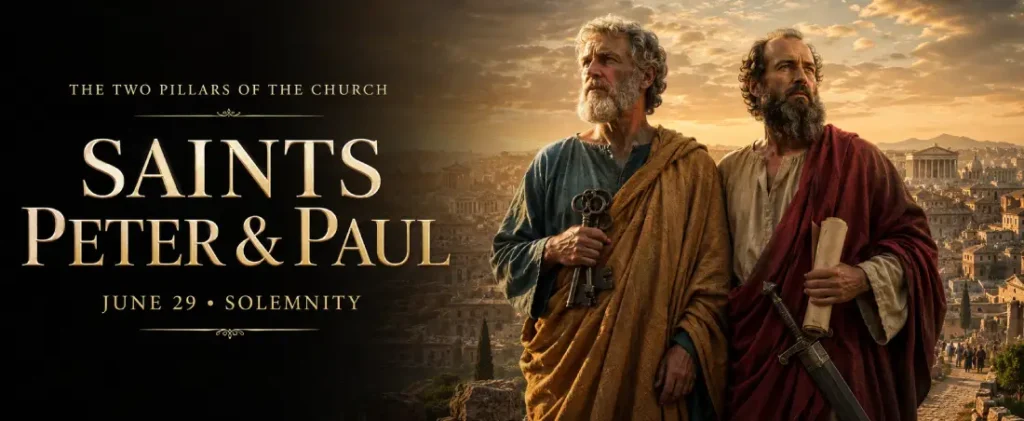
Christian art often depicts Peter holding keys. These symbolize the authority entrusted to him by Christ.
He may also appear with a rooster, recalling his denial and repentance.
Paul is usually shown holding a sword, representing both his martyrdom and the power of the Word of God.
He often carries a book or scroll symbolizing his inspired letters.
When shown together, Peter and Paul represent the unity and universality of the Church.
The Spiritual Legacy of Saints Peter and Paul
The lives of Peter and Paul teach enduring spiritual lessons.
Peter teaches that failure does not have the final word. Even grave weakness can become a path to holiness through repentance and trust in Christ.
Paul teaches that no person is beyond God’s mercy. The persecutor became an apostle because grace transformed his heart.
Together they remind Christians that the Church is built not upon human perfection but upon divine grace.
Their witness continues to inspire priests, missionaries, catechists, scholars, and ordinary believers around the world.
Why Saints Peter and Paul Still Matter Today
Nearly twenty centuries have passed since Peter and Paul walked the streets of Jerusalem, Antioch, and Rome. Yet their voices still speak to the modern world.
Peter calls Christians to remain faithful to Christ and united with His Church.
Paul urges believers to carry the Gospel courageously into every culture and every generation.
Their lives proclaim a timeless truth: God chooses ordinary and imperfect people to accomplish extraordinary things.
The fisherman and the former persecutor became two of the greatest saints in Christian history because they surrendered everything to Jesus Christ.
That is why the Church continues to honor Saints Peter and Paul—not merely as heroes of the past, but as living witnesses whose faith still points millions of souls toward Christ today.