
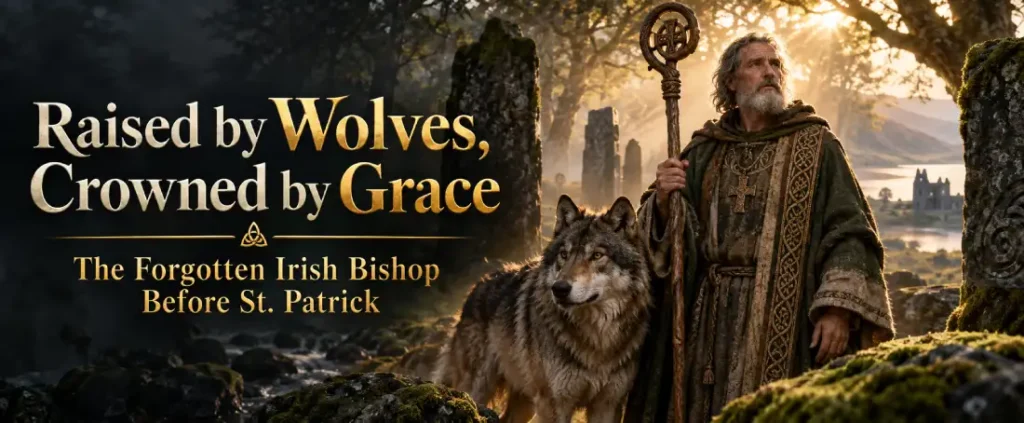
Who Was St. Ailbhe?
Saint Ailbhe of Emly (also known as Saint Ailbe, Albeus, or Saint Elvis) was a 6th-century Irish bishop, monastic founder, and evangelist revered as the Patron Saint of Munster and the Patron Saint of Wolves. Celebrated on his feast day of September 12, St. Ailbhe is traditionally honored as one of the four “Pre-Patrician Saints” of Ireland—missionaries who cultivated the Catholic faith in southern Ireland alongside and preceding the work of Saint Patrick.
As the founding Bishop of the See of Emly in County Tipperary, St. Ailbhe established a world-renowned monastic center of learning, interceded for St. Enda to found the monastery on the Aran Islands, and authored an ancient Celtic monastic rule centered on humility, perpetual prayer, and radical hospitality. Catholic tradition famously remembers him for being rescued and suckled by a she-wolf as an abandoned infant—a creature he protected in her old age.
The Pre-Patrician Saints of Ireland: A Historical Comparison
Before Saint Patrick’s mission reached nationwide prominence, four regional bishops laid the foundation for the Gospel across southern Ireland.
| Saint | Primary Region | Main Tradition / Legacy | Feast Day |
| St. Ailbhe of Emly | Munster (Tipperary) | Founded See of Emly; nursed by a she-wolf; authored early monastic rule. | September 12 |
| St. Declan of Ardmore | Waterford (Decies) | Evangelized southern coast; founded Ardmore Monastery; famous for miracle stone. | July 24 |
| St. Ciarán of Saigir | Ossory (Offaly) | Founded monastery of Saigir; lived as an ascetic hermit among wild animals. | March 5 |
| St. Ibar of Beggerin | Wexford | Established monastic school on Beggerin Island; defender of early Irish autonomy. | April 23 |
The Spiritual Need: Trusting Divine Providence in Isolation
When personal abandonment or unexpected isolation strikes, surrendering to God’s providence feels nearly impossible. When earthly protectors fail or human circumstances turn hostile, the soul naturally recoils in anxiety.
Saint Ailbhe’s life proves a forgotten truth: God never abandons a soul entrusted to Him. Cast into the wilderness at birth, Ailbhe was preserved not by human nobility, but by God’s sovereign control over creation. His life demonstrates that when we surrender to the Father’s divine will, God transforms our deepest trials into the foundation for sanctity and spiritual fatherhood. As Our Lord teaches, “Not every one who says to me, ‘Lord, Lord,’ shall enter the kingdom of heaven, but he who does the will of my Father who is in heaven” (Matthew 7:21, RSV-2CE). St. Ailbhe did not merely profess faith; he aligned his life completely with the Father’s Divine Will.
Biblical & Magisterial Foundation
The life and legacy of St. Ailbhe rest upon three core Catholic doctrines: Divine Providence, the Stewardship and Renewal of Creation, and Episcopal Authority.
1. Divine Providence and Heavenly Fatherhood
Sacred Scripture promises that God’s fatherly protection transcends human abandonment:
“For my father and my mother have forsaken me, but the LORD will take me up.”
— Psalm 27:10 (RSV-2CE)
The Catechism of the Catholic Church teaches that God actively governs His creation toward its final end:
- CCC 302: Creation was made “in a state of journeying” (in statu viae) toward ultimate perfection, under God’s continuous guidance.
- CCC 305: Jesus requests childlike trust in the Father’s providence, who provides for our smallest physical and spiritual needs.
St. Ailbhe’s miraculous preservation in the wild demonstrates how Divine Providence directs unexpected means to fulfill God’s saving plan.
2. Creation Harmonized in Christ
The miraculous account of St. Ailbhe living in harmony with wild beasts is understood in Catholic theology as a manifestation of sanctifying grace. While the fullness of cosmic renewal awaits the Parousia (CCC 1046–1047), the lives of the saints offer a foretaste of Christ’s victory over the disorder of Original Sin, echoing the prophetic promise of Messianic peace (cf. Isaiah 11:6; St. Thomas Aquinas, Summa Theologiae I, q. 96, a. 1).
The Church affirms that human dominion over nature is a sacred stewardship rooted in mercy:
- CCC 2416: Animals are God’s creatures surrounded by His providential care; humanity owes them kindness.
- CCC 2418: Inflicting needless suffering or destruction on animal life is contrary to human dignity.
3. Episcopal Governance and Pastoral Care
As Bishop of Emly, Ailbhe exercised the apostolic authority passed down through the episcopacy to sanctify Munster. St. Peter instructs all spiritual pastors:
“Tend the flock of God that is your charge, not by constraint but willingly… being examples to the flock.”
— 1 Peter 5:2–3 (RSV-2CE)
The Magisterium confirms that individual bishops serve as authentic teachers and visible sources of unity within their local dioceses (CCC 886).
Historical Context: The Life & Rule of St. Ailbhe
The Infant Under the Rock (Pious Hagiography)
According to ancient Irish hagiographical tradition (specifically the medieval Vita Sancti Albei)—which the Church preserves as a pious historical witness rather than dogmatic Scripture—Ailbhe was born in County Tipperary during the 5th century. He was the son of a maidservant named Sanclit and fathered by a local ruler. Displeased by the birth, the chieftain ordered the infant exposed in the wilderness.
Divine Providence intervened through nature. A mother she-wolf carried the baby to her lair, nursing him alongside her pups. When travelers later found the child living beneath a stone ledge, they noted he was completely unharmed. He was named Ailbhe—from the Old Irish Ail (“rock”) and beo (“alive”), meaning “he who was found alive under the rock.”
Missionary Zeal & The Monastery of Emly
After being taken into human care, Ailbhe was instructed in the Christian faith and eventually ordained. Recognized alongside Saints Declan, Ciarán, and Ibar as one of Munster’s early bishops, Ailbhe worked tirelessly to convert pagan tribes. Saint Patrick held Ailbhe in such high regard that he named him the “Patrick of Munster.”
St. Ailbhe established his primary episcopal seat and monastery at Emly in County Tipperary. Emly grew into a major European monastic school. Great saints, including St. Enda of Aran, trained under Ailbhe’s spiritual direction. When Enda sought a secluded place for solitude, Ailbhe successfully petitioned King Aengus of Cashel to grant Enda the Aran Islands.
“I Will Protect Thee, Old Mother”
Decades into his episcopal ministry, hunters cornered an aging she-wolf near Emly. Recognizing the creature that had nursed him in infancy, St. Ailbhe stepped between the hunters and the beast.
The old wolf ran directly to the bishop and rested her head upon his chest. St. Ailbhe comforted her, saying: “I will protect thee, Old Mother.” He ordered the hunters to lower their weapons and welcomed the she-wolf into the monastery, where she lived peacefully for the remainder of her life.
The Monastic Rule of St. Ailbhe
St. Ailbhe passed to eternal rest around A.D. 528. His spiritual wisdom lived on in an ancient Old Irish monastic rule attributed to his tradition:
“Let him be steady, let him not be restless; let him be wise, learned, pious; let him be vigilant… Against the torrent of the world, let him be watchful; against the brood of the world, let him be warlike.”
— The Rule of St. Ailbhe
Practical Application: The Catholic “Battle Plan” for Daily Holiness
Modern Catholics can apply St. Ailbhe’s monastic discipline through four practical daily steps:
1.Establish Daily Order and Recollection:Fostering interior silence amidst noise.
Set fixed morning and evening prayer times. Begin your day with 15 minutes of silent mental prayer before engaging with digital devices. Bow your mind before God without excitement or distraction.
2.Practice Radical Christian Hospitality:Welcoming Christ in the stranger.
St. Ailbhe’s rule mandated clean lodging and warm fires for every visitor. Open your home to those needing encouragement. Serve guests with charity, seeing Christ in the vulnerable (CCC 1822).
3.Protect the Vulnerable and Honor Creation:Stewardship and mercy toward creation.
Avoid cruelty toward animals and wastefulness toward nature (CCC 2415–2418). Support pro-life pregnancy centers that rescue abandoned and vulnerable infants, mirroring Ailbhe’s deliverance.
4.Engage in Daily Spiritual Combat:Standing firm against cultural corruption.
Be watchful against worldly compromise. Fast on Fridays, go to Confession monthly, and guard your senses against digital temptations (Ephesians 6:12).
Daily Examination of Conscience (St. Ailbhe Standard)
- Did I maintain interior peace today, or yield to restlessness and anxiety?
- Did I treat my family, colleagues, and visitors with genuine Christian hospitality?
- Have I placed full trust in Divine Providence, or let fear dictate my choices? (CCC 305)
- Did I complete my daily prayers with attention and reverence?
Recommended Catholic Spiritual Tools
- Ignatius Catholic Study Bible (RSV-2CE): Essential for Lectio Divina, featuring scholarly Catholic commentary aligned with the Catechism and Church Fathers.
- Rugged Paracord Rosary: Durable prayer beads built for daily spiritual warfare and outdoor prayer.
- The Liturgy of the Hours (4-Volume Breviary): Sanctify the hours of your day alongside the universal Church.
Prayer to Saint Ailbhe of Emly
O God, Who in Your marvelous Providence preserved Saint Ailbhe from infant abandonment and raised him to be a holy Shepherd to the people of Munster:
Grant us, through his heavenly intercession, the grace of childlike trust in Your Fatherly care. Teach us to be steady in virtue, humble in service, generous in hospitality, and courageous against worldly temptations.
May we extend mercy to all Your creation and remain forever obedient to Your holy Will. Through our Lord Jesus Christ, Your Son, Who lives and reigns with You in the unity of the Holy Spirit, God, for ever and ever. Amen.
Saint Ailbhe of Emly, pray for us!
Frequently Asked Questions
Yes. Elvis is the Anglicized version of the Old Irish name Ailbhe (or Albeus). Welsh and English historical records frequently refer to Saint Ailbhe as St. Elvis, and the village of St. Elvis in Pembrokeshire, Wales, was named after his missionary journeys.
St. Ailbhe is the patron saint of wolves because ancient Irish tradition holds that he was nursed by a she-wolf after being abandoned as an infant. In his old age, Bishop Ailbhe protected this same wolf from hunters, giving her sanctuary within his monastery.
Yes. Church tradition lists St. Ailbhe as one of the four “Pre-Patrician Saints” who established Christian communities in southern Ireland prior to St. Patrick’s wider mission. St. Patrick recognized Ailbhe’s holiness and confirmed him as the founding Bishop of Emly in Munster.
The feast day of St. Ailbhe is celebrated on September 12. It is observed across Ireland, particularly as a solemn feast in the Archdiocese of Cashel and Emly, where his monastic foundation served as a hub of Celtic Christianity.