Modern secular culture frequently pressures Catholics to choose between quiet compromise and bold fidelity. In a world of noise, materialism, and moral decay, proclaiming the fullness of the Gospel can feel daunting. How does a faithful Catholic live out an unyielding commitment to Jesus Christ while cultivating deep personal holiness, reverence for the Sacraments, and active charity toward the vulnerable?
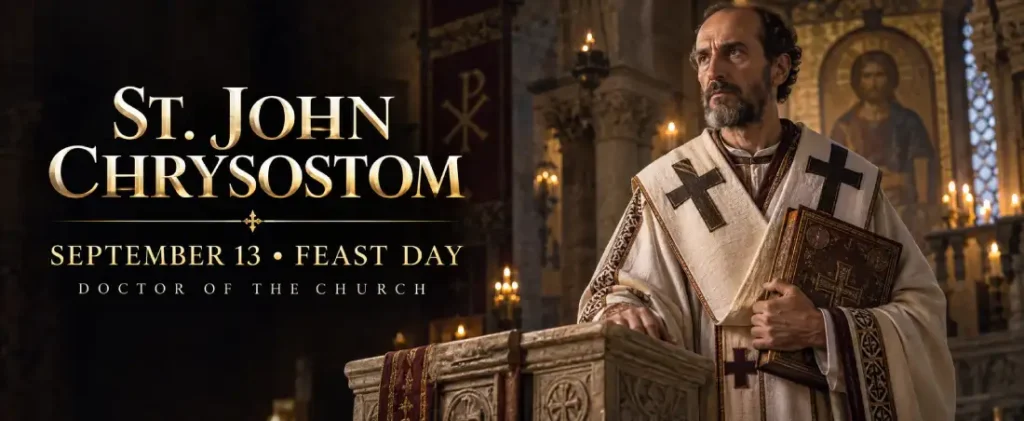
St. John Chrysostom (c. 347–407 AD), Archbishop of Constantinople and Doctor of the Church, offers a battle-tested blueprint for unyielding orthodoxy, active charity, and biblical literacy. Known universally as Chrysostomos (“Golden-Mouthed”) for his breathtaking preaching, he taught that authentic Catholic discipleship requires far more than passive belief. It demands radical obedience to the Father’s will (Matthew 7:21), daily saturation in Sacred Scripture, profound reverence for the Holy Sacrifice of the Mass, and tangible works of mercy for the poor.
Biblical & Magisterial Foundation
His writings directly anchor key definitions in Catholic dogmatic and moral theology, as frequently cited in the Catechism of the Catholic Church (CCC).
1. Sacred Scripture: The Spiritual Food of the Soul
St. John Chrysostom insisted that ignorance of Scripture is the root cause of moral decay and heresy. He exhorted lay Christians—not merely monks and clergy—to read and meditate on the Word of God daily within their households.
“To ignore Scripture is to ignore Christ… A man who is well acquainted with the Scriptures is fortified against all attacks of evil.”
— St. John Chrysostom, Homilies on the Epistles
This patristic principle is enshrined in Catholic dogmatic teaching:
- CCC 2654: “The Church forcefully and specially exhorts all the Christian faithful… to learn ‘the surpassing knowledge of Jesus Christ’ (Phil 3:8) by frequent reading of the divine Scriptures… Let them remember that prayer should accompany the reading of Sacred Scripture, so that a dialogue takes place between God and man.”
- Scriptural Anchor: “All scripture is inspired by God and profitable for teaching, for reproof, for correction, and for training in righteousness, that the man of God may be complete, equipped for every good work.” (2 Timothy 3:16–17, RSV-2CE)
2. The Holy Eucharist & The Real Presence
As an Eastern Father whose liturgy remains the central Eucharistic Liturgy of the Byzantine Catholic Rite (The Divine Liturgy of St. John Chrysostom), St. John spoke of the Holy Sacrifice of the Mass with awe-inspiring reverence. He emphasized the objective reality of the Eucharistic transformation—teaching the substantial conversion of the bread and wine into the actual Body, Blood, Soul, and Divinity of Jesus Christ, a dogma later formally defined by the Magisterium as Transubstantiation (Council of Trent, Session 13, Canon 2; CCC 1376).
“It is not man who causes the things offered to become the Body and Blood of Christ, but he who was crucified for us, Christ Himself. The priest stands bearing the icon of Christ, speaking those words, but their effectiveness and grace are from God.”
— St. John Chrysostom, Homilies on the Treachery of Judas
The Church affirms this profound mystery across magisterial texts:
- CCC 1374: “The mode of Christ’s presence under the Eucharistic species is unique… In the most blessed sacrament of the Eucharist ‘the body and blood, together with the soul and divinity, of our Lord Jesus Christ and, therefore, the whole Christ is truly, really, and substantially contained.'”
- CCC 1386 & Warning on Unworthy Reception: “To prepare for worthy reception of this sacrament, the faithful should observe the fast prescribed in their Church’s law… Anyone who desires to receive Christ in Eucharistic Communion must be in the state of grace.”
- Scriptural Anchor: “Whoever, therefore, eats the bread or drinks the cup of the Lord in an unworthy manner will be guilty of profaning the body and blood of the Lord. Let a man examine himself, and so eat of the bread and drink of the cup.” (1 Corinthians 11:27–28, RSV-2CE)
3. Almsgiving, Wealth, and Social Justice
St. John Chrysostom is best known for his fierce defense of the poor and his relentless condemnation of luxury and greed. He taught that private property carries a social mortgage and that failing to assist those in dire need is a violation of justice.
- CCC 2446: The Catechism explicitly quotes St. John Chrysostom on the Catholic obligation to the poor: “Not to enable the poor to share in our goods is to steal from them and deprive them of life. The goods we possess are not ours, but theirs.”
- CCC 2447: “The works of mercy are charitable actions by which we come to the aid of our neighbor in his spiritual and bodily necessities… Among these, giving alms to the poor is one of the chief witnesses to fraternal charity: it is also a work of justice pleasing to God.”
- Scriptural Anchor: “And the King will answer them, ‘Truly, I say to you, as you did it to one of the least of these my brethren, you did it to me.'” (Matthew 25:40, RSV-2CE)
Historical & Patristic Context
The Life and Trials of the Golden-Mouthed Doctor
Born in Antioch around 347 AD, John was raised by a devout Christian widow, Anthusa, and studied rhetoric under the famous pagan orator Libanius. After embracing rigorous monastic asceticism in the Syrian desert, he returned to Antioch and was ordained a priest in 386 AD.
For twelve years, his sermons in the Cathedral of Antioch captivated the Christian world. His style combined intense expository commentary on Sacred Scripture with sharp, uncompromising practical applications regarding Christian morality.
In 397 AD, John was consecrated Archbishop of Constantinople, the imperial capital. Immediately, he instituted sweeping reforms:
- Reforming the Clergy: He stripped away luxurious living quarters, disciplined lax priests, and reallocated ecclesiastical wealth to construct hospitals and soup kitchens.
- Denouncing Imperial Corruption: He fearlessly called out the corruption, vanity, and extravagance of the imperial court, specifically targeting Empress Eudoxia.
- Defending the Sacred: He refused to grant communion to corrupt politicians or nobles who refused to repent of extortion and oppression.
His unyielding stance enraged political elites and envious bishops. In 403 AD, an illegal synod (the Synod of the Oak), organized by Patriarch Theophilus of Alexandria and supported by Empress Eudoxia, falsely condemned John and sent him into exile. Though recalled briefly after public outcry and an earthquake in Constantinople, he was banished again in 404 AD to Armenia and forced on a brutal death march toward Pityus on the Black Sea.
On September 14, 407 AD, exhausted and dying at Comana in Pontus, St. John Chrysostom uttered his famous final words before yielding his spirit:
“Glory be to God for all things!” (Doxa tō Theō pantōn heneka!)
| Quick Fact | Historical Detail |
| Born / Died | c. 347 AD (Antioch, Syria) – September 14, 407 AD (Comana, Pontus) |
| Feast Day | September 13 (Latin Rite) / November 13 (Eastern Rites) |
| Declared Doctor | 1568 by Pope St. Pius V |
| Patronage | Preachers, Orators, Speakers, Lectors, Constantinople |
| Major Works | On the Priesthood, Homilies on St. Matthew, Homilies on Romans |
Patristic Witness & Papal Endorsements
The Church has consistently held up Chrysostom as a master of pastoral theology:
- St. Thomas Aquinas famously remarked that he would rather possess St. John Chrysostom’s Homilies on the Gospel of St. Matthew than the entire city of Paris.
- Pope Benedict XVI praised him during a 2007 General Audience: “Chrysostom is among the most prolific of the Fathers… He is an authentic Father of the Church, a teacher of the faith, and a witness to the extraordinary vitality of the early Church who continues to speak to modern believers today.”
Practical Application: The Catholic “Battle Plan” for Daily Life
St. John Chrysostom was not an abstract theologian; he was a pastor focused on soul-winning and holiness. To honor his legacy and implement his teachings today, Catholics should execute this step-by-step spiritual battle plan:
| Pillar | Daily Action Target | Practical Execution |
| 1. Scripture Meditation | 15–20 Minutes Daily | Read the New Testament slowly (Lectio Divina); apply text to daily choices. |
| 2. Worthy Communion | Frequent Sacraments | State of grace via regular Confession; observe Eucharistic fast; adore the Real Presence. |
| 3. Direct Almsgiving | Dedicated Monthly Income | Tithing 5–10% to poor relief, crisis pregnancy centers, and local shelters. |
| 4. Domestic Church | Daily Household Prayer | Family Rosary, saint readings, making the home a sanctuary of truth. |
| 5. Custody of Tongue | Daily Examination | Eliminate gossip, slander, and idle speech; defend Catholic truth boldly. |
Step 1: Daily Scripture Meditation (Lectio Divina)
Commit to spending 15 to 20 minutes every morning reading Sacred Scripture. Begin with the New Testament (e.g., the Gospel of Matthew or the Epistles of St. Paul). Read slowly, highlight key verses, and ask: “What is God calling me to change in my life through this passage?”
Step 2: Worthy & Reverent Eucharistic Reception
Never approach the Holy Eucharist casually or in a state of unconfessed mortal sin. Practice regular Sacramental Confession (at least monthly, or immediately after grave sin). Observe the Eucharistic fast conscientiously. Make an act of profound adoration before receiving Holy Communion, remembering Chrysostom’s admonition that the altar is surrounded by angels.
Step 3: Direct, Personal Almsgiving
Chrysostom taught that Christ waits for us in the person of the poor. Almsgiving is not an optional extra; it is a fundamental duty of justice. Establish a dedicated portion of your monthly income (e.g., 5–10%) specifically for direct charitable relief to the poor, crisis pregnancy centers, or local shelters. Combine financial support with physical acts of service.
Step 4: Build the “Domestic Church” (Ecclesiola)
Chrysostom coined the concept of the home as a “miniature church” (ecclesiola). Gather your family daily for evening prayers, the Holy Rosary, and a brief reading from the Lives of the Saints or the Scripture lessons of the day. Turn off secular entertainment and make your home a sanctuary of truth.
Step 5: Custody of the Tongue
As the “Golden-Mouthed” Doctor, Chrysostom warned against using the tongue—which receives the Holy Body of Christ—to slander, gossip, or speak falsehoods. Perform a daily examination of conscience on your speech. Resolve never to speak ill of absent persons, avoid idle gossip, and use your voice to defend Catholic truth and encourage others.
Free Spiritual Resource Callout: Download our printable 1-Page St. John Chrysostom Daily Examination Card to keep in your Missal or prayer journal to track your speech, daily scripture reading, and works of mercy.
Recommended Resources for Spiritual Growth
To deepen your understanding of St. John Chrysostom and incorporate his teachings into your daily routine, consider these essential Catholic tools:
1. Ignatius Catholic Study Bible: New Testament (RSV-2CE)
- Overview: Featuring commentary by Dr. Scott Hahn and Curtis Mitch, this volume draws heavily upon patristic commentary, including St. John Chrysostom’s homilies on the Gospels and Epistles.
- Why We Recommend It: It provides an orthodox, scholarly, and practical guide for lay Catholics seeking to fulfill Chrysostom’s mandate to master Sacred Scripture.
2. St. John Chrysostom: On Marriage and Family Life (Popular Patristics Series)
- Overview: A concise collection of Chrysostom’s homilies on Christian marriage, the education of children, and transforming the home into a domestic church.
- Why We Recommend It: Essential reading for married couples and parents seeking clear, timeless Catholic guidance on sanctifying family life amidst a pagan culture.
3. Handcrafted Heavy-Duty Wood & Cord Catholic Rosary
- Overview: A durable, beautifully crafted 5-decade rosary built for serious daily prayer warriors.
- Why We Recommend It: St. John Chrysostom emphasized spiritual warfare through persistent prayer. A durable physical rosary serves as a daily tactical weapon in your prayer life.
Frequently Asked Questions
St. John Chrysostom earned the title Chrysostomos (Greek for “Golden-Mouthed”) posthumously in the 6th century due to his extraordinary eloquence, masterly expository preaching of Sacred Scripture, and uncompromising moral clarity in Antioch and Constantinople.
St. John Chrysostom is the patron saint of Christian preachers, public speakers, orators, lectio divina practitioners, lecto-catechists, and the city of Constantinople. Faithful Catholics invoke his intercession for clarity, courage, and zeal when proclaiming the Catholic Faith.
St. John Chrysostom taught the literal Real Presence of Jesus Christ in the Eucharist, affirming that the bread and wine undergo a substantial conversion into Christ’s Body and Blood—a dogma formally defined as Transubstantiation. He strictly warned against receiving Holy Communion unworthily.
St. John Chrysostom died in exile on September 14, 407 AD, at Comana Pontica, after being forced by imperial guards on a grueling death march in harsh weather. Before dying, he received the Holy Sacraments and uttered: “Glory be to God for all things!”