
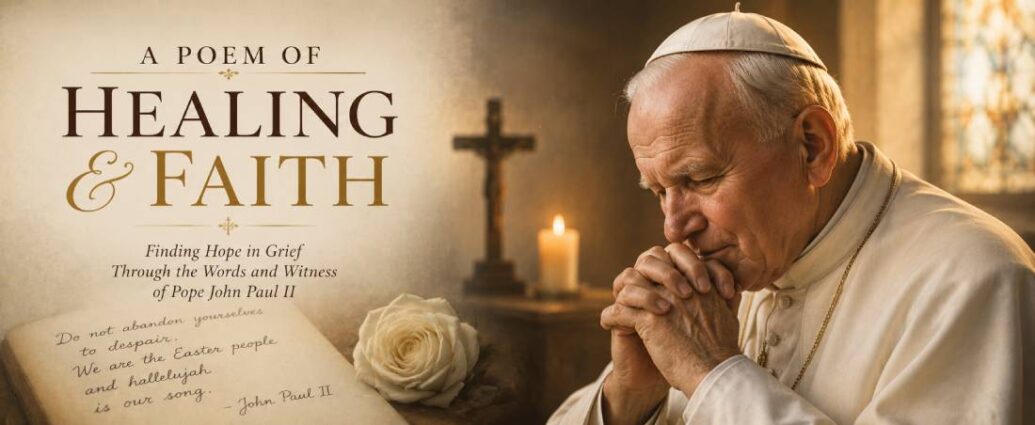
Long before Karol Wojtyła became Pope John Paul II, he was a young boy who experienced devastating loss. The future pope lost his mother, Emilia, when he was only eight years old. This profound grief shaped his faith and inspired him to write a moving poem that still speaks to grieving hearts today.
The Pope John Paul II poem titled “Over This, Your White Grave” offers a window into how one of Christianity’s most influential leaders processed loss through faith. His words remind us that even in our darkest moments, God walks with us through the valley of the shadow of death.
The Story Behind Pope John Paul II’s Poem About Loss
Young Karol stood at his mother’s graveside in 1929, confronting a reality no child should face. Emilia Wojtyła died from heart and kidney failure, leaving behind her husband and two sons. Her death devastated the family, particularly young Karol, who had shared a special bond with his devout mother.
Years later, he poured his grief into poetry. The poem reflects raw emotion transformed by faith. He wrote of standing over her white grave, grappling with absence while clinging to eternal hope. This wasn’t mere theological exercise—it was a son’s love letter to the mother he lost too soon.
His father raised him in deep Catholic devotion after Emilia’s death. This foundation helped Karol develop a prayer life that would sustain him through future losses, including his brother’s death just three years later.
Catholic Prayer Poetry as a Path Through Grief
Poetry became one of Karol’s spiritual disciplines. He understood that creative expression could channel grief into something redemptive. Many Christians today struggle to articulate their pain when loved ones die. We fumble for words at funerals and gravesides, wondering if our faith should somehow shield us from sorrow.
John Paul II’s poetry teaches us differently. Faith doesn’t eliminate grief—it transforms it. Prayer doesn’t erase our tears—it gives them meaning. When we bring our broken hearts before God, He meets us there with compassion.
The tradition of Catholic prayer poetry stretches back centuries. Believers have always used verse to process spiritual truths too deep for ordinary prose. David’s psalms overflow with raw emotion. Generations of saints wrote hymns through their suffering. This creative expression honors both our humanity and God’s presence in our pain.
What Pope John Paul II Mother’s Death Taught Him
Emilia’s influence on her son extended far beyond her short life. She had prayed fervently for him, instilling in young Karol a devotion to Mary that would characterize his entire papacy. After his mother died, this Marian devotion deepened. He saw Mary as a spiritual mother who understood a son’s grief.
The loss taught him compassion for the suffering. Throughout his pontificate, John Paul II reached out to the grieving, the sick, and the dying with unusual tenderness. He had walked through that dark valley himself. His authenticity came from lived experience, not theoretical theology.
His mother’s death also reinforced his understanding of eternal life. Catholics believe death is not the end but a doorway to eternity. This hope doesn’t diminish our grief, but it does anchor us. We weep, but not as those without hope. We mourn, but we also believe in resurrection.
How John Paul II Writings Guide Us Through Sorrow
The writings of John Paul II offer practical wisdom for modern grievers. He never minimized pain or offered cheap comfort. Instead, he pointed toward Christ, who wept at Lazarus’s tomb even knowing He would raise him. Jesus validated human grief while promising divine hope.
When you lose someone you love, give yourself permission to grieve fully. Bring your pain to God in prayer, even if your prayers dissolve into tears. Write your own prayers or poems if words fail you. Creative expression can unlock emotions too deep for ordinary speech.
Lean into Christian community during loss. Isolation intensifies grief, while fellowship lightens it. The body of Christ exists to bear one another’s burdens, especially in seasons of mourning.
Remember that grief comes in waves, not stages. Some days feel manageable; others knock you flat. This is normal. Even popes experience this human reality. Your faith remains real even when emotions overwhelm you.
Finally, hold fast to resurrection hope. We will see our loved ones again if they died in Christ. Death has lost its sting. The grave cannot hold those whom Jesus claims. This isn’t wishful thinking—it’s the bedrock promise of Christian faith.
Pope John Paul II understood grief because he lived it. His poetry, his prayers, and his example show us how to walk through loss without losing faith. In our darkest hours, his words still whisper hope.
Source: NCRegister