
National Mall Prayer Rally: A Catholic Call to Moral Renewal, Sacramental Repentance, and the Social Reign of Christ
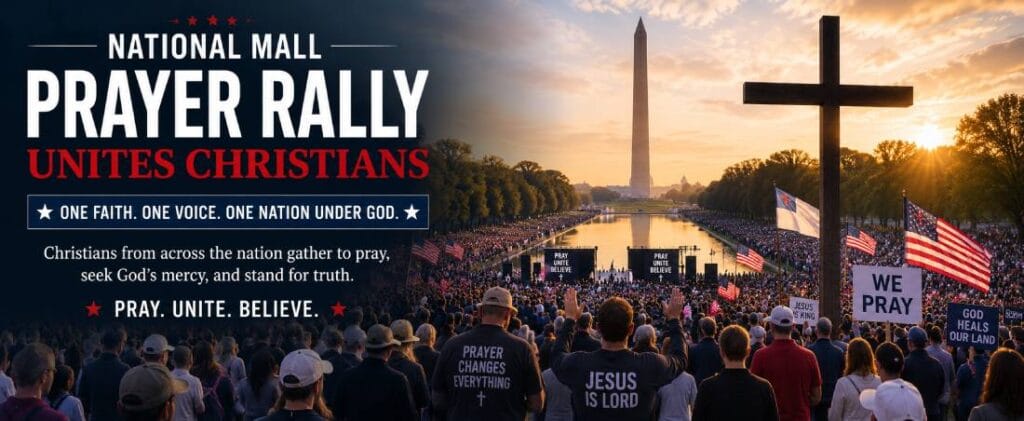
Public Witness on the National Mall: Faith in the Public Square
Thousands of Christians assembled on the National Mall in Washington, D.C., for a day dedicated to intercession, public worship, and prayer for the United States. Spanning families, young adults, and clergy from across the country, the gathering highlighted a growing desire among citizens to re-anchor public life in moral and spiritual principles. The event featured speeches, public intercession, and music centered on national restoration.
The presence of prominent Catholic prelates, including Cardinal Timothy Dolan of New York and Bishop Robert Barron of the Diocese of Winona-Rochester, provided spiritual leadership throughout the day. Both bishops have long been articulate defenders of the sanctity of human life, religious freedom, and public evangelization. Their participation highlighted the vital role Catholic shepherds play when witnessing to moral truth in the secular public square (Gaudium et Spes 76).
As Cardinal Dolan and Bishop Barron demonstrated, Catholic involvement in civic prayer gatherings serves a distinct purpose: to give witness to the dignity of the human person from conception to natural death (Evangelium Vitae 57; CCC 2270). Rather than treating public prayer as a political tool, Catholic teaching emphasizes that civic engagement must always flow from a desire to order human society toward the true Good, which is God Himself (Centesimus Annus 41; CCC 1902).
Beyond Civil Religion: The Social Reign of Christ the King and Natural Law
The central theme of the rally, “One Nation under God,” drew upon the historical phrase added to the U.S. Pledge of Allegiance in 1954. Organizers stressed that political reforms alone cannot repair deep moral wounds, calling instead for national spiritual renewal. While popular American discourse often attributes the nation’s founding to “biblical foundations” in a generic sense, Catholic political philosophy offers a more precise and rigorous framework.
Authentic national healing cannot be achieved through Enlightenment political theory or vague civil religion. Instead, Catholic theology insists that human legislation and civil institutions must align with the Natural Law—the rational creature’s participation in the Eternal Law of God, as articulated by St. Thomas Aquinas (Summa Theologiae, I-II, q. 91, a. 2). When civil laws contradict the Natural Law—such as through the legal protection of abortion or the dismantling of the traditional family—society loses its moral foundation (CCC 1956; Veritatis Splendor 72).
Furthermore, the Church proclaims the Social Reign of Christ the King, a principle solemnized by Pope Pius XI in his encyclical Quas Primas (1925). Pius XI taught that true peace and moral stability can only exist when both individuals and civil authorities recognize the sovereign authority of Jesus Christ (Quas Primas 18). As the Catechism of the Catholic Church affirms, “The duty of offering God genuine worship concerns man both individually and socially” (CCC 2105). True renewal requires that public policies respect the inviolable law of God, acknowledging that political community cannot find its ultimate purpose apart from divine truth.
Understanding Repentance: Scriptural Hermeneutics and Sacramental Grace
A cornerstone text of the rally was 2 Chronicles 7:14: “If my people, who are called by my name, will humble themselves and pray and seek my face and turn from their wicked ways, then I will hear from heaven, and I will forgive their sin and will heal their land.” While this passage movingly expresses God’s mercy toward a penitent people, Catholic biblical interpretation (hermeneutics) requires a proper understanding of how Old Testament promises apply today.
According to the Second Vatican Council’s Dogmatic Constitution on Divine Revelation, Dei Verbum, Holy Scripture must be read within the living Tradition of the Church, recognizing the unity of God’s plan across both Testaments (Dei Verbum 12). The Old Covenant promises made to Israel find their ultimate fulfillment typologically in Jesus Christ and His Mystical Body, the Church (CCC 1094). Therefore, applying 2 Chronicles 7:14 directly to a modern secular nation-state as an automatic temporal covenant misinterprets the text. Instead, Scripture calls all individuals to an ongoing, personal conversion (metanoia) that finds its realization within the sacramental life of the Church (CCC 1423, 1427).
Moreover, Catholic moral theology teaches that national repentance cannot remain an abstract, collective sentiment expressed through public rallies alone. Sins against life, justice, and purity are committed by individuals and require real, personal conversion. For the Catholic faithful, true repentance necessitates the Sacrament of Penance and Reconciliation (Confession). As defined by the Council of Trent (Session XIV) and reiterated in the Catechism, Confession is the ordinary means established by Christ for the forgiveness of grave sins committed after Baptism (CCC 1422, 1446). Public prayer gatherings ought to direct souls toward sacramental absolution, Eucharistic Adoration, and personal amendment of life, where divine grace genuinely heals human hearts (CCC 1378, 1468).
Catholic Ecumenism vs. Religious Indifferentism
The participation of Catholic bishops alongside Protestant ministers highlighted the complex reality of ecumenical collaboration in the public sphere. While joint efforts on critical moral issues—such as defending the unborn, supporting marriage, and safeguarding religious liberty—are meritorious, Catholic doctrine strictly distinguishes between authentic ecumenism and religious indifferentism.
Religious indifferentism is the erroneous belief that all religious confessions are equally valid pathways to salvation, or that doctrinal differences between Christian communities are ultimately unimportant (Pius XI, Mortalium Animos). Catholic ecumenism, as articulated by the Second Vatican Council in Unitatis Redintegratio, seeks the ultimate restoration of full visible unity among all Christians within the one true Church of Christ, which subsists in the Catholic Church (Unitatis Redintegratio 3, 8; CCC 816, 870).
When Catholics join fellow citizens in public prayer for the nation, they do so not by compromising Catholic dogma or adopting non-Catholic ecclesiological assumptions. Instead, Catholics offer a witness of solidarity in defense of the Natural Law while inviting all people of goodwill to discover the fullness of revealed truth preserved within the Catholic Church (Dignitatis Humanae 14; CCC 816). Collaborative public action for the common good must always be paired with a clear, uncompromised commitment to Catholic truth.
Practical Devotions and Civic Duty for the Faithful
To build upon the spiritual awareness generated by public gatherings, Catholics are called to engage in authentic, time-tested spiritual practices rather than relying on non-Catholic devotional models. Expressions such as “praying Scripture over” places or “declaring promises” reflect Evangelical terminology that differs from the Catholic tradition of liturgical and contemplative prayer.
Catholic tradition provides robust spiritual resources for personal and national renewal (CCC 2698):
- The Holy Rosary: Long recognized as a powerful prayer for peace and spiritual protection, the Rosary invokes the intercession of the Blessed Virgin Mary to defeat moral evils and protect families (Rosarium Virginis Mariae 40; CCC 2683).
- Eucharistic Adoration: Spending time before the Blessed Sacrament offers intercession for civic leaders, national repentance, and the conversion of culture directly in the presence of Christ (CCC 1378, 2698).
- The Liturgy of the Hours: As the official public prayer of the Church, the Divine Office consecrates the daily hours to God, offering Psalms and supplications for the whole world (CCC 1174).
- Fasting and Penance: In accordance with Church tradition, voluntary fasting and acts of mortification make satisfaction for sin and implore divine mercy upon society (CCC 1434, 2043).
Spiritual devotions must also translate into responsible civic action. Catholic moral teaching requires the faithful to participate actively in civic life, exercising their right to vote in accordance with a well-formed Catholic conscience (Christifideles Laici 42; CCC 2239–2240). As Pope St. John Paul II taught in Evangelium Vitae, Catholics have an inescapable duty to oppose laws that legalize abortion, euthanasia, or the destruction of family structures, actively voting to establish an authentic culture of life (Evangelium Vitae 73; CCC 2242).
Action Guide: Catholic Spiritual Practice for Civic Renewal
To assist individuals, families, and parish groups in putting faith into action, the following matrix outlines core spiritual practices, their theological objectives, and their authoritative Church citations:
| Spiritual Practice | Objective in Civic Renewal | Magisterial Citation & Anchor |
| Sacramental Reconciliation | Individual conversion and restoration of sanctifying grace | CCC 1422–1424; Council of Trent, Sess. XIV |
| Eucharistic Adoration | Intercession for civil leaders and public moral transformation | CCC 1378, 2698; Ecclesia de Eucharistia 25 |
| The Holy Rosary for Life | Protection of the unborn, traditional marriage, and families | Evangelium Vitae 103; CCC 2270, 2683 |
| Informed Civic Action | Voting and advocating according to Natural Law and Church teaching | CCC 2239–2240; Christifideles Laici 42 |
| Liturgy of the Hours | Sanctification of daily time and national intercession | CCC 1174, 1175; Sacrosanctum Concilium 83 |
Frequently Asked Questions
Catholics support public prayer and civic intercession when grounded in moral truth and Natural Law. However, Catholic doctrine emphasizes that public gatherings should direct souls toward sacramental grace, particularly Sacramental Reconciliation and Eucharistic Adoration, rather than relying solely on non-sacramental corporate sentiment (CCC 1422, 2105).
Catholic scripture hermeneutics interpret 2 Chronicles 7:14 typologically. Old Testament covenant promises to Israel find their ultimate fulfillment in Jesus Christ and the Church (CCC 1094). National repentance requires personal moral conversion (metanoia) through the Sacrament of Penance rather than automatic temporal promises to modern secular nations (Dei Verbum 12).
Yes, Catholics may collaborate with non-Catholic Christians on moral issues like defending life and religious liberty. However, Church teaching prohibits religious indifferentism—the belief that all denominations are equal. Authentic ecumenism seeks full visible unity within the Catholic Church while witnessing to uncompromised Catholic truth (Unitatis Redintegratio 3; CCC 816).
Catholics are encouraged to pray the Holy Rosary for life and families, offer hours in Eucharistic Adoration, pray the Liturgy of the Hours, fast, and receive Sacramental Reconciliation. These practices are paired with informed voting and civic action consistent with Catholic moral theology (CCC 2239–2240, 2698).
Conclusion: Building a Culture of Life and Truth
The prayer assembly on the National Mall demonstrated that millions of citizens desire moral clarity and spiritual renewal in an increasingly secularized world. Yet, emotional momentum alone cannot transform a culture. Lasting renewal requires an unwavering commitment to the truth of Jesus Christ, mediated through His Church, implemented in sacramental life, and reflected in laws that honor the Natural Law.
By grounding civic intercession in Sacramental Reconciliation, Eucharistic Adoration, the Holy Rosary, and informed political participation, Catholic faithful act as true salt and light in society. As the Church continues her mission in the world, she calls all people to recognize that human flourishment is inseparable from divine truth, and that national healing begins with personal conversion to the Lordship of Christ.
Source: Crux
Continue Your Faith Journey
Catholic Prayer for Toxic Family Conflict: A Faithful Guide to Boundaries, Healing, and Charity
Navigating family conflict, estrangement, and narcissistic behavior requires balancing Christian charity with prudent boundaries. Discover how Catholic doctrine, Sacred Scripture, and daily…
How to Pray the 54 Day Rosary Novena: Complete Guide and Tracker
Discover how to pray the miraculous 54 Day Rosary Novena with this Catholic guide, complete 27-day petition and thanksgiving schedule, and daily…
How to Conduct a Catholic Night Prayer Examination of Conscience: A Step-by-Step Spiritual Guide
Learn how to conduct a daily Catholic night prayer examination of conscience using the timeless five-step method of the saints. Cultivate true…