
Catholic Prayer for Toxic Family Conflict: A Faithful Guide to Boundaries, Healing, and Charity
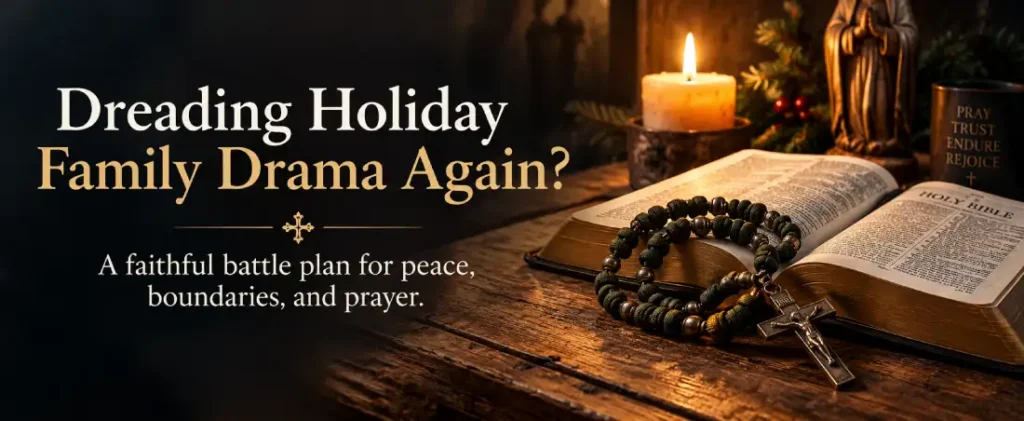
When family life becomes a battleground of narcissism, estrangement, and holiday drama, faithful Catholics often feel trapped between explosive anger and guilt. You may wonder if setting firm boundaries with destructive relatives violates Christian charity or the Fourth Commandment.
Catholic theology clearly teaches that while Christians must offer unconditional forgiveness (CCC 2843), forgiveness does not require enduring continuous abuse, enabling sin, or surrendering holy boundaries. Establishing prudent distance from abusive parents or toxic siblings is fully compatible with Catholic moral teaching when done to protect virtue, peace, and the spiritual well-being of your home (CCC 2217, CCC 1822).
1. The Spiritual Wounding of Family Conflict
Because the family is the “domestic Church” (Ecclesia domestica, CCC 1656), systemic dysfunction and emotional abuse within the household cause profound spiritual damage. Victims frequently struggle with righteous indignation that risks devolving into sinful bitterness or despair.
During high-stress seasons—such as holidays, weddings, or funerals—these tensions inevitably erupt. At the core of this struggle is a foundational principle: Grace builds upon nature, but grace also restores order where nature has fallen.
True Christian charity is not emotional compliance or codependency. It is willing the ultimate good of the other for the love of God. Sometimes, the greatest good you can offer an unrepentant relative is a boundary that halts their ability to commit further sin against you.
2. Biblical & Magisterial Foundations: Honor, Forgiveness, and Boundaries
Navigating toxic relationships requires examining Scripture and Magisterial teaching with precision.
“If it be possible, as much as is in you, have peace with all men.”
— Romans 12:18 (Douay-Rheims)
The Fourth Commandment and Its Authentic Limits
The Fourth Commandment obliges children to honor their father and mother (Exodus 20:12; CCC 2214). While living under parental authority, children owe their parents obedience in all that is for the good of the child or family (CCC 2217).
When children reach adulthood, obedience ceases, though respect remains obligatory (CCC 2218). However, honoring an abusive or narcissistic parent does not mean accepting manipulation or physical harm. Honoring them means:
- Praying for their conversion and eternal salvation.
- Refraining from detraction—the unjust revelation of another’s hidden faults without an objectively grave reason (CCC 2477). (Note: Seeking confidential counsel from a priest, licensed therapist, or trusted authority to process abuse or seek safety is fully justified and does not constitute detraction under CCC 2479).
- Ensuring their basic material needs are met in old age or illness, provided this can be arranged safely (CCC 2218).
Parents are likewise warned by St. Paul: “Fathers, do not provoke your children to anger, lest they become discouraged” (Colossians 3:21, RSV-2CE). Where a parent habitually violates this trust, an adult child is not morally obligated to expose their own household to ruin.
Forgiveness vs. Reconciliation
Catholic theology makes a critical distinction between forgiveness and reconciliation:
- Forgiveness is an act of the will—a decision to surrender personal vengeance and release the debt of sin to God (CCC 2843). It is unconditional and mandatory: “Forgive… seventy times seven” (Matthew 18:21–22).
- Reconciliation is conditional. It requires the offender’s genuine repentance, amendment of life, and restoration of justice.
Joseph in Genesis freely forgave his brothers, yet he tested their hearts before restoring communion with them (Genesis 42–45). When a relative remains unrepentant or abusive, forgiveness must be granted in the heart, but reconciliation may remain impossible.
The Divine Order of Charity (Ordo Caritatis)
St. Thomas Aquinas teaches that charity is an ordered virtue (Summa Theologiae, II-II, Q. 26). Under the Ordo Caritatis, a Catholic’s moral obligations are structured according to their primary duty of state:
- God, loved above all created things.
- The salvation of one’s own soul, which must never be endangered through mortal sin.
- One’s primary domestic Church (spouse and children), to whom a married adult owes immediate protection and care (Summa Theologiae, II-II, Q. 26, A. 11).
- Parents, siblings, and extended kin, who are owed honor and aid in grave necessity, but whose demands cannot supersede the spiritual safety of one’s immediate home.
3. Patristic & Canonical Wisdom: Truth Over False Peace
The Catholic Saints were no strangers to severe family conflict.
St. Thomas Aquinas on Fraternal Correction
In the Summa Theologiae (II-II, Q. 33, A. 6), St. Thomas notes that if correcting a person produces no fruit and only worsens their malice, correction must be omitted out of prudence:
“If, however, it is foreseeable that the sinner will not receive the correction, but will be turned to worse things, fraternal correction should be foreborne.”
When dealing with severe narcissistic traits—refusing accountability and twisting words—St. Thomas justifies stepping back rather than engaging in destructive arguments.
St. John Chrysostom on False Peace
St. John Chrysostom explains that a superficial peace purchased at the expense of truth is invalid:
“It is not peace that God approves, but that which is united with godliness… For peace is not always a good thing.” (Homilies on Matthew, Homily 35)
Enduring toxic behavior simply to “keep the peace” at holiday dinners is a false peace. True Christian peace (Pax Christi) is founded on truth and righteousness.
Saints Who Overcame Toxic Family Dynamics
- St. Dymphna: Fled her abusive father to protect her purity and life.
- St. Thomas Aquinas: Resisted his family when his brothers kidnapped and imprisoned him for over a year to stop his vocation.
- St. Francis of Assisi: Publicly renounced his abusive father Pietro Bernardone to fulfill his mission.
4. The Catholic “Battle Plan” for Toxic Conflict
Handling toxic family relationships requires spiritual warfare, sacramental grace, and psychological prudence.
Quick-Reference: Holiday Boundaries Checklist
- Time-Box Visits: Limit gatherings to a strict, pre-planned timeframe (e.g., 2 hours in a neutral location).
- Drive Separately: Ensure you have an independent means of transportation to leave if boundaries are violated.
- Apply Meek Non-Engagement: Respond politely to baiting without defending, explaining, or justifying your choices.
- State Clear Terms: Communicate consequences calmly prior to events (e.g., “If shouting occurs, we will excuse ourselves”).
- Pray Before Entering: Recite the St. Michael Prayer for protection against spirits of discord before entering.
Step 1: Sacramental Examination & Confession
Examine your soul to ensure your motives are free from vengeance:
- Am I acting out of a desire for peace, or a desire to inflict hurt?
- Have I nurtured bitter fantasies or spoken unjust detraction?
If resentment has taken root, make a prompt Confession. Sacramental grace removes the spiritual blindness caused by anger.
Step 2: Implement the Holy Boundary Framework
When interacting with difficult relatives:
- Limit Exposure: Keep visits time-boxed and held in neutral environments.
- Practice Polite Distance: Avoid sharing personal information that can be weaponized.
- Enforce Exit Strategies: If disrespect occurs, execute your exit calmly without dramatic argument.
Step 3: Daily Spiritual Protection
- Pray the Holy Rosary Daily: Offer your decades to Our Lady, Undoer of Knots, asking her to untangle family wounds.
- Invoke St. Michael: Pray for protection against spirits of division before gatherings.
- Have Masses Offered: Request Holy Mass intentions for the conversion of difficult family members.
Catholic Prayer for Toxic Family Conflict and Healing
In the Name of the Father, and of the Son, and of the Holy Spirit. Amen.
O Lord Jesus Christ, Prince of Peace, I place my family into Your wounded Hands. You know the deep anguish of my heart caused by unhealed wounds, narcissistic pride, estrangement, and conflict.
Grant me the grace of unconditional forgiveness. I release all bitterness and desire for revenge against [Name relatives]. I surrender them to Your divine mercy, asking for their conversion and salvation.
Heavenly Father, grant me supernatural wisdom to establish holy and prudent boundaries. Protect my mind, home, and immediate family from spiritual and emotional harm. Deliver me from the temptation to engage in vain arguments.
Our Lady, Undoer of Knots, pray for my family.
St. Joseph, Head of the Holy Family, guard our home.
St. Michael the Archangel, defend us in battle.
Amen.
5. Recommended Tools for Spiritual Warfare and Healing
The following study tools and spiritual weapons provide practical support when enforcing boundaries and praying for family healing:
- The Ignatius Catholic Study Bible (RSV-2CE): Provides Patristic commentary on Scripture to clarify Catholic teachings on family, trial, and forgiveness.
- Rugged Rosary (Paracord): A durable prayer tool for daily spiritual warfare and invoking Our Lady’s intercession.
- Be Healed by Dr. Bob Schuchts: Integrates Catholic theology with psychological insights to help heal emotional wounds rooted in family trauma.
Frequently Asked Questions
No. Establishing low-contact or no-contact is not inherently sinful if done without hatred or revenge and for grave reasons—such as protecting your mental, emotional, or spiritual safety. You must continue praying for their salvation while maintaining necessary boundaries (CCC 2217, CCC 1822).
Adult children honor difficult parents by praying for their conversion, refusing to speak of them with malice, and ensuring their basic physical needs are met in old age or illness (CCC 2218). Honoring a parent does not require enduring ongoing abuse or accepting unlawful demands (CCC 2217).
No. Catholic theology distinguishes between forgiveness and reconciliation. Forgiveness is an internal release of malice required unconditionally of all Christians (CCC 2843). Reconciliation is conditional, requiring the offender’s genuine repentance, reform, and restoration of trust.
Detraction is the unjust disclosure of another’s hidden faults without a grave reason (CCC 2477). Discussing toxic dynamics confidentially with a priest, licensed counselor, or trusted advisor to process trauma, seek safety, or establish moral boundaries is fully justified and is not detraction (CCC 2479).
Continue Your Faith Journey

How to Pray the 54 Day Rosary Novena: Complete Guide and Tracker
Discover how to pray the miraculous 54 Day Rosary Novena with this Catholic guide, complete 27-day petition and thanksgiving schedule, and daily…
The 7 Best Catholic Bibles for Beginners and Scholars: The Ultimate Guide to Faithful Scripture Study
Discover the best Catholic Bibles for beginners and scholars. Compare top translations like the RSV-2CE, NABRE, and Douay-Rheims to deepen your daily…
What Is a Novena? The Biblical Meaning and How to Pray It
Discover the biblical origins of the Catholic nine-day prayer tradition and learn how to pray a novena effectively. Transform your prayer routine…