
Why Does the Catholic Bible Have More Books Than the Protestant Bible?
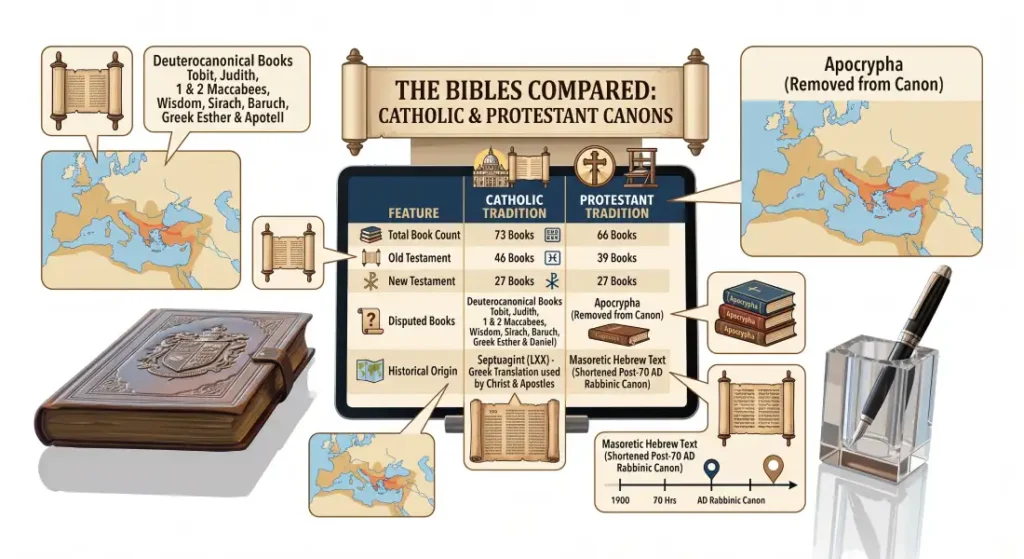
When you compare a Catholic Bible to a Protestant Bible, the most immediate difference is its size. The Catholic Bible contains 73 books (46 in the Old Testament, 27 in the New Testament). In contrast, the Protestant Bible contains 66 books (39 in the Old Testament, 27 in the New Testament).
This difference is not a modern translation choice—it reflects a 1,500-year history of how Christians define apostolic authority and divine revelation.
The seven books in question are known as the deuterocanonical books (meaning “second canon,” though equal in authority): Tobit, Judith, 1 Maccabees, 2 Maccabees, Wisdom, Sirach (Ecclesiasticus), and Baruch, along with Greek additions to Esther and Daniel.
The Apostolic Roots: The Septuagint Canon
The early Church did not receive the Bible as a pre-bound book with a printed table of contents. Instead, the apostles and early Christians relied on the Septuagint—the Greek translation of the Hebrew Scriptures completed between 250 and 100 BC by Jewish scholars in Alexandria.
The Septuagint contained the deuterocanonical books. When New Testament authors quote Old Testament passages, they quote directly from the Septuagint in the vast majority of instances.
“The tradition of the Indian and Eastern churches, as well as the Western Latin Church, received the sacred books of the Old Testament from the Greek Septuagint translation.” — Catechism of the Catholic Church (CCC 120)
Because the apostles preached across the Greco-Roman world using the Septuagint, the early Christian Church embraced these books as inspired Scripture from the very beginning.
How the Church Defined the Canon
How did we get the official list of Bible books? The Holy Spirit guided the Church’s Magisterium to discern which writings were divinely inspired.
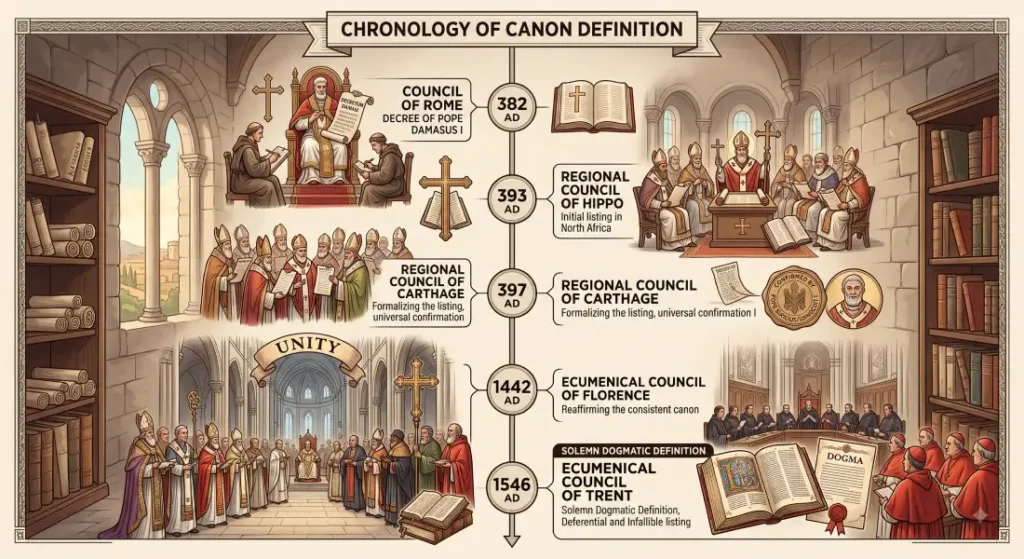
The regional Council of Carthage in 397 AD promulgated the complete 73-book canon. This decree was subsequently submitted to and confirmed by the Bishop of Rome, reflecting the unified judgment of the universal Church.
For over a thousand years, Western Christendom used this exact 73-book Bible. In 1546, the Council of Trent solemnly defined this canon dogmatically in response to Protestant reformers who sought to remove the deuterocanonical texts.
St. Augustine and Church Authority
Great Doctors of the Church defended the authority of the Church to discern the canon. St. Augustine of Hippo (354–430 AD) recognized that Christians accept Scripture precisely because of the Church’s divine commission.
“I should not believe the Gospel, except as moved by the authority of the Catholic Church.” — St. Augustine (Contra Epistolam Manichaei)
Augustine accepted the deuterocanonical books without reservation because the Church had handed them down. Early Church Fathers such as Clement of Rome, Polycarp, Irenaeus, Tertullian, Clement of Alexandria, and Cyprian all quoted these books as sacred authority.
While scholar St. Jerome initially raised questions about translating books outside the Hebrew collection, he humbly submitted his scholarly opinion to the judgment of the Pope and Church councils.
New Testament References to the Deuterocanon
The New Testament explicitly draws upon the events and moral teachings found in the deuterocanonical books.
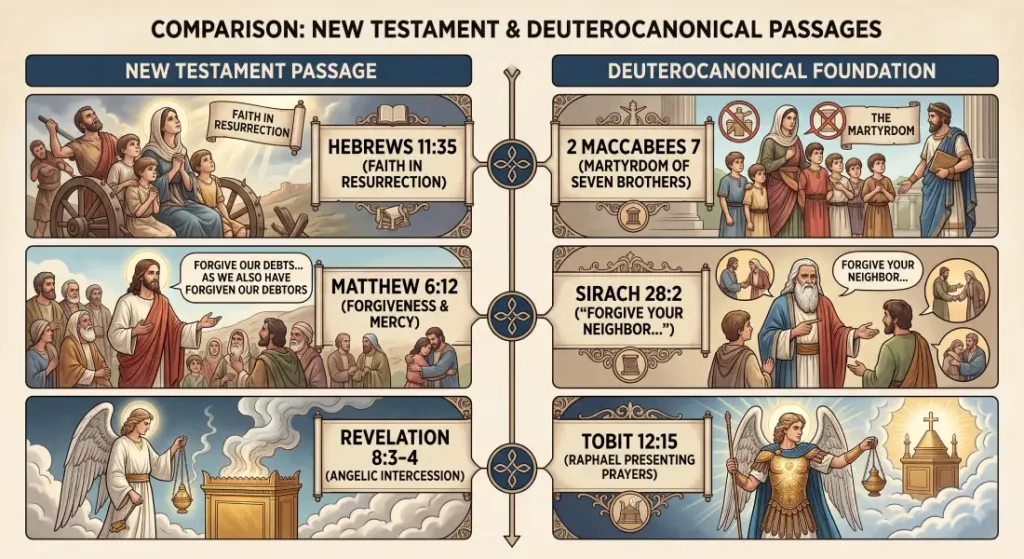
Consider Hebrews 11:35, which speaks of saints who “were tortured, refusing to accept release, that they might rise again to a better life.”
This passage is a direct historical reference to 2 Maccabees 7, where a heroic mother and her seven sons endured brutal torture rather than violate God’s law, proclaiming their explicit hope in the bodily resurrection.
Key Biblical Teachings in the Deuterocanonical Books
The deuterocanonical books contain essential doctrines of the Catholic faith that illuminate the continuity between the Old and New Testaments.
1. Prayer for the Dead and Purgatory
“For if he were not expecting that those who had fallen would rise again, it would have been superfluous and foolish to pray for the dead… Therefore he made atonement for the dead, that they might be delivered from their sin.” — 2 Maccabees 12:44–45
This passage provides clear Old Testament evidence for praying for the deceased—a practice the Church has maintained since apostolic times. It presupposes a state of post-death purification (Purgatory) where souls benefit from the suffrages of the living (CCC 1030–1032).
2. Sanctifying Value of Almsgiving
“For almsgiving delivers from death, and it will purge away every sin. Those who perform deeds of charity and righteousness will have fullness of life.” — Tobit 12:9
“Water extinguishes a blazing fire, so almsgiving atones for sin.” — Sirach 3:30
This teaching does not promote Pelagianism (the heresy that we earn salvation by our own human effort). Rather, it illustrates that good works, performed under the influence of God’s grace, participate in our ongoing sanctification and growth in charity (CCC 2010).
3. Creation Ex Nihilo and God’s Immanence
“For the whole world before thee is as a little grain of the balance, yea, as a drop of the morning dew that falleth down upon the earth.” — Wisdom 11:22
Long before St. Thomas Aquinas systematically detailed the balance between God’s infinite transcendence and His presence in creation, the Book of Wisdom expressed this exact reality. This book reflects on the dignity of the human soul and uses Greek philosophical categories to express Hebrew faith in divine providence and immortality.
4. Heroic Virtue and Marian Types
“Then Judith fell upon her face, and put ashes upon her head… and cried unto the Lord.” — Judith 9:1
The Book of Judith showcases a widow who rescues her people through prayer, fasting, and courageous action. Catholic typology has long viewed Judith as a foreshadowing of the Blessed Virgin Mary, who cooperates uniquely with God’s plan to defeat evil.
Why Were These Books Removed by Reformers?
If these 73 books were accepted for over 1,500 years, why did Protestant Bibles drop seven of them?
During the 16th-century Protestant Reformation, Martin Luther adopted a shortened Hebrew canon that coalesced within rabbinic Judaism in the centuries following the destruction of the Jerusalem Temple.
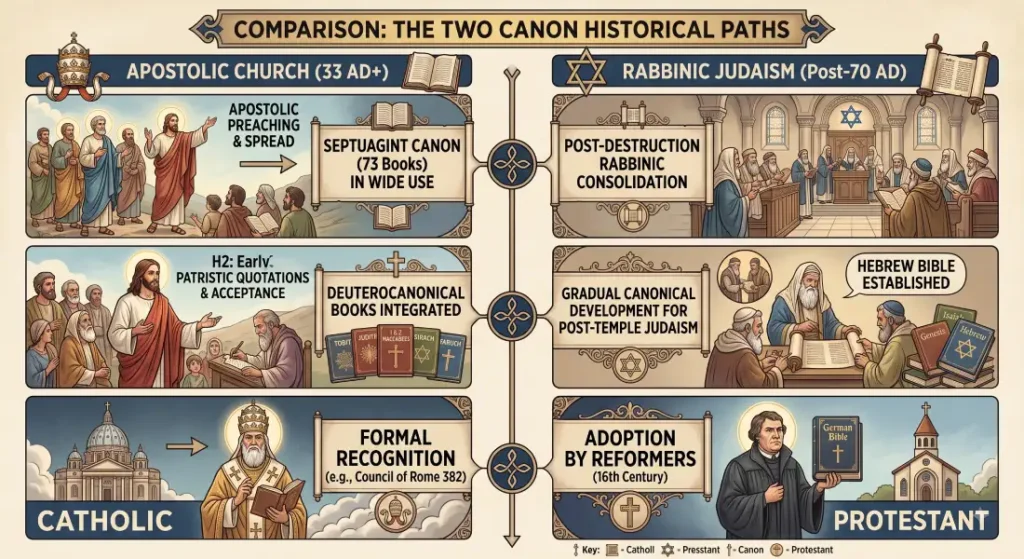
Protestant reformers favored this shortened Hebrew canon primarily because the deuterocanonical books explicitly supported Catholic doctrines they rejected—most notably purgatory, prayer for the dead, and the merit of good works.
Luther moved these seven books to an appendix titled “Apocrypha,” declaring them useful but not divinely inspired.
A Question of Authority
Ultimately, the count of books in your Bible reveals who you trust to preserve God’s Word.
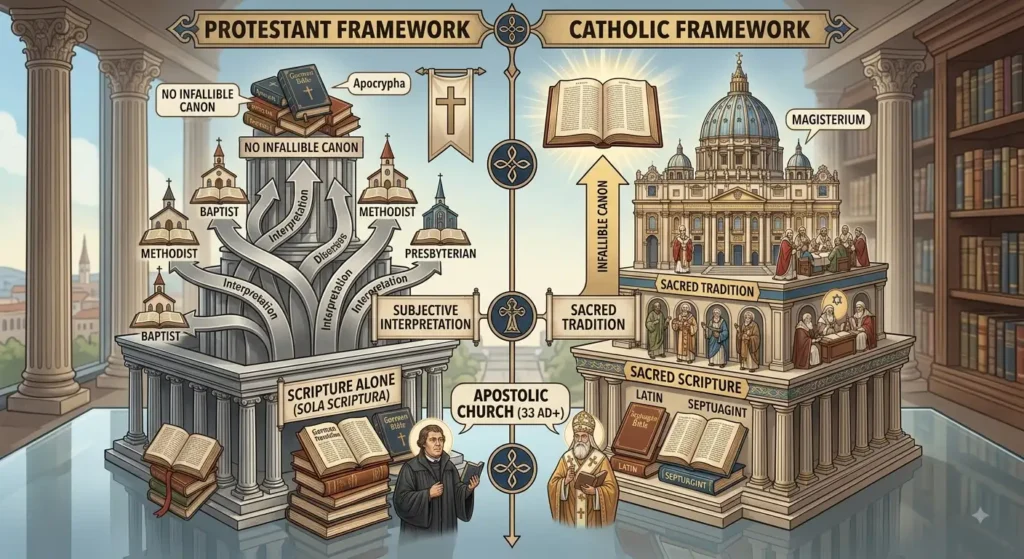
Scripture does not contain an internal list of its own books. To know which books belong in the Bible, we rely on an authoritative witness outside of Scripture.
Christ established His Church with the authority to teach, govern, and preserve the deposit of faith (Matthew 16:18–19, 1 Timothy 3:15). The Magisterium identified the canon under the guidance of the Holy Spirit.
When you open a 73-book Catholic Bible, you hold the complete written revelation entrusted to the Church across two millennia.
Frequently Asked Questions
No. The Council of Trent (1546) did not add new books. It solemnly defined the same 73-book canon that regional church councils in Hippo (393 AD) and Carthage (397 AD) had affirmed over 1,100 years earlier. Trent responded to Protestant reformers who were actively removing books.
Martin Luther removed the deuterocanonical books because their explicit teachings—such as praying for the dead (2 Maccabees 12:45) and the spiritual merit of almsgiving (Tobit 12:9)—contradicted his new doctrines of Sola Fide (faith alone) and Sola Scriptura (Scripture alone).
“Apocrypha” means “hidden writings.” Protestants use this label to imply that these books are non-canonical or spurious. Catholics use the term Deuterocanonical (“second canon”) to indicate that while their canonization was confirmed later in historical debate, they possess equal divine inspiration and authority as the protocanonical books.
Continue Your Faith Journey
Catholic Prayer for Adult Child Who Left the Faith: Doctrinal & Intercessory Action Plan
Discover how Catholic parents can overcome grief and guilt when an adult child leaves the Church. Anchored in Scripture, Church teaching, and…
How to Conduct a Catholic Night Prayer Examination of Conscience: A Step-by-Step Spiritual Guide
Learn how to conduct a daily Catholic night prayer examination of conscience using the timeless five-step method of the saints. Cultivate true…
What Is the Assumption of Mary? Catholic Dogma, Scripture, and Meaning
Explore the Catholic dogma of the Assumption of the Blessed Virgin Mary. Learn how Munificentissimus Deus, Sacred Scripture, and Church Tradition reveal…