
Catholic Prayer for Adult Child Who Left the Faith: Doctrinal & Intercessory Action Plan
1. Overcoming Guilt & Helplessness When an Adult Child Leaves the Church
There is no sorrow quite like watching a child whom you baptized, catechized, and brought to the Altar walk away from the Holy Catholic Church. For devout parents, this grief is intensely spiritual. You spent years ensuring they received the Sacraments, yet today they may identify as secular, agnostic, or “spiritual but not religious.”
When adult children abandon the Sacraments, parents often experience crippling guilt. They ask themselves where they failed as mothers or fathers, wondering if their personal shortcomings pushed their children away. This heavy burden can lead aging parents into paralyzing despair.
Doctrinal Summary for Grieving Parents
While parents possess a grave sacred duty to catechize their minor children (CCC 2221), the Catholic Church teaches that every adult person possesses God-given free will and moral agency (CCC 1730). God does not hold parents morally culpable for the free, voluntary decisions of an adult child who chooses to reject the Truth, provided the parents strove to fulfill their parental duties to the best of their ability and knowledge. Parental intercession remains a uniquely powerful, grace-filled instrument that can penetrate the hardest heart when human words fail.
Replacing crippling guilt with targeted intercession begins with understanding what the Church actually teaches about human freedom, divine grace, and parental duty.
2. Biblical & Magisterial Foundation: Free Will, Grace, and Intercession
Effective intercession requires grounded theology. The Magisterium draws a clear distinction between parental responsibility and adult free will:
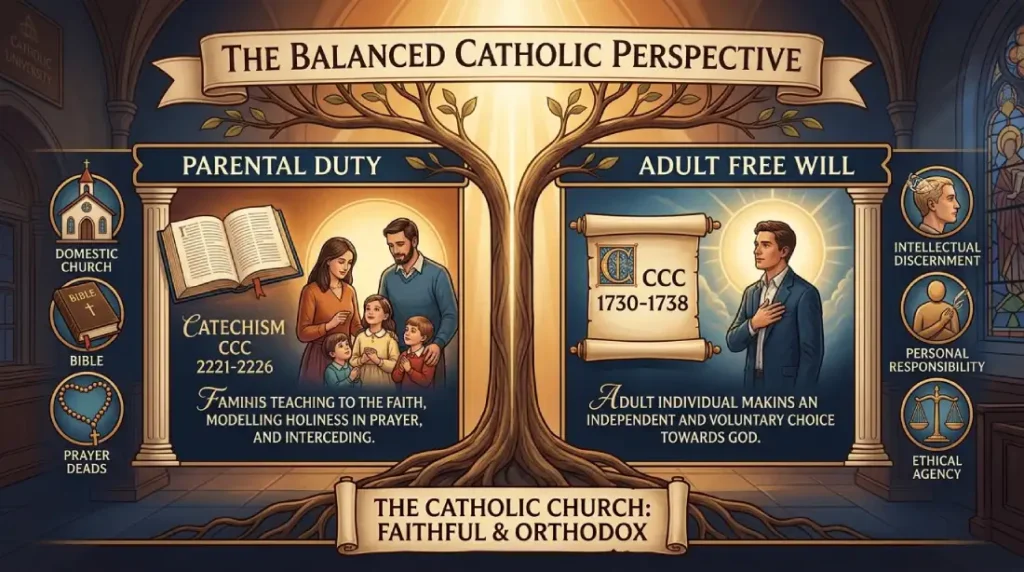
The Limits of Parental Responsibility and the Gift of Free Will
The Catechism of the Catholic Church highlights the noble vocation of parents as primary educators in the domestic church:
“The role of parents in creation is of such importance that it is almost impossible to provide an adequate substitute.” (CCC 2221) “Parents have the first responsibility for the education of their children…” (CCC 2223)
Yet the Church also acknowledges that God created man as a rational being endowed with free will (CCC 1730). When a child reaches adulthood, personal moral agency takes effect. Prophet Ezekiel speaks directly to this distinction:
“The soul that sins shall die. The son shall not bear the iniquity of the father, neither shall the father bear the iniquity of the son…” (Ezekiel 18:20, RSV-2CE)
Even God Himself, the perfect Father, saw His first human children—Adam and Eve—rebel in the Garden of Eden. Parents must reject the spiritual lie that an adult child’s defection proves complete parental failure.
The Parable of the Father’s Patient Hope
In the Parable of the Prodigal Son (Luke 15:11–32), the father does not chase the son into a distant land to force compliance. He keeps the home open, maintains his dignity, and watches the horizon unceasingly.
When the young man “came to himself” (Luke 15:17), grace moved his heart. Your primary spiritual objective is cooperating with divine grace so your child does the same.
The Efficacy of Intercessory Prayer
Intercession does not violate free will; it obtains actual grace that illuminates the intellect and disposes the heart (CCC 2634, 2635).
Saint Paul commands us to “pray without ceasing” (1 Thessalonians 5:17). Saint James reminds us that “the effectual fervent prayer of a righteous man availeth much” (James 5:16, Douay-Rheims).
3. Historical & Patristic Context: St. Monica and the Church Fathers
Saint Monica stands as the Church’s primary model for parents praying for a prodigal child.
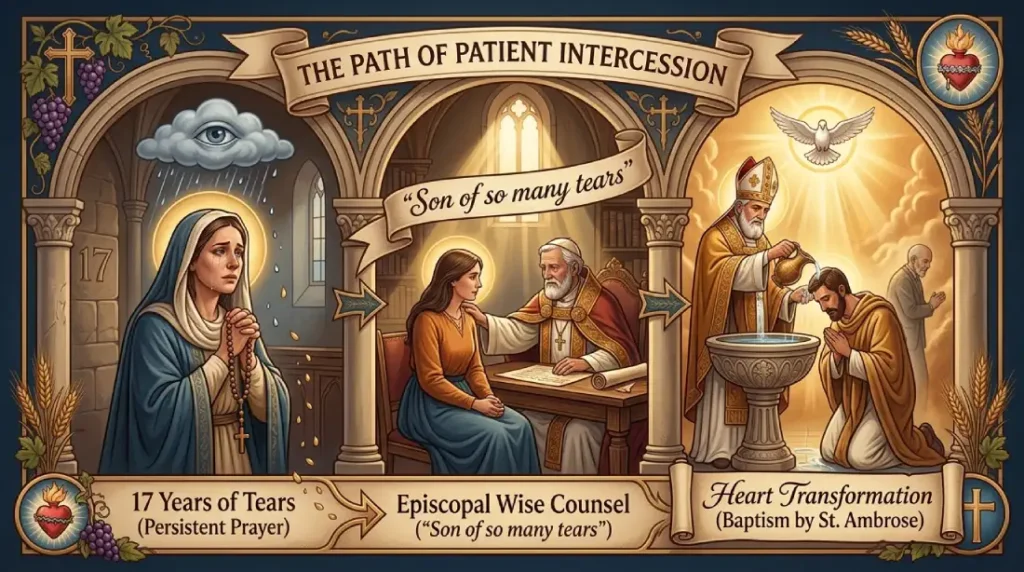
Saint Monica and Saint Augustine: 17 Years of Unceasing Tears
For nearly two decades, Saint Monica wept, fasted, and offered prayers for her son, Augustine. Augustine had embraced Manichaeism, fathered a child out of wedlock, and explicitly rejected Catholic doctrine.
A holy bishop comforted Monica with famous words recorded in Augustine’s Confessions:
“Go away from me now. As host to your living spirit, it is impossible that the son of these tears should perish.” — Saint Augustine, Confessions, Book III, Chapter 12
Augustine was converted in 387 AD under Saint Ambrose and became a Doctor of the Church. His mother offered up her tears as a spiritual sacrifice before God.
Patristic Wisdom on Intercession
The Fathers and Doctors of the Church reaffirm the power of parental intercession:
- Saint John Chrysostom (Homilies on Matthew): Taught that neglecting the spiritual welfare of one’s household severely harms personal holiness.
- Saint Thomas Aquinas (Summa Theologiae, II-II, q. 83, a. 7): Explained that prayer disposes the heart by impetrating light for the intellect without violating human free will.
- Saint Alphonsus Liguori (The Great Means of Salvation): Reminded faithful parents that God grants parents a spiritual instinct to advocate for their children’s salvation.
4. Practical Application: The 5-Step Intercessory Action Plan
Praying effectively for a fallen-away child requires consistency and spiritual order. While you cannot control an adult child’s choices, you can execute a targeted spiritual action plan.
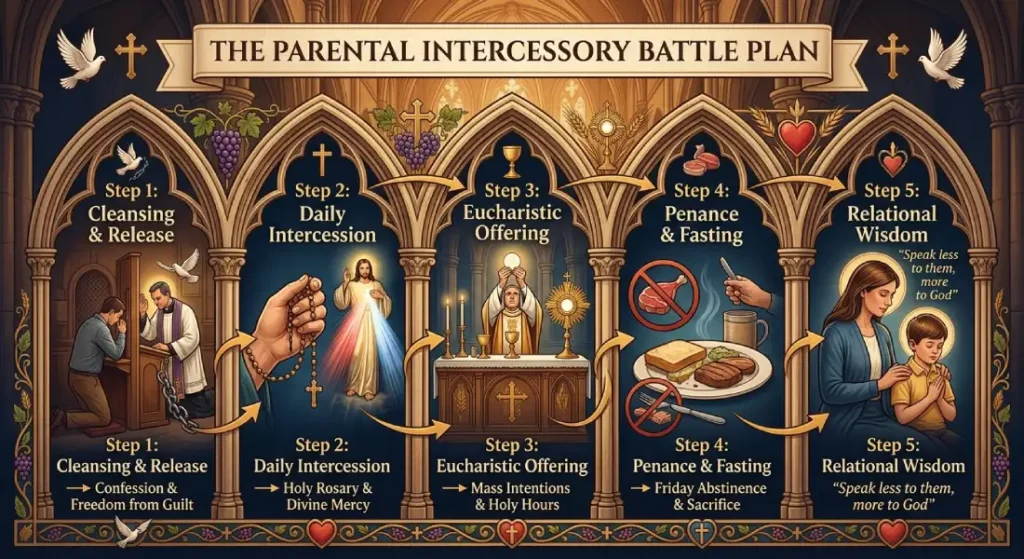
Step 1: Make a Good Confession and Release Unnecessary Guilt
Begin by receiving the Sacrament of Reconciliation. Confess genuine past faults, receive absolution, and surrender false guilt. Lingering shame is a spiritual distraction that hinders persistent prayer.
Step 2: Establish a Dedicated Daily Prayer Rule
Commit to daily spiritual warfare. Offer the Holy Rosary for Mary’s intercession, pray the Chaplet of Divine Mercy at 3:00 PM for hardened hearts, and pray the Saint Monica Novena.
| Daily Practice | Recommended Time | Spiritual Purpose |
| The Holy Rosary | Morning or Evening | Entrusting your child to Mary’s Immaculate Heart. |
| Chaplet of Divine Mercy | 3:00 PM (Hour of Mercy) | Pleading Christ’s Blood over hardened hearts. |
| Saint Monica Novena | 9 Consecutive Days / Ongoing | Seeking patronal intercession for conversion. |
Prayer of a Grieving Parent to Saint Monica
“O Holy Monica, exemplary mother and tireless advocate for your wandering son, look upon my sorrow and present my son/daughter [Name] to the Throne of Divine Mercy. Ask our Lord to remove the scales from their eyes and grant them true repentance. As you never gave up on Augustine, do not give up on my child. Obtain for me patience, charity, and steadfast hope. Amen.”
Step 3: Leverage the Mass and Eucharistic Adoration
Have Mass intentions offered specifically for your child’s reconversion. Spend a weekly Holy Hour before the Blessed Sacrament, placing your child into the Sacred Heart of Jesus.
Step 4: Incorporate Fasting and Ascetical Sacrifice
Certain spiritual strongholds yield only to prayer and fasting (Mark 9:29, Douay-Rheims). Fast on simple meals every Friday and offer daily physical or emotional discomforts in union with the Cross.
Step 5: Practice Relational Wisdom
Avoid constant nagging or theological debate, which often hardens pride. Model Christ’s joy, maintain clear moral boundaries, and pray continuously behind the scenes.

Receive Your Free Prayer Guides
Choose the prayer guides you would like us to send you.
5. Recommended Resources for Family Intercession
Equip yourself with reliable Catholic tools for spiritual warfare:
- The Ignatius Catholic Study Bible: New Testament (RSV-2CE): Provides orthodox commentary by Dr. Scott Hahn to address theological questions.
- Handcrafted Paracord or Solid Wood Rosary: Built for daily, heavy-duty intercessory prayer.
- Manual for Spiritual Warfare (TAN Books): Offers Church-approved prayers and guidance for breaking spiritual strongholds.
Frequently Asked Questions
Not necessarily. While parents must catechize minor children (CCC 2221), adult children possess free moral agency (CCC 1730). If you strove to pass on the Faith, their departure reflects their own choice. Confess past shortcomings, receive absolution, and focus on intercession.
The Holy Rosary paired with the Divine Mercy Chaplet is widely recognized as the most effective combination. The Rosary invokes the Blessed Mother’s intercession, while the Divine Mercy Chaplet implores Christ’s infinite passion for hardened hearts and wandering souls.
Avoid aggressive debates or emotional guilt, which often harden hearts. Invite them warmly on feast days, maintain loving boundaries, model Catholic joy, and follow saintly counsel: speak less to your child about God, and speak more to God about your child.
Saint Monica prayed, wept, and fasted for 17 years before Saint Augustine converted and was baptized by Saint Ambrose in 387 AD. Her perseverance shows that God acts in His divine timing, and no faithful prayer is ever wasted.
Continue Your Faith Journey

How to Conduct a Catholic Night Prayer Examination of Conscience: A Step-by-Step Spiritual Guide
Learn how to conduct a daily Catholic night prayer examination of conscience using the timeless five-step method of the saints. Cultivate true…
Why Does the Catholic Bible Have More Books Than the Protestant Bible?
Ever wonder why the Catholic Bible contains 73 books while Protestant Bibles have only 66? Discover the apostolic origins, historical councils, and…

Can a Catholic Marriage Be Annulled? Understanding the Process, Canon Law, and Truth
Facing civil divorce or seeking healing in the Church? Discover how the Catholic marriage annulment process works under Canon Law, including true…