
What Is the Assumption of Mary? Catholic Dogma, Scripture, and Meaning
The Assumption of the Blessed Virgin Mary is an infallibly defined dogma of the Catholic Church declaring that the Immaculate Mother of God, at the close of her earthly life, was taken up body and soul into heavenly glory. Solemnly promulgated by Pope Pius XII on November 1, 1950, in the Apostolic Constitution Munificentissimus Deus, the Assumption is not pious folklore; it is an essential truth of the Catholic Faith.
Celebrated annually on August 15 as a Holy Day of Obligation, the Solemnity of the Assumption honors the mother of Jesus Christ and reveals God’s ultimate plan for human nature: the resurrection of the body.
| Key Fact | Catholic Dogmatic Teaching | Authoritative Source |
| Solemn Promulgation | Declared ex cathedra on November 1, 1950 | Pope Pius XII, Munificentissimus Deus, 44 |
| Core Dogma | Mary was assumed body and soul into heavenly glory | Catechism of the Catholic Church, 966 |
| Liturgical Feast | August 15 (Solemnity of the Assumption) | Roman Missal; General Roman Calendar |
| Biblical Typology | The Incorrupt Ark of the Covenant; The Heavenly Woman | Psalm 132:8; Revelation 12:1 |
| Doctrinal Meaning | A singular grace flowing from the Immaculate Conception and Divine Maternity | Lumen Gentium, 59, 68; CCC 966, 972 |
The Infallible Definition in Munificentissimus Deus
The definitive teaching on the Assumption is formulated in paragraph 966 of the Catechism of the Catholic Church:
“Finally the Immaculate Virgin, preserved free from all stain of original sin, when the course of her earthly life was finished, was taken up body and soul into heavenly glory, and exalted by the Lord as Queen over all things, so that she might be the more fully conformed to her Son, the Lord of lords and conqueror of sin and death.”
In defining this dogma, Pope Pius XII pronounced the following solemn formula:
“We pronounce, declare, and define it to be a divinely revealed dogma: that the Immaculate Mother of God, the ever Virgin Mary, having completed the course of her earthly life, was assumed body and soul into heavenly glory.” (Munificentissimus Deus, 44)
Did the Blessed Virgin Mary Die?
Notice the exact wording chosen by the Magisterium: “having completed the course of her earthly life.” The Church deliberately left open the theological debate regarding whether Mary underwent physical death before her assumption.
- The Dormition View (Mortalist): The dominant tradition in the Eastern Churches (the Dormition of the Theotokos) and Western theology holds that Mary experienced a natural, peaceful death—falling asleep in the Lord—to be fully conformed to her Divine Son, who Himself died on the Cross.
- The Immortalist View: A minority theological perspective suggests that because Mary was conceived without original sin, she was entirely exempt from the penalty of temporal death and was taken up directly without passing through physical death.
While theologians may discuss both views, the dogma guarantees that Mary’s holy body never suffered corruption in the tomb. She was translated directly into the glory of heaven, soul and body united.
Theological Foundations: Why the Assumption Is Fitting
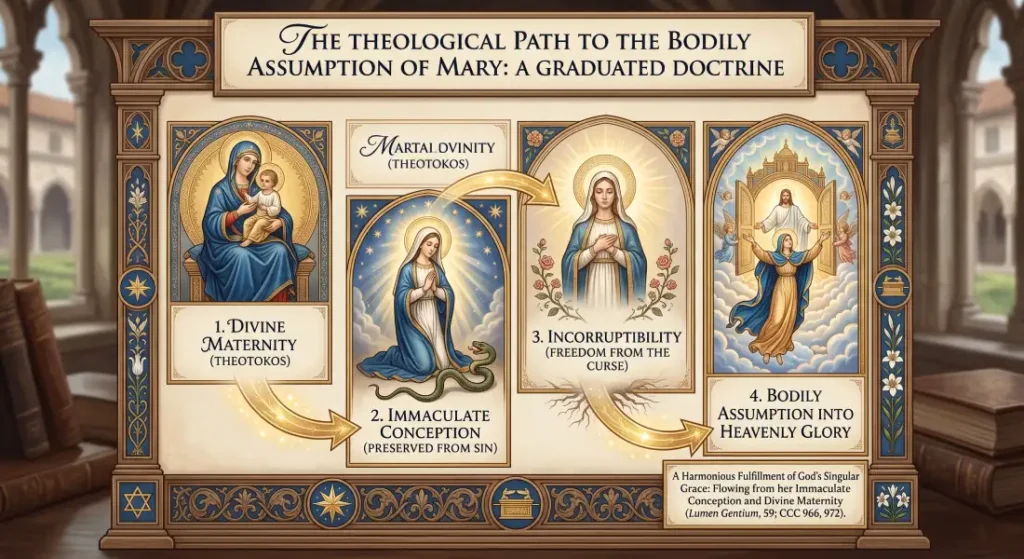
The dogma of the Assumption does not stand in isolation. It is intimately bound to the other Marian dogmas and Christological truths.
1. The Principle of Lex Orandi, Lex Credendi
Pope Pius XII underscored that the Church had liturgically celebrated the Assumption—under the titles of the Dormition or Transitus Mariae—since the earliest centuries. The ancient Latin adage lex orandi, lex credendi (“the law of prayer is the law of belief”) demonstrates that the liturgical life of the Church testified to this dogma long before its 1950 definition.
2. The Fruit of the Immaculate Conception
Because Mary was preserved free from the stain of original sin from the moment of her conception (defined by Pope Blessed Pius IX in 1854), she was exempt from the primordial curse of bodily decay: “For you are dust, and to dust you shall return” (Genesis 3:19). Bodily corruption is a consequence of sin; thus, the sinless Mother of God was fittingly spared the corruption of the grave.
3. The Dignity of the Divine Maternity
St. John Damascene, an eighth-century Doctor of the Church, argued that the body that gave flesh to God Himself could not be held captive by decay. As he wrote: “It was fitting that she, who had kept her virginity intact in childbirth, should keep her own body free from all corruption even after death.”
Scriptural Typology: The Ark and the Heavenly Woman
While Sacred Scripture contains no explicit verse stating “Mary was assumed into heaven,” the Word of God foreshadows this mystery through biblical typology. As the Second Vatican Council teaches in Dei Verbum (10), Sacred Scripture and Sacred Tradition form a single sacred deposit of the Word of God, faithfully interpreted by the Church’s living Magisterium.
The Ark of the New Covenant
In the Old Testament, the Ark of the Covenant was crafted from incorruptible acacia wood and overlaid with pure gold (Exodus 25:10–11) to hold the Ten Commandments, the rod of Aaron, and the manna.
In the New Testament, Mary is the Ark of the New Covenant who carried within her womb the Living Word, the Eternal High Priest, and the Bread of Life. Psalm 132 points toward her final rest:
“Arise, O LORD, and go to thy resting place, thou and the ark of thy might.” (Psalm 132:8, RSV-CE)
Just as the earthly Ark was sanctified and set apart, Mary, the Living Ark, was brought into God’s eternal resting place in heaven, body and soul.
The Woman Clothed with the Sun
The Book of Revelation unveils the heavenly fulfillment of this typology:
“And a great portent appeared in heaven, a woman clothed with the sun, with the moon under her feet, and on her head a crown of twelve stars.” (Revelation 12:1, RSV-CE)
While the Woman represents the People of God (Israel and the Church), the Church Fathers and the Sacred Liturgy identify her as Mary—the Mother of the Messiah, exalted in celestial glory as Queen of Heaven.
What the Assumption Means for Our Daily Lives
The Assumption is not a distant mystery; it speaks directly to our identity and eternal destiny.
1. Living Hope for the Resurrection of the Body
Every Sunday in the Nicene Creed, Catholics profess: “I look forward to the resurrection of the dead and the life of the world to come.”
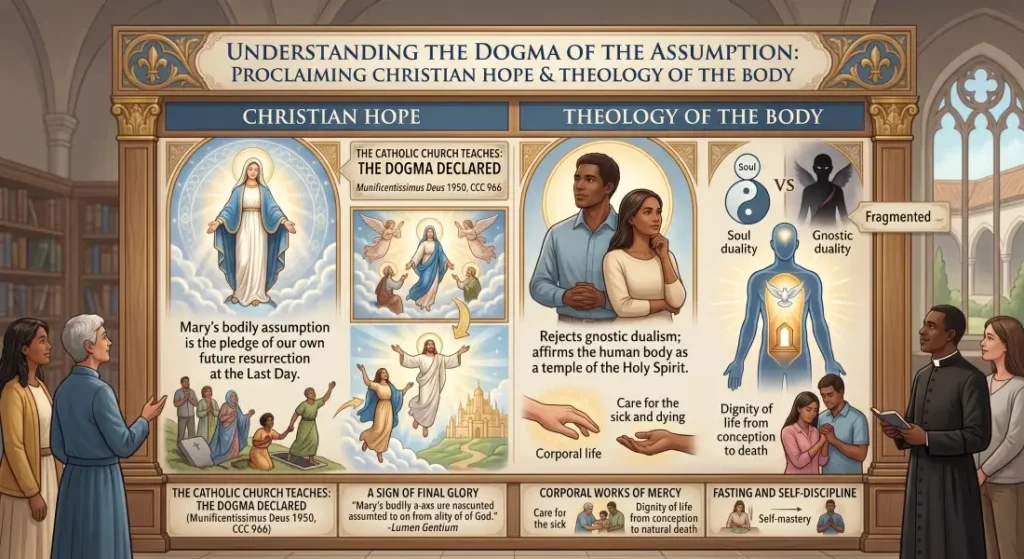
Christ is the definitive “firstfruits of those who have fallen asleep” (1 Corinthians 15:20). Mary is the first among the redeemed to share bodily in His glorification. In Mary, the Church sees her own future realized: human flesh, redeemed by Christ, raised up into eternal life (Lumen Gentium, 68; CCC 972).
2. The Sacred Dignity of the Human Body
Contemporary culture often oscillates between two destructive extremes: worshipping the body through vanity or despising it through utilitarian manipulation. The Assumption refutes both errors.
Following Thomistic anthropology (rooted in St. Thomas Aquinas), the human person is a composite of body and soul—matter and substantial form. The body is not a disposable shell; it is an intrinsic part of who we are. Because Christ redeemed us body and soul, what we do with our bodies matters eternally:
- We practice chastity to honor the body’s sacred design.
- We defend innocent human life from conception to natural death.
- We care for the sick and elderly, knowing their flesh carries eternal dignity.
- We receive the Holy Eucharist reverently, uniting our physical bodies to the Body of Christ.
A Catholic Prayer on the Assumption of Mary
Lord God,
You looked with favor on the lowliness of the Virgin Mary and raised her to the heights of heavenly glory as the Mother of Your Son.
Grant that, through her prayers, we may be freed from the corruption of sin, honor our bodies as temples of the Holy Spirit, and one day share with her in the full glory of the resurrection.
We ask this through Christ our Lord.
Amen.
Frequently Asked Questions
In Munificentissimus Deus, Pope Pius XII defined that Mary was assumed “having completed the course of her earthly life,” leaving her physical death open to theological discussion. While most Church Fathers and liturgical traditions hold that Mary died a peaceful death before her glorification, the dogma strictly requires belief in her bodily incorruption and assumption.
The Assumption is not stated in a single narrative verse, but it is rooted in biblical typology. Scripture reveals Mary as the incorruptible Ark of the New Covenant (Psalm 132:8) and the glorified Woman crowned in heaven (Revelation 12:1), interpreted in light of Sacred Tradition and the Magisterium.
Yes. Celebrated on August 15, the Solemnity of the Assumption is a Holy Day of Obligation in the Universal Church. Catholics are obligated to attend Mass on this day, unless a local Episcopal Conference grants a dispensation when the feast falls on a Saturday or Monday.
The Ascension refers to Jesus Christ rising into heaven by His own divine power as God. The Assumption refers to Mary being taken up into heaven by the power and grace of God, as a created human being redeemed by her Son.
Continue Your Faith Journey
Immaculate Conception vs. Virgin Birth: Key Differences Explained
Discover the essential differences between the Immaculate Conception of Mary and the Virgin Birth of Christ. Learn how Catholic dogma, Scripture, and…
Does Watching Live Stream Mass Fulfill Your Sunday Obligation? A Catholic Theological Guide
Discover whether watching Mass online satisfies your weekly Catholic duty. Learn what the Catechism of the Catholic Church, Canon Law, and Sacred…

The Cost of Discipleship in Matthew 10: What Christ Demands of Catholics
Explore what Matthew 10:37–42 teaches about the cost of discipleship in Catholic tradition. Learn how the order of charity, the cross, and…