How to Pray the Rosary: A Complete Beginner’s Guide The Rosary isn’t complicated — but it can feel that way when you’re holding those beads for the first time, trying to remember which prayer goes where and what you’re supposed to be thinking about while you’re saying it. You might’ve seen someone praying it beautifully, their fingers moving effortlessly through the decades, their face peaceful and focused. And maybe you thought, I want that. I want to know how to pray the rosary like that. Here’s the truth: the Rosary is a gift. It’s a scriptural prayer, a meditation on the life of Christ seen through the eyes of His mother. Pope St. John Paul II called it “my favorite prayer” in his apostolic letter Rosarium Virginis Mariae, and he wasn’t exaggerating when he said it’s a compendium of the Gospel. Every mystery draws us deeper into the life of Jesus — His birth, His suffering, His glory. When we pray the Rosary, we’re doing what Mary did: pondering these things in our hearts. This rosary prayer guide will walk you through every step. You don’t need to be a theologian or a mystic. You just need a willing heart and a set of beads. Let’s pray.
Understanding the Rosary Beads Prayer
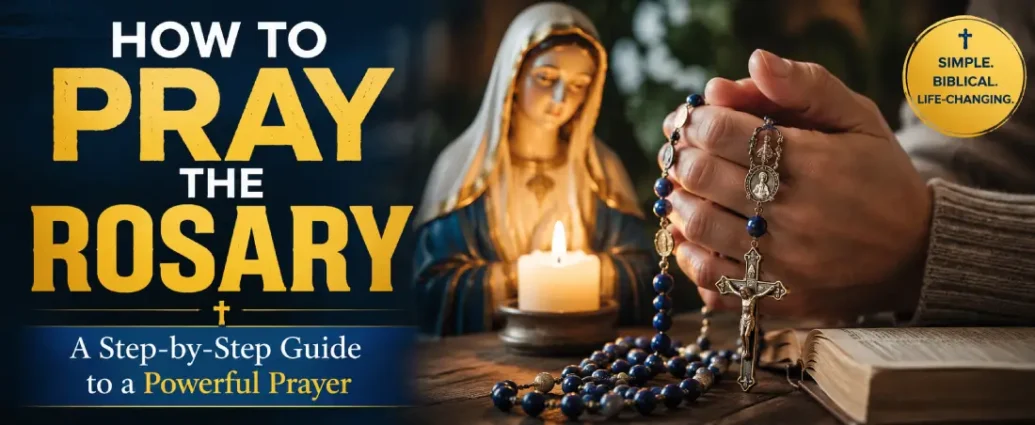
The physical rosary is simple: five decades of ten beads each, separated by single beads, with a crucifix and a short strand at the beginning. But those beads aren’t magic — they’re tools, helps for keeping count so your mind can focus on the mysteries instead of worrying about whether you’ve said ten Hail Marys yet or only nine.
How to Pray the Rosary: The Opening Prayers
The Rosary begins with the physical act of holding the crucifix, making the sign of the cross, and entering into prayer. Just as Mary arose and went with haste to serve Elizabeth, we arise from our distractions and turn toward God with purpose.
The Mysteries of the Rosary and Their Scriptural Foundations
This is the posture of the Rosary: magnifying the Lord, not ourselves. Every Hail Mary we pray echoes Mary’s own song of praise, her Magnificat, which proclaimed God’s greatness and her own humble obedience.
Praying the Rosary Catholic: Completing Each Decade
To pray the Rosary is to ponder — not to rush through words, but to hold the mysteries close and let them speak. Mary didn’t just witness the events of Christ’s life; she contemplated them deeply, and we’re invited to do the same.
The Rosary for Beginners: Final Prayers and Intentions
Before you begin the decades, you’ll pray a few preparatory prayers. These aren’t filler — they’re the doorway into the meditation that follows.
- Hold the crucifix and pray the Apostles’ Creed.
“I believe in God, the Father almighty, Creator of heaven and earth…” This ancient profession of faith grounds the entire Rosary in the doctrines we hold as Catholics. You’re not just reciting devotional words; you’re affirming the truth of the Incarnation, the Resurrection, the communion of saints.
- On the first single bead, pray one Our Father.
“Our Father, who art in heaven, hallowed be thy name…” This is the prayer Jesus Himself taught us, recorded in Matthew 6:9-13. It reminds us that every Rosary is fundamentally about relationship — with the Father, through the Son, in the Spirit.
- On the next three beads, pray three Hail Marys for an increase in faith, hope, and love.
These theological virtues — faith, hope, and charity — are the foundation of the Christian life according to the Catechism (CCC 1813). We ask Mary to intercede for their growth in our hearts as we begin this meditation on her Son.
- Pray the Glory Be after the three Hail Marys.
“Glory be to the Father, and to the Son, and to the Holy Spirit…” This doxology, this little burst of praise, punctuates each decade. It keeps the Rosary Trinitarian, reminding us that all honor and glory belong to God alone.
- Announce the first mystery and pray one Our Father on the single bead before the first decade.
Before each decade, you’ll name the mystery you’re about to contemplate — for example, “The First Joyful Mystery: The Annunciation.” Then you pray the Our Father, entering into that particular moment of salvation history.
The mysteries are the heart of the Rosary. There are four sets: the Joyful, Luminous, Sorrowful, and Glorious Mysteries, traditionally assigned to different days of the week. Each one is rooted in Scripture.
The First Joyful Mystery is the Annunciation, the moment when God became man in Mary’s womb. As you pray this decade, you’re contemplating the mystery of the Incarnation — God’s humility, Mary’s yes, the world’s redemption beginning in a young girl’s consent.
The Second Joyful Mystery, the Visitation, shows us Mary bringing Christ to others. She carried Jesus to Elizabeth, and Elizabeth’s child leaped with joy in recognition of the Lord. This is what the Rosary does — it brings Christ into our daily lives.
The Third Joyful Mystery is the Nativity, God entering the world in poverty and vulnerability. As you pray this decade, you’re meditating on divine love emptying itself, taking on flesh, becoming one of us.
The Fourth Joyful Mystery, the Presentation, shows Mary and Joseph’s obedience to the Law. Simeon would tell Mary that a sword would pierce her heart — a prophecy she accepted even as she offered her Son in the temple.
The Fifth Joyful Mystery is the Finding in the Temple. Jesus was about His Father’s business even as a twelve-year-old boy. Mary didn’t understand, but she kept all these things in her heart — just as we’re called to trust even when we don’t understand.
The First Luminous Mystery is the Baptism of the Lord. Pope John Paul II added these mysteries in 2002 to highlight Christ’s public ministry. As you pray this decade, you’re contemplating the Father’s voice saying, “This is my beloved Son.”
The Second Luminous Mystery, the Wedding at Cana, reveals Christ’s power and Mary’s intercession. She told the servants, “Do whatever he tells you” — words that echo through the centuries to us.
The Third Luminous Mystery is the Proclamation of the Kingdom. Jesus came preaching repentance and the Good News. This decade invites us to examine our own hearts and recommit to conversion.
The Fourth Luminous Mystery, the Transfiguration, gave the disciples a glimpse of Christ’s glory. In this decade, we ask for eyes to see Jesus as He truly is — not just a moral teacher, but the Son of God.
The Fifth Luminous Mystery is the Institution of the Eucharist. Every Mass makes present this same sacrifice. As you pray this decade, you’re meditating on the greatest gift Christ gave us — Himself, truly present under the appearance of bread and wine.
Once you’ve announced a mystery and prayed the Our Father, you’ll pray ten Hail Marys on the ten beads of that decade, meditating on the mystery the whole time. Then you’ll pray the Glory Be and, if you choose, the Fatima Prayer.
Every Hail Mary begins with the angel Gabriel’s greeting to Mary at the Annunciation. We’re not inventing prayers; we’re praying Scripture. The first half of the Hail Mary is pure Gospel.
Elizabeth’s greeting to Mary forms the second part of the Hail Mary’s opening. When we say “blessed is the fruit of your womb, Jesus,” we’re proclaiming the Incarnation — that Mary’s child is the Lord Himself.
The First Sorrowful Mystery is the Agony in the Garden, followed by the Scourging, the Crowning with Thorns, the Carrying of the Cross, and finally the Crucifixion. These mysteries confront us with the cost of our redemption — Christ’s suffering, freely chosen out of love for us.
As you pray the Sorrowful Mysteries, you’re walking with Jesus through His Passion. You’re standing at the foot of the Cross with Mary, watching her Son die for the sins of the world.
After you’ve prayed all five decades, you’ll finish with a few closing prayers. This is where you bring all your intentions — your needs, your loved ones, the Church, the world — before Our Lady.
The Glorious Mysteries begin with the Resurrection — the foundation of our faith, as St. Paul says in 1 Corinthians 15. Without the Resurrection, our faith would be in vain, but Christ is risen, and everything changes.
The Second Glorious Mystery is the Ascension. Jesus returned to the Father, but He didn’t abandon us — He sent the Holy Spirit, and He remains with us in the Eucharist, in the Church, in the poor and suffering.
The Third Glorious Mystery, Pentecost, is the birthday of the Church. Mary was there in the upper room when the Spirit descended in tongues of fire. She’s still there, still interceding, still drawing us closer to her Son.
- Pray the Hail Holy Queen after the five decades.
This beautiful prayer, “Hail, Holy Queen, Mother of Mercy,” acknowledges Mary as our advocate and our hope. We’re exiles in this valley of tears, and she points us toward Jesus, the blessed fruit of her womb.
- Conclude with the Sign of the Cross and any personal intentions.
The Rosary doesn’t end when the formal prayers are done. It continues in your day, in the graces you’ve received, in the way you carry those mysteries into your work and relationships and struggles. You don’t have to pray the Rosary perfectly. You don’t have to feel overwhelming consolation every time. Some days your mind will wander, and that’s okay — just gently bring it back to the mystery, back to Jesus, back to Mary’s intercession. The Church has treasured this prayer for centuries because it works. It changes hearts. It opens us to grace. Start small if you need to — one decade a day, or just the Joyful Mysteries once a week. But start. Pick up those beads. Make the Sign of the Cross. Let Mary lead you to her Son, mystery by mystery, bead by bead, until praying the Rosary becomes as natural as breathing — and just as life-giving.
📖 You Might Also Like