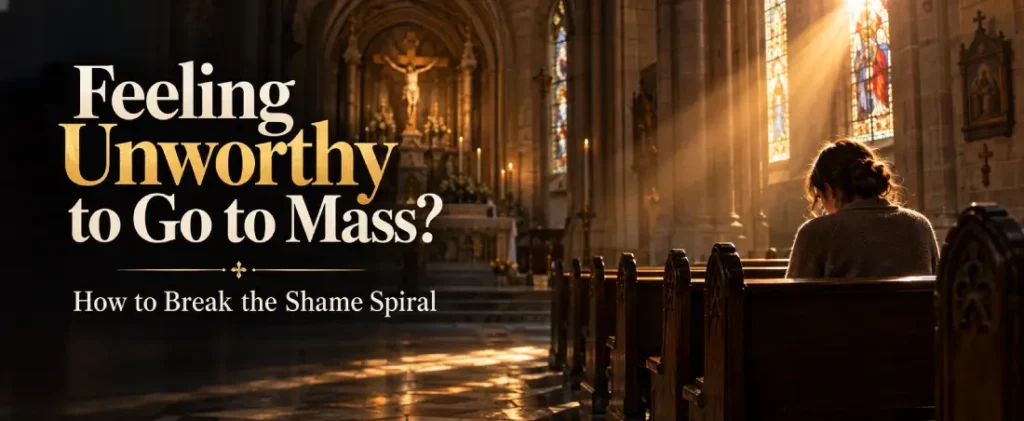
Standing outside a Catholic church after months or years away brings an immediate weight to your chest. You look at parishioners walking through the doors and wonder if you belong among them. A quiet voice inside insists that your sins are too great, your past is too messy, or your presence would be hypocritical.
This fear of stepping inside is a spiritual trap. It isolates you from the Sacraments, the very source of healing established by Jesus Christ.
Quick Answer: Can I Go to Mass If I Feel Too Sinful?
Yes. You can and should attend Catholic Mass, even if you are in a state of mortal sin or have been away for decades. The Mass is a spiritual hospital for sinners, not a prize for the flawless. While a Catholic in a state of mortal sin must refrain from receiving Holy Communion until receiving Sacramental Absolution in Confession (CCC 1385), attending Mass fulfills your Sunday obligation (CCC 2180). It provides actual graces that incline your heart toward true repentance without replacing Sacramental Reconciliation.
Conviction vs. Shame: Unmasking the Lie
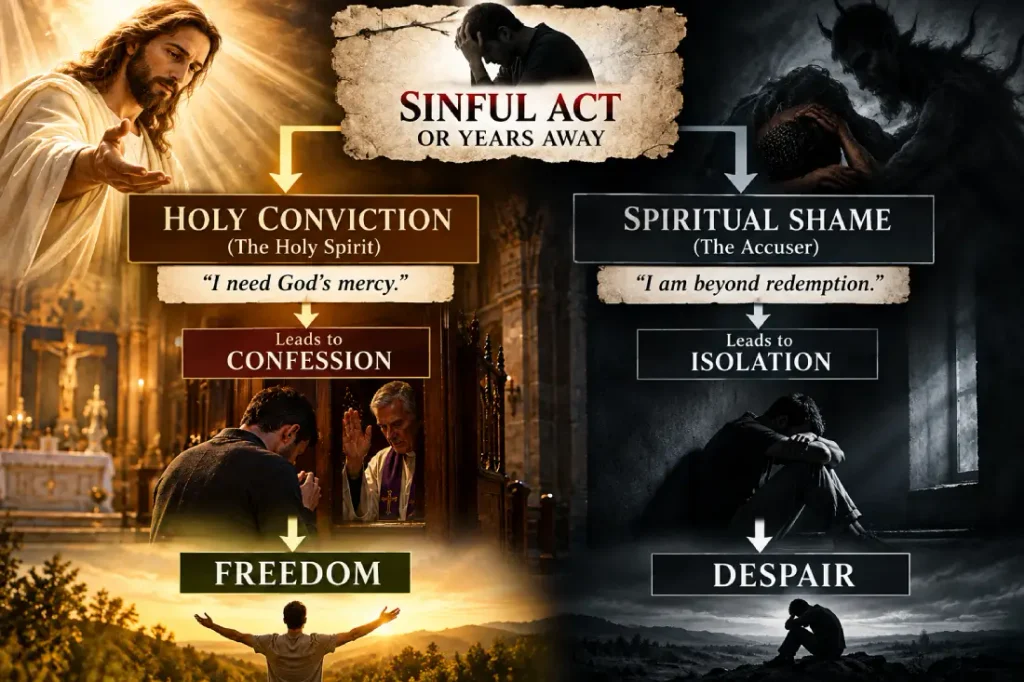
To quiet the fear of judgment, separate holy conviction from spiritual shame.
- Holy Conviction (From the Holy Spirit): Identifies your sin to lead you toward God’s mercy. It says, “You have fallen, but Christ offers forgiveness. Go to Confession.” Conviction produces hope, humility, and restoration.
- Spiritual Shame (From the Accuser): Attacks your personal identity to drive you away from God. It says, “You are defective. You are beyond redemption. Do not dare cross that threshold.” Shame produces despair, anxiety, and isolation (cf. Revelation 12:10).
When you feel “too sinful” to sit in the pews, you are listening to the Accuser, not the Good Shepherd.
Biblical & Magisterial Foundation
1. The Mass Acknowledges Human Frailty
Every Catholic Mass begins with an explicit acknowledgment of sin. Priest and congregation together recite words inspired by the Roman Centurion:
“Lord, I am not worthy that you should enter under my roof, but only say the word and my soul shall be healed.” (cf. Matthew 8:8, RSV-2CE)
No person enters the church on their own merit. We gather at Mass strictly through the unmerited grace of Jesus Christ.
2. Christ Came for the Sick
When critics questioned why Jesus ate with notorious sinners, He defined His mission clearly:
“Those who are well have no need of a physician, but those who are sick; I came not to call the righteous, but sinners.” (Mark 2:17, RSV-2CE)
Avoiding Mass because of sin is like avoiding a hospital because of illness. The Church exists precisely to dispense Christ’s healing to broken human beings.
┌─────────────────────────────────────────────────────────────────────────┐
│                      DOCTRINAL DISTINCTION                              │
├─────────────────────────────────────────────────────────────────────────┤
│ ATTENDING MASS                    │ RECEIVING HOLY COMMUNION            │
│ Required every Sunday (CCC 2180). │ Requires a state of grace (CCC 1385)│
│ Fulfills Church obligation.       │ Refrain if conscious of grave sin.  │
│ Dispenses actual grace.           │ Restored through Sacramental Penance│
└─────────────────────────────────────────────────────────────────────────┘
3. Mass Attendance vs. Receiving Communion
Catholic moral theology makes a clear distinction between attending Mass and receiving Holy Communion:
- The Sunday Obligation (CCC 2180): Every baptized Catholic is bound to participate in Mass on Sundays and Holy Days of Obligation. Attending Mass is an act of obedience that pleases God, even when you cannot receive Communion.
- Worthily Receiving the Eucharist (CCC 1385): Receiving the Eucharist requires being in a state of sanctifying grace (free from unconfessed mortal sin). St. Paul warns that receiving unworthily profanes the Body and Blood of the Lord (1 Corinthians 11:27).
If you have been away from Mass or carry grave sin, attend Mass, but remain in your pew during Communion. Staying seated shows reverence for the Eucharist and honesty before God.
Wisdom from the Saints and Church History
St. John Chrysostom (347–407 AD)
St. John Chrysostom reminded believers that the Church exists to welcome the fallen:
“Did you sin? Enter the Church and say to God, ‘I have sinned’… The Church is a hospital, not a courtroom; it is a place of forgiveness, not of punishment.” (De Poenitentia, Hom. 8)
While Christ acts medicinally through the Church, dogmatic teaching adds that the Sacrament of Penance also operates as a tribunal of mercy (tribunal misericordiae; Council of Trent, Sess. XIV). You do not approach the priest to receive condemnation, but to hear the judicial sentence of acquittal pronounced by Christ.
St. Augustine of Hippo (354–430 AD)
St. Augustine lived in sexual immorality and heresy for decades before his conversion. He later reflected:
“Late have I loved You, O Beauty so ancient and so new, late have I loved You!” (Confessions, Book X)
If God transformed Augustine into a Doctor of the Church, His mercy is vast enough for your past.
Practical Battle Plan: 4 Steps Home
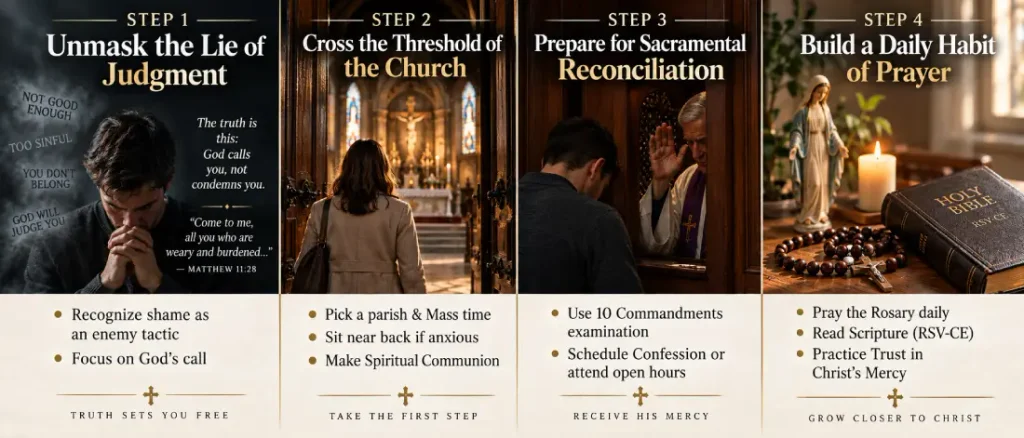
Step 1: Ignore Real or Imagined Judgment
Most parishioners are focused on their own prayers and families. Even if someone gives you an unkind look, you attend Mass for Jesus Christ, not public approval.
Step 2: Sit Kneel, and Pray
Select a local parish Mass time. If you feel anxious, sit near the back or along a side aisle. During Communion, remain seated or kneeling in prayer, and make an Act of Spiritual Communion:
Act of Spiritual Communion
“My Jesus, I believe that You are present in the Most Holy Sacrament. I love You above all things, and I desire to receive You into my soul. Since I cannot at this moment receive You sacramentally, come at least spiritually into my heart. I embrace You as if You were already there and unite myself wholly to You. Never permit me to be separated from You. Amen.”
Step 3: Receive Sacramental Reconciliation
To return to Holy Communion, receive Sacramental Absolution in Confession:
- Examine Your Conscience: Use a standard examination of conscience based on the Ten Commandments.
- Be Honest: Priests are bound by the absolute Seal of Confession under penalty of automatic excommunication (CCC 1467; Canon 983 §1).
- Ask for Help: Tell the priest: “Father, it has been many years since my last Confession. Please guide me.”
Step 4: Build Daily Spiritual Defenses
Protect your return with daily prayer:
- Recite the Chaplet of Divine Mercy at 3:00 PM.
- Keep a Rosary with you for moments of anxiety.
- Read one Gospel chapter each morning.
First Sunday Back Pocket Checklist
Use this quick-reference checklist when returning to Mass:
- [ ] Before Mass: Check the parish bulletin or website for Mass and Confession times.
- [ ] Arrival: Aim to arrive 10 minutes early; select a comfortable seat toward the back or side.
- [ ] During Mass: Follow along with the responses in the pew missalette.
- [ ] At Communion: Remain in your pew to pray quietly; recite the Act of Spiritual Communion.
- [ ] After Mass: Spend 2 minutes thanking God for the grace to return.
Recommended Spiritual Tools
Having reliable prayer aids makes stepping back into the sacramental life manageable:
| Resource | Primary Purpose |
| Ignatius Catholic Study Bible (RSV-2CE) | Read Christ’s words on mercy with orthodox commentary. |
| Catechism of the Catholic Church | Clear answers on moral theology and sacraments. |
| Durable Paracord Rosary | Daily prayer tool for spiritual stability and peace. |
The Father Runs to You
In the Parable of the Prodigal Son, the younger son rehearsed a speech detailing his unworthiness after squandering his life:
“While he was yet at a distance, his father saw him and had compassion, and ran and embraced him and kissed him.” (Luke 15:20, RSV-2CE)
The father did not wait for his son to prove his worthiness. He ran to meet him. God is waiting for you in Holy Mass today.
Frequently Asked Questions
No. Faithful Catholic priests experience immense joy when souls return after years away. Priests act in persona Christi (in the person of Christ) and are bound by the absolute Seal of Confession (CCC 1467). They will patiently guide you through the sacrament.
Missing Mass on a Sunday without a serious reason (such as grave illness or caring for an infant) is a grave matter (CCC 2181). Feeling guilty or unworthy does not dispense the obligation, but Sacramental Confession completely wipes away all mortal sins and restores sanctifying grace.
The universal liturgical practice is to remain seated or kneeling in your pew in quiet prayer. You can use this time to make an Act of Spiritual Communion, asking Jesus to enter your heart spiritually until you receive Sacramental Absolution in Confession.
Tears during Mass are common for those returning home. Catholic tradition recognizes this as the “gift of tears”—an interior grace of the Holy Spirit leading to contrition and healing. Simply sit quietly; parishioners will respect your personal prayer space.
Continue Your Faith Journey
Does Watching Live Stream Mass Fulfill Your Sunday Obligation? A Catholic Theological Guide
Discover whether watching Mass online satisfies your weekly Catholic duty. Learn what the Catechism of the Catholic Church, Canon Law, and Sacred…
Why Does the Catholic Bible Have More Books Than the Protestant Bible?
Ever wonder why the Catholic Bible contains 73 books while Protestant Bibles have only 66? Discover the apostolic origins, historical councils, and…