If you are watching Sunday Mass from home on a screen, you may wonder whether it fulfills your weekly Catholic duty. The direct answer is no: watching a live stream or televised Mass does not fulfill your Sunday obligation.
Under the Catechism of the Catholic Church (CCC 2180–2181) and the Code of Canon Law (Can. 1247–1248), Catholics are morally bound to participate physically in the Eucharistic assembly every Sunday and Holy Day of Obligation. While broadcast liturgies offer spiritual comfort to the homebound or hospitalized, a video feed cannot substitute for physical, sacramental participation at the altar.
Quick Reference: When Does the Sunday Obligation Bind?
| Situation / Scenario | Obligation Status | Practical Action Required |
| Healthy at home / Busy | Binds Fully | Must attend physical Mass in person. Deliberately skipping is a grave sin. |
| Contagious illness / Fever | Excused Automatically | Stay home to protect others; watch live stream piously; make a Spiritual Communion. |
| Bedridden / Hospitalized | Excused Automatically | Watch broadcast Mass if able; request an Extraordinary Minister of Holy Communion. |
| Severe weather / Impassable roads | Excused Automatically | Stay safe; the obligation ceases under physical impossibility (ad impossibile nemo tenetur). |
| Traveling / Vacation | Binds Fully | Locate a nearby Catholic parish via MassTimes.org; plan travel around Saturday vigil or Sunday Mass. |
Biblical and Magisterial Foundations of the Sunday Precept
The obligation to attend Sunday Mass is not a mere bureaucratic rule. It flows directly from the Third Commandment given to Moses:
“Remember the sabbath day, to keep it holy.”
— Exodus 20:8 (RSV-2CE)
In the New Covenant, the Church transferred this holy observance to Sunday—the Day of the Resurrection. The Catechism of the Catholic Church defines the moral gravity of this duty:
“The precept of the Church specifies the law of the Lord more precisely: ‘On Sundays and other holy days of obligation the faithful are bound to participate in the Mass.’ ‘The precept of participating in the Mass is satisfied by assistance at a Mass which is celebrated anywhere in a Catholic rite either on the holy day or on the evening of the preceding day.'”
— CCC 2180
The Catechism underscores the seriousness of this weekly encounter:
“The Sunday Eucharist is the foundation and confirmation of all Christian practice. For this reason the faithful are obliged to participate in the Eucharist on days of obligation, unless excused for a serious reason (for example, illness, the care of infants) or dispensed by their own pastor. Those who deliberately fail in this obligation commit a grave sin.”
— CCC 2181
The Code of Canon Law confirms this requirement:
- Canon 1247: “On Sundays and other holy days of obligation, the faithful are obliged to participate in the Mass.”
- Canon 1248 §1: “A person who assists at a Mass celebrated anywhere in a Catholic rite either on the feast day itself or in the evening of the preceding day satisfies the obligation of participating in the Mass.”
In canonical jurisprudence, the Latin verb assistere (“to assist” or “to be present”) historically and legally requires bodily presence in the physical space of the liturgy. Watching pixels on a display is observation, not physical assistance.
The Incarnational Reality of Catholic Worship
Why does God require our physical presence? Because Catholicism is an incarnational faith.
“And the Word became flesh and dwelt among us, full of grace and truth.”
— John 1:14 (RSV-2CE)
God did not redeem humanity from a distance. The Second Person of the Blessed Trinity took on real human flesh, died on a physical Cross, and rose bodily from the grave.
The seven Sacraments instituted by Christ are outward, sensible signs that communicate grace. They require physical matter and personal contact:
- Water poured in Baptism.
- Chrism oil applied in Confirmation.
- Bread and wine consecrated and consumed in the Holy Eucharist.
A digital stream transmits light and audio, but it cannot convey physical matter or impart sacramental grace ex opere operato. You cannot be baptized over a video call, receive Absolution via text message, or consume the Body and Blood of Christ through a screen.
St. Paul reminds us of the communal unity forged at the altar:
“Because there is one bread, we who are many are one body, for we all partake of the one bread.”
— 1 Corinthians 10:17 (RSV-2CE)
What the Papal Magisterium Teaches: Pope St. John Paul II on Broadcast Liturgies
The Church addressed broadcast liturgies long before the emergence of high-speed streaming. In his 1998 Apostolic Letter Dies Domini, Pope St. John Paul II drew a clear line between observing a broadcast and fulfilling the liturgical precept:
“Television and radio broadcasts… are a precious help, especially for those who are sick or disabled… But these same broadcasts cannot satisfy the Sunday obligation, which requires participation in the assembly of the faithful gathered in one place.”
— Dies Domini, 54
The Holy Sacrifice of the Mass is not an entertainment program. It is the public worship of Christ the Head united with His Mystical Body, offering the eternal Sacrifice of Calvary to the Father. Physical presence enables you to unite your interior sacrifices, prayers, and daily labors with the priest at the altar.
Patristic Witness: “Sine Dominico Non Possumus”
The early Church recognized that physical gathering for the Eucharist was essential to the Christian life, even under penalty of death.
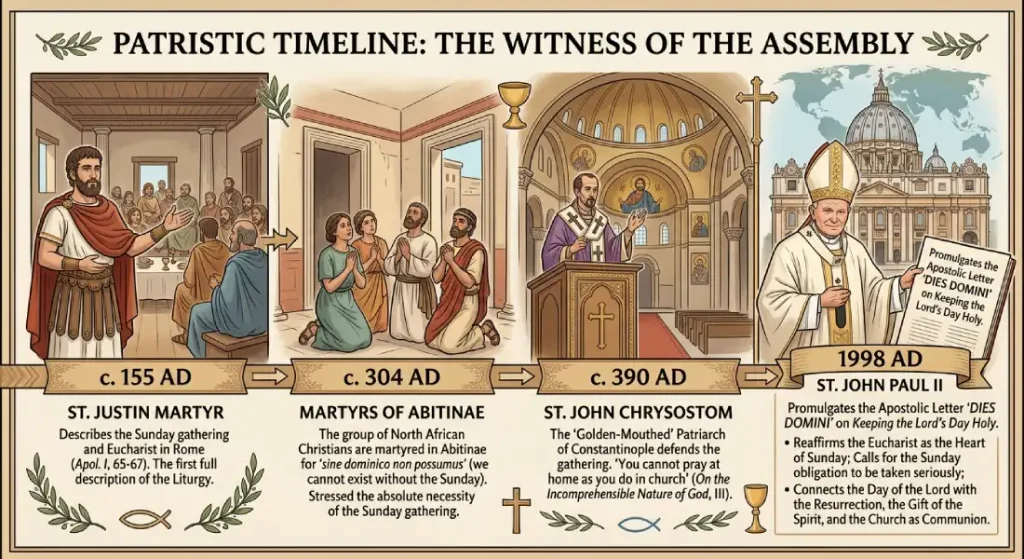
The Martyrs of Abitinae (304 AD)
During the persecution of Emperor Diocletian, Roman authorities banned Christian assemblies under pain of death. In North Africa, 49 Christians were arrested for gathering secretly for Sunday Mass in the home of a local reader named Felix.
Interrogated under torture by the Roman proconsul as to why they defied the imperial decree, one of the martyrs, Emeritus, gave a defining answer:
“Sine dominico non possumus.”
(Without the Lord’s Day [Eucharist], we cannot live.)
To the early Christians, missing the Sunday assembly was spiritual starvation. They understood that their communion with the Risen Christ depended on gathering around the altar.
St. John Chrysostom on the Church Assembly
Doctor of the Church St. John Chrysostom (c. 349–407 AD) addressed those who claimed private home devotions could replace the liturgical assembly:
“You cannot pray at home as at church, where there is a great multitude, where exclamations are cried out to God as from one great heart, and where there is something more: the union of minds, the accord of souls, the bond of charity, the prayers of the priests.”
— De Incomprehensibili Dei Natura
Legitimate Excusing Causes vs. Invalid Excuses
The moral theology of the Catholic Church applies the classical principle: the law does not bind under physical or moral impossibility (ad impossibile nemo tenetur).
1. Genuine Excusing Causes (No Sin Incurred)
When a serious impediment prevents your attendance, the moral obligation to attend Mass ceases automatically:
- Acute Illness or Contagion: Having a fever, flu, or contagious illness where attending puts vulnerable parishioners at risk.
- Medical Infirmity or Advanced Age: Chronic illness, severe mobility limitations, or bedridden hospitalization.
- Essential Caregiving: Caring for an infant, an elderly parent, or a critically ill family member who cannot be left alone.
- Impassable Weather or Danger: Severe blizzards, floods, road hazards, or lack of transportation.
- Essential Public Safety Duties: Emergency first responders (police, firefighters, trauma medical personnel) on active shift duty.
Note for the Sick: If you are sick, watching a live stream Mass is a praiseworthy, meritorious practice. However, it is not the broadcast that fulfills the obligation; rather, your illness has already excused you from the precept entirely.
2. Invalid Excuses (Grave Matter)
Skipping Mass for casual convenience is a serious offense against God’s law. The following reasons do not excuse you from Mass:
- Watching a live stream simply to avoid getting dressed or driving to church.
- Skipping Mass for youth sports tournaments, vacations, social gatherings, or sleeping in.
- Choosing an online Mass because you prefer the music or preaching of a remote parish over your local church.
Deliberately missing Mass for invalid reasons constitutes grave matter. When committed with full knowledge and deliberate consent, it is a mortal sin (CCC 1857). In that case, you must make a sacramental Confession before receiving Holy Communion.
A 4-Step Practical Guide for Sanctifying the Lord’s Day
Making the transition from passive screen viewing to active sacramental worship requires intentional habit building:
- Prepare on Saturday Evening: Power down secular media early. Read the Sunday Mass readings ahead of time and examine your conscience.
- Participate Actively in the Pews: Arrive 10 minutes early. Join boldly in the prayers and congregational singing (Sacrosanctum Concilium, 14). Mentally offer your weekly crosses and labor upon the paten during the Offertory.
- If Genuinely Ill, Pray Reverently: Set up a quiet space, dress respectfully, and follow the live stream reverently. When the priest receives the Eucharist, pray an Act of Spiritual Communion:
An Act of Spiritual Communion
(By Saint Alphonsus Liguori)
“My Jesus, I believe that Thou art present in the Blessed Sacrament.
I love Thee above all things, and I desire to receive Thee into my soul.
Since I cannot now receive Thee sacramentally, come at least spiritually into my heart.
I embrace Thee as if Thou wert already there, and unite myself wholly to Thee;
never permit me to be separated from Thee.
Amen.”
- Keep Sunday Holy After Mass: Under CCC 2184–2187, refrain from unnecessary servile work and commercial shopping. Dedicate the day to family meals, spiritual reading, and works of mercy.
Essential Catholic Resources for Sunday Worship
Equip your home to foster deeper reverence for the Holy Mass:
- The Ignatius Catholic Study Bible (RSV-2CE): Offers comprehensive orthodox commentary, cross-references to the Catechism, and Patristic insights to prepare your family for Sunday readings.
- The Daily Roman Missal (Midwest Theological Forum): A complete liturgical missal containing Latin and English texts, antiphons, and readings for Sunday and weekday liturgies.
- Combat / Paracord Rosary: A durable devotional tool designed for daily spiritual discipline, family devotions, and meditation before the Blessed Sacrament.
The Heart of Discipleship: Doing the Father’s Will
Our Lord Jesus Christ issued a clear challenge regarding authentic devotion:
“Not every one who says to me, ‘Lord, Lord,’ shall enter the kingdom of heaven, but he who does the will of my Father who is in heaven.”
— Matthew 7:21 (RSV-2CE)
The Sunday Mass precept is not a burdensome legal checklist. It is an invitation to the wedding feast of the Lamb. Do not settle for a screen when you are invited to stand in the real presence of Jesus Christ at the altar.
Frequently Asked Questions
No. Canon 1248 §1 and CCC 2180 require physical, bodily presence (assistere) at the Eucharistic assembly. While live streams and televised broadcasts offer spiritual solace to the sick and homebound, they do not fulfill the canonical Sunday Mass obligation for anyone physically capable of attending in person.
It is always an act of grave matter. Under CCC 2181, deliberately missing Sunday Mass or a Holy Day of Obligation without an excusing grave cause or a pastoral dispensation is grave matter. It constitutes a mortal sin if committed with full knowledge of the law and deliberate consent of the will (CCC 1857).
Under Canon 1248 §1, the Sunday obligation may be fulfilled on the evening of the preceding day. In most Catholic dioceses, any anticipated vigil Mass celebrated in the late afternoon (typically 4:00 PM or later) validly fulfills the Sunday precept.
Sacramental Communion is the physical consumption of the consecrated Eucharist, which ex opere operato nourishes and increases sanctifying grace in a properly disposed soul (CCC 1392). Spiritual Communion is an interior prayer of desire that obtains actual graces when physical sacramental reception is impossible.
Continue Your Faith Journey

Feeling Like God Is Punishing You? A Catholic Guide to Suffering, Grace and Hope
If you are going through a trial and feeling like God is punishing you, Catholic theology offers hope, clarity, and peace. Discover…
Feeling Unworthy to Go to Mass? How to Break the Catholic Shame Spiral and Come Home
Struggling with spiritual shame or feeling too sinful to step inside a Catholic church? Discover how Church teaching, the Sacrament of Reconciliation,…
What Is the Assumption of Mary? Catholic Dogma, Scripture, and Meaning
Explore the Catholic dogma of the Assumption of the Blessed Virgin Mary. Learn how Munificentissimus Deus, Sacred Scripture, and Church Tradition reveal…