
Bible Verses About Defending the Innocent: Scripture and Catholic Teaching on the Vulnerable
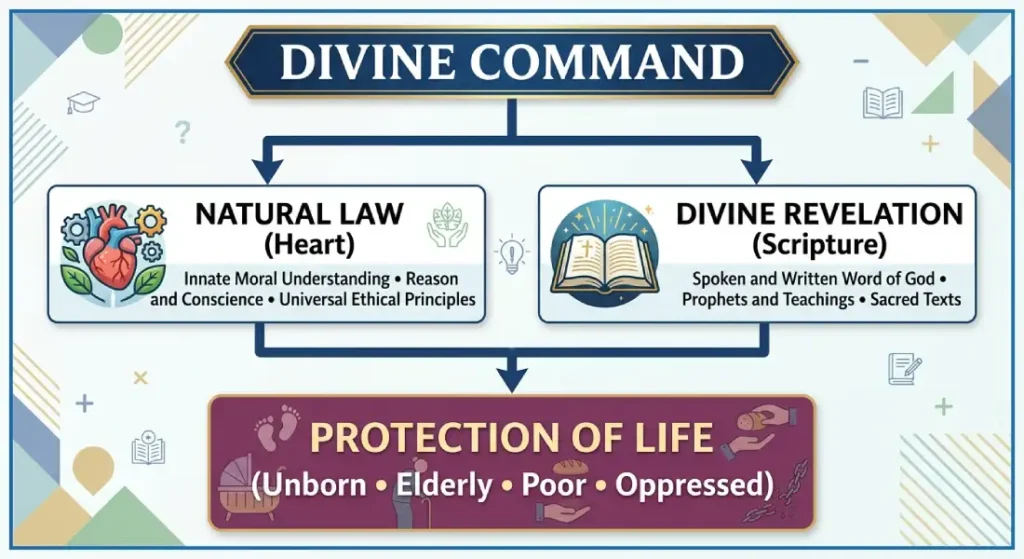
Every human life—from the moment of conception to natural death—possesses inherent dignity guaranteed not by human consensus, but by Almighty God. Written upon the human heart through the Natural Law, the imperative to defend the innocent is confirmed and elevated by Divine Revelation (CCC 1954).
When Sacred Scripture commands us to protect the vulnerable, it reveals an unyielding moral obligation rooted in the character of God. Defending the voiceless is not an optional social initiative; it is a divine mandate required of every Christian.
Quick Reference: Scripture & Catechism Guardrails
The following table provides a quick guide linking key Biblical passages with the official teaching of the Catholic Church:
| Concern / Vulnerable Group | Primary Scripture Anchor | Catholic Catechism (CCC) Anchor |
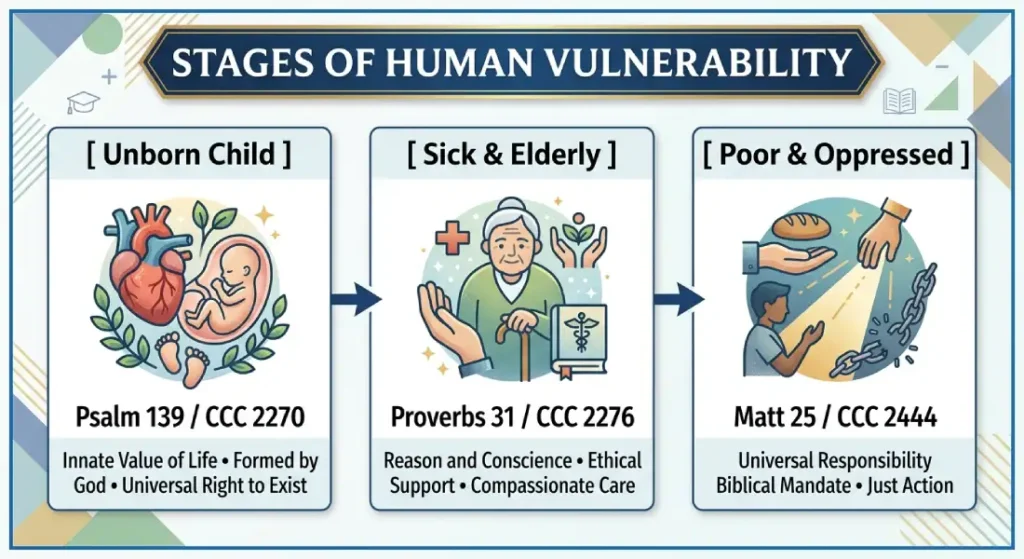
| The Unborn Child | Psalm 139:13–14; Jeremiah 1:5 | CCC 2270 (Inviolability of life from conception) |
| The Sick, Elderly, & Disabled | Proverbs 31:8–9; Psalm 82:3 | CCC 2276 (Duty to care for the frail and dying) |
| The Poor & Oppressed | Isaiah 1:17; Matthew 25:40 | CCC 2444 (Preferential option for the poor) |
| Unjust Laws & Governance | Isaiah 10:1–2; Proverbs 24:11 | CCC 1903 (Unjust laws lack binding moral authority) |
Old Testament Foundation: The Law and the Prophets
The Old Covenant establishes that God actively defends those without worldly power. Crucially, God warns that turning a blind eye to oppression invites His judgment.
Protection of the Defense in the Law (Pentateuch)
“You shall not mistreat any widow or fatherless child. If you do mistreat them, and they cry out to me, I will surely hear their cry.”
— Exodus 22:22–23
God doesn’t merely suggest care for the vulnerable; He warns of divine retribution. The Lord hears the cries of the helpless, establishing protection for widows and orphans as a direct test of covenant fidelity.
“You shall not pervert the justice due to the sojourner or to the fatherless, or take a widow’s garment in pledge, but you shall remember that you were a slave in Egypt and the Lord your God redeemed you from there; therefore I command you to do this.”
— Deuteronomy 24:17–18
Redemption imposes moral obligation. Those redeemed by God’s mercy must extend protection to others, proving their gratitude through concrete acts of justice.
Mandates from Old Testament Wisdom Literature
“Open your mouth for the mute, for the rights of all who are destitute. Open your mouth, judge righteously, defend the rights of the poor and needy.”
— Proverbs 31:8–9
Wisdom demands action. Scripture commands us to use our influence, legal standing, and public voice to shield those who cannot advocate for themselves.
“Rescue those who are being taken away to death; hold back those who are stumbling to the slaughter.”
— Proverbs 24:11
When human lives are threatened by violence or legal sanction, neutrality is a grave moral failure. We are commanded by God to step between the aggressor and the victim.
The Prophetic Voice Against Oppression
“Learn to do good; seek justice, correct oppression; bring justice to the fatherless, plead the widow’s cause.”
— Isaiah 1:17
Justice is not passive feeling; it is an active discipline. The Prophet Isaiah demands that we actively seek out oppression and dismantle it.
“Woe to those who decree iniquitous decrees, and the writers who keep writing oppression, to turn aside the needy from justice…”
— Isaiah 10:1–2
God pronounces condemnation on state institutions that write oppression into public policy. As St. Thomas Aquinas observed, an unjust law is no law at all (Summa Theologiae, I-II, q. 95, a. 2) and fails to bind the human conscience (CCC 1903).
Sacred Scripture on the Sacredness of Life in the Womb
The Church’s unwavering defense of unborn children rests upon the biblical truth that God is the sole Author of life. Human existence is sacred from its very origin.
“For you formed my inward parts; you knitted me together in my mother’s womb. I praise you, for I am fearfully and wonderfully made.”
— Psalm 139:13–14
Human life does not gain worth through developmental stage, independence, or productivity. The unborn child is intentionally created by God, holding absolute dignity from the moment of conception (CCC 2270).
“Before I formed you in the womb I knew you, and before you were born I consecrated you…”
— Jeremiah 1:5
God’s relationship with every individual precedes birth. St. John Paul II emphasized in Evangelium Vitae (n. 62) that direct abortion constitutes a grave violation of the moral law, destroying a life known and loved by God from all eternity.
“Did not he who made me in the womb make him? And did not one fashion us in the womb?”
— Job 31:15
All human beings share an identical origin in the creative hand of God. Universal human rights depend entirely upon this equal creation by the same Lord.
The New Testament: Gospel Teaching and Apostolic Exhortation
In the New Covenant, Jesus Christ reveals that serving the vulnerable is synonymous with serving Him directly.
Christ’s Identification with the Least
“Truly, I say to you, as you did it to one of the least of these my brothers, you did it to me.”
— Matthew 25:40
Our final judgment will rest upon our charity toward the vulnerable. Christ identifies Himself directly with the hungry, the sick, the unborn, and the prisoner (CCC 2448).
“The Spirit of the Lord is upon me, because he has anointed me to proclaim good news to the poor… to set at liberty those who are oppressed.”
— Luke 4:18
Jesus begins His public ministry by announcing freedom for the captive and oppressed. The Church carries out Christ’s mission through her preferential option for the poor and defenceless (CCC 2444).
Apostolic Directives on Active Charity
“Religion that is pure and undefiled before God the Father is this: to visit orphans and widows in their affliction, and to keep oneself unstained from the world.”
— James 1:27
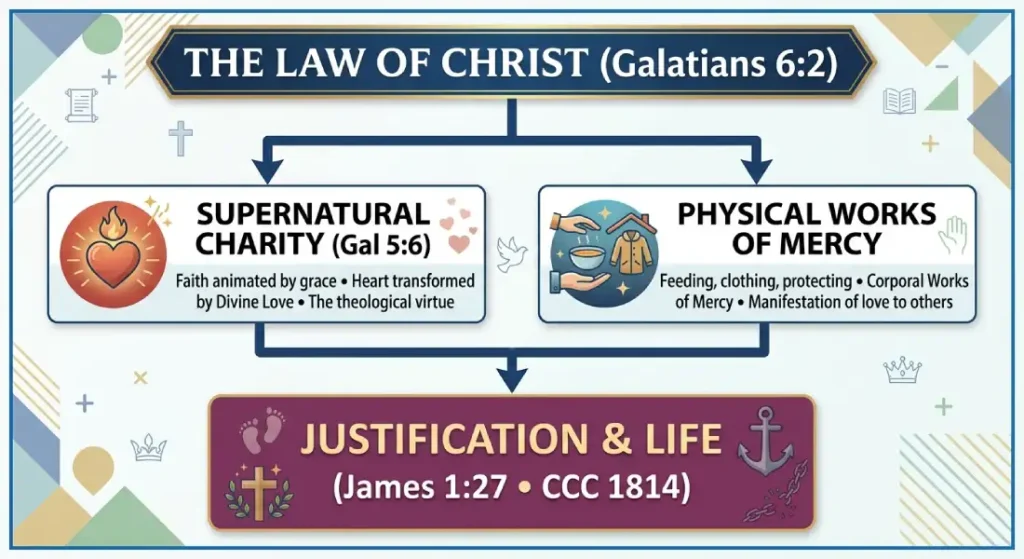
Authentic Christian faith demands supernatural charity (CCC 1814). Works of mercy toward the defenseless are not optional external additions, but the necessary fruit of sanctifying grace without which faith remains dead (cf. James 2:17; Council of Trent, Sess. VI).
“Bear one another’s burdens, and so fulfill the law of Christ.”
— Galatians 6:2
The law of Christ is fulfilled when we share the heavy burdens carried by the weak. Shielding others from harm is the practical fulfillment of evangelical love.
The Christian Call to Courageous Action
Defending the innocent demands far more than vague sentiment. It requires courage, public advocacy, and personal sacrifice.
As the Second Vatican Council proclaimed in Gaudium et Spes (n. 27), anything that opposes life itself—such as murder, genocide, abortion, euthanasia, or willful suicide—poison human society and insult the Creator.
By standing firmly with the unborn, the frail elderly, the disabled, and the marginalized, we mirror the righteous heart of God. Guided by Scripture and Catholic Tradition, let us speak boldly for those who have no voice, ensuring that truth and mercy prevail over the culture of death.
Frequently Asked Questions
Sacred Scripture affirms that human life is created directly by God in the womb (Psalm 139:13–14; Jeremiah 1:5). God explicitly commands the defense of defenseless lives (Proverbs 24:11), establishing that life is sacred from conception (CCC 2270).
Protection of the weak is rooted in Natural Law and the Imago Dei—the truth that every person is created in God’s image. Catholic doctrine emphasizes that faith must be animated by charity (Galatians 5:6; CCC 1814), making care for the vulnerable necessary for salvation (Matthew 25:40).
Drawing from Isaiah 10:1–2 and St. Thomas Aquinas, the Catholic Church teaches that a civil law authorizing the destruction of innocent human life (such as abortion or euthanasia) lacks moral validity (CCC 1903). Citizens are not bound in conscience to obey such laws.
In Matthew 25:40, Jesus explicitly states, “As you did it to one of the least of these my brothers, you did it to me.” Catholic social teaching terms this the “preferential option for the poor,” recognizing Christ present within every vulnerable human person (CCC 2444, 2448).
Continue Your Faith Journey
Catholic Church Teaching on IVF: Doctrine, Dignity, and Moral Alternatives
Explore the Catholic Church's official teaching on IVF, rooted in the dignity of human life and marital union. Learn about licit alternatives…
Dobbs Decision Anniversary: Why the Battle for Life Has Moved from the Courts to the Heart
On the Dobbs decision anniversary, the pro-life mission shifts from courtrooms to human hearts. Discover how Catholic teaching and Evangelium Vitae call…
What the Catholic Church Teaches About Surrogacy: Dignity, Marriage, and the Gift of Life
Explore what the Catholic Church teaches about surrogacy, human dignity, and the sacred marital covenant. Learn why the Magisterium protects children as…