
What the Catholic Church Teaches About Surrogacy: Dignity, Marriage, and the Gift of Life

Medical & Pastoral Disclaimer: Prayer Warrior USA provides faith-based commentary rooted in Catholic moral teaching. Nothing in this article should be taken as medical diagnosis or treatment advice. Please consult licensed medical providers specializing in restorative reproductive medicine (such as NaProTechnology) for individual healthcare needs.
Approved Catholic Support & Healthcare Directory for Couples
The Catholic Church teaches clearly and unequivocally that surrogacy—whether commercial, altruistic, gestational, or traditional—is gravely contrary to the moral law. This constant teaching of the Magisterium affirms that a child is not a commodity or a legal deliverable, but an image-bearer of God to be received as a gift within the marital covenant.
While modern society increasingly promotes surrogacy as a generous act of love or a straightforward technological remedy for infertility, the Church evaluates the practice through the lens of human dignity, biblical anthropology, and the sacred integrity of marriage.
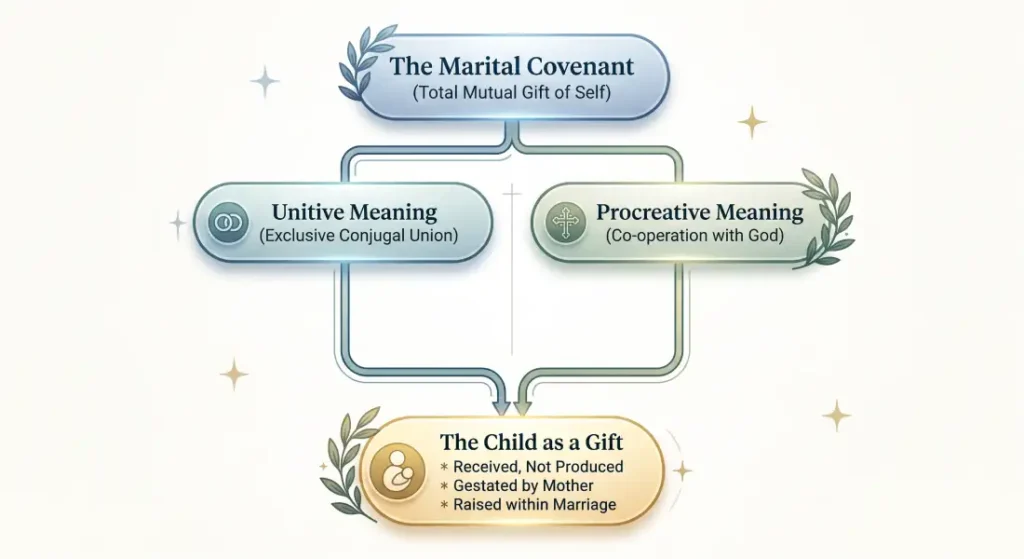
The Settled Magisterial Teaching: Donum Vitae and the Catechism
The moral evaluation of surrogate motherhood is not a matter of theological speculation; it is established Magisterial doctrine articulated in major Church documents.
In 1987, the Congregation for the Doctrine of the Faith (CDF) issued the landmark instruction Donum Vitae (“The Gift of Life”) to address modern reproductive technologies. The document establishes that life is a divine gift rather than a property right or manufacturing outcome:
“Surrogate motherhood represents an objective failure to meet the obligations of maternal love, of conjugal fidelity and of responsible parenthood; it offends the dignity and the right of the child to be conceived, carried in the womb, brought into the world and brought up by his own parents.” (Donum Vitae, II, A, 3)
The Catechism of the Catholic Church (CCC) reaffirms this standard under its treatment of the Sixth Commandment:
- CCC 2376: “Techniques that entail the dissociation of husband and wife, by the intrusion of a person other than the couple (donation of sperm or ovum, surrogate uterus), are gravely immoral. These techniques (heterologous artificial insemination and fertilization) infringe the child’s right to be born of a father and mother known to him and bound to each other by marriage. They betray the spouses’ ‘right to become a father and a mother only through each other.'”
- CCC 2377: Techniques involving only the married couple (homologous artificial fertilization) remain morally illicit when they sever the procreative act from the unitive conjugal embrace, treating procreation as a technological production rather than an act of self-giving love.
More recently, the Dicastery for the Doctrine of the Faith’s declaration Dignitas Infinita (2024) explicitly listed surrogacy among grave violations of human dignity, noting that it turns an innocent human life into an object of trafficking and exploits the economic vulnerability of women.
Three Core Theological Reasons the Church Opposes Surrogacy
Catholic moral theology evaluates human actions based on their intrinsic object, intention, and circumstances. Even when driven by a compassionate desire to alleviate childlessness, surrogacy is intrinsically disordered for three central reasons.
1. The Violation of the Child’s Inalienable Rights
Catholic doctrine emphasizes that the child is a subject with inherent rights, not an object to be acquired.
Every child possesses the right to be conceived through the marital act of their parents, gestated in their mother’s womb, and welcomed into a family founded on marriage. Surrogacy intentionally plans the separation of a child from the mother who carried them for nine months.
While the manner of conception never diminishes a child’s infinite, intrinsic dignity (Dignitas Infinita, §1; CCC 1700), deliberately orchestrating a fragmented lineage inflicts an objective injustice on the child before birth.
2. The Dissociation of the Marital Covenant
In God’s design, procreation is inseparable from the total mutual self-gift of husband and wife (Humanae Vitae, §12).
Surrogacy introduces a third party into the intimate procreative sanctuary of marriage. By separating genetic parenthood, gestational parenthood, and social parenthood, surrogacy fractures what St. Thomas Aquinas identified as the natural order of filial and conjugal unity (Summa Theologiae, II-II, q. 154).
3. The Commodification of Women and Procreation
Surrogacy reduces the sacred capacity of motherhood to a biological service governed by commercial or legal contracts.
Even in “altruistic” arrangements, a woman’s body and reproductive capacity are utilized as an instrument for another’s desires. In commercial practices, surrogacy frequently exploits economically vulnerable women, reducing gestation to a commercial transaction.
Scriptural Foundations of Life as a Divine Gift
Sacred Scripture consistently presents human life as a gift created directly by God, rather than a manufactured product:
- The Image of God (Imago Dei): “So God created man in his own image, in the image of God he created him; male and female he created them” (Genesis 1:27). Every person bears the divine image from the moment of conception, precluding any treatment of human life as an engineered product.
- Children as a Heritage, Not Property: “Behold, sons are a heritage from the Lord, the fruit of the womb a reward” (Psalm 127:3). Scripture frames children as a divine trust received in gratitude, not a commodity acquired by contract.
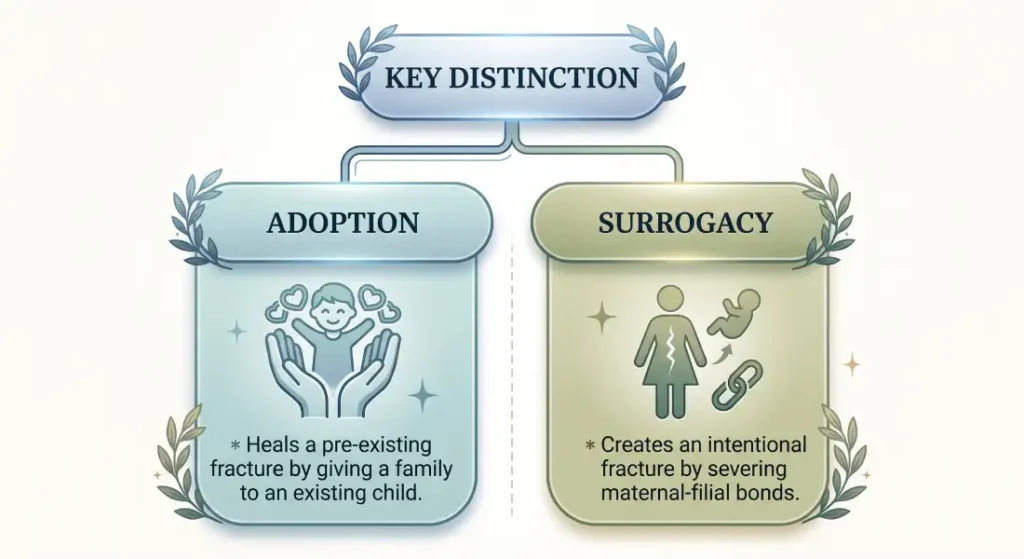
Surrogacy vs. Adoption: The Essential Moral Difference
A common point of confusion is comparing surrogacy to adoption. The Catholic Church strongly praises adoption while rejecting surrogacy:
- Adoption is a loving, restorative response to an existing tragedy. A child already exists, lacks parental care, and is welcomed into a home that provides security and love.
- Surrogacy deliberately engineers the conception of a child with the explicit intent of separating that child from the gestational mother upon birth.
Catholic Moral Teaching at a Glance
| Practice / Topic | Moral Assessment | Primary Magisterial Source |
| Commercial Surrogacy | Gravely Immoral: Exploits women, commodifies children, ruptures marriage. | CCC 2376; Dignitas Infinita §48 |
| Altruistic Surrogacy | Gravely Immoral: Still severs gestational and maternal bonds owed to the child. | Donum Vitae II, A, 3 |
| In Vitro Fertilization (IVF) | Gravely Immoral: Dissociates procreation from the marital act; involves embryo loss. | CCC 2377; Dignitas Personae §14–16 |
| Restorative Fertility (NaPro) | Morally Licit: Heals underlying pathology to assist natural conjugal conception. | CCC 2375 |
| Legal Adoption | Virtuous & Encouraged: Provides parental care to a child in need. | CCC 2379; Evangelium Vitae §93 |
Pastoral Guidance: Navigating Infertility with Faith and Hope
The Church recognizes that infertility is a profound, painful cross carried by many married couples. The desire for children is natural, healthy, and holy. Rejecting surrogacy is not a dismissal of this suffering; rather, the Church refuses to resolve suffering through means that violate the rights of the child or the integrity of marriage.
For Catholic couples experiencing infertility, the Church encourages morally licit paths:
- Restorative Reproductive Medicine: Modalities such as NaProTechnology (Natural Procreative Technology) and FEMM work cooperatively with the woman’s natural cycle to identify and cure root causes of infertility without separating conception from marital intercourse.
- Foster Care and Adoption: Opening the home to children in need embodies heroic Christian charity and mirrors God’s fatherhood.
- Spiritual Fruitfulness: Married couples without children are called to live fruitful lives through apostolates, mentorship, community service, and spiritual parenthood (CCC 2379).
Prayers for Families and the Protection of Life
Prayer for Couples Experiencing Infertility
Heavenly Father, You are the author of life and the source of all love. Look with compassion upon couples who carry the cross of infertility. Grant them healing, strengthen their marital bond, and bestow upon them the wisdom to pursue paths of parenthood that honor Your sacred design. Fill their homes with fruitfulness, whether through restorative healing, adoption, or generous service to Your Church. Through Christ our Lord. Amen.
Prayer for Children and Mothers
Lord Jesus Christ, defender of the innocent, wrap Your loving protection around every child conceived through artificial technologies. Let them know their infinite dignity as Your beloved image-bearers. We entrust to Our Lady’s maternal mantle all women facing financial hardship, that they may be preserved from exploitation and supported by communities of authentic Christian charity. Amen.
Approved Catholic Support & Healthcare Directory for Couples
1. Restorative Fertility Care & NaProTechnology
- Saint Paul VI Institute / FertilityCare Centers of America (FCCA)
- Focus: Locating certified NaProTechnology doctors, fertility surgeons, and Creighton Model practitioners.
- Website: saintpaulvi.com / fertilitycare.org
- Phone: (402) 390-6600
- Address: 6901 Mercy Rd, Omaha, NE 68106
- FEMM Health (Fertility Education & Medical Management)
- Focus: Restorative reproductive medicine, telehealth consultations, and cycle charting clinics.
- Website: femmhealth.org
- Email:
info@femmhealth.org
- FACTS (Fertility Appreciation Collaborative to Teach the Systems)
- Focus: Educating and connecting patients to natural fertility awareness-based methods (FABMs) and restorative physicians.
- Website: factsaboutfertility.org
- Email:
info@factsaboutfertility.org
2. Catholic Infertility Ministries & Pastoral Accompaniment
- Springs in the Desert
- Focus: Spiritual accompaniment, peer mentorship, local retreats, and virtual small groups for couples carrying the cross of infertility and childlessness.
- Website: springsinthedesert.org
- Email:
info@springsinthedesert.org
- The Fruitful Hollow
- Focus: A Catholic digital fellowship offering prayer circles, monthly blog reflections, mentorship, and support networks for couples facing infertility and pregnancy loss.
- Website: thefruitfulhollow.com
- Made for Life Ministries
- Focus: Catholic peer ministry supporting married couples dealing with infertility and recurrent miscarriage.
- Website: madeforlifeministries.org
3. Ethical Adoption & Foster Care Support
- Catholic Charities USA
- Focus: Domestic infant adoption, foster care placement, and family support services coordinated through local dioceses.
- Website: catholiccharitiesusa.org
- Phone: (703) 549-1390
- Headquarters: 2050 Ballenger Ave, Suite 400, Alexandria, VA 22314
4. Free, Confidential Catholic Bioethics Consultations
Consultation Request Portal: ncbcenter.org/ask-a-question
The National Catholic Bioethics Center (NCBC)
- Focus: Providing free, confidential guidance by credentialed moral theologians to help couples assess specific fertility treatments, tests, and medical procedures under Catholic moral teaching.
- Website: ncbcenter.org
- Ethics Consultation Phone Line: (215) 877-2660
Frequently Asked Questions
No. The Catholic Church teaches in Donum Vitae (II, A, 3) and CCC 2376 that altruistic surrogacy remains gravely immoral. While commercial coercion may be absent, altruistic surrogacy still intentionally separates the child from their gestational mother and violates the exclusive procreative covenant between husband and wife.
Every child conceived through surrogacy possesses infinite, God-given dignity and is made in the image and likeness of God (Dignitas Infinita, §1; CCC 1700). The moral illicitness of the conception method does not diminish the child’s worth, holiness, or right to love and pastoral care.
Adoption provides a loving home to a child who already exists and needs care, repairing a broken situation. In contrast, surrogacy intentionally plans and creates a child with the explicit legal mandate to sever the child from their gestational mother upon birth.
The Church supports treatments that assist the natural marital act to achieve pregnancy without replacing it (CCC 2375). Restorative reproductive options like NaProTechnology identify and treat underlying medical issues (such as endometriosis, hormonal deficiencies, or tubal blockages) while preserving the natural unitive and procreative marital act.
Continue Your Faith Journey
Catholic Church Teaching on IVF: Doctrine, Dignity, and Moral Alternatives
Explore the Catholic Church's official teaching on IVF, rooted in the dignity of human life and marital union. Learn about licit alternatives…

Venerable Jérôme Lejeune, Pope Leo XIV, and the Inviolable Dignity of Human Life
Explore how Venerable Jérôme Lejeune's scientific witness and Catholic teaching defend the sacred dignity of human life against modern programmed death. Learn…
Dobbs Decision Anniversary: Why the Battle for Life Has Moved from the Courts to the Heart
On the Dobbs decision anniversary, the pro-life mission shifts from courtrooms to human hearts. Discover how Catholic teaching and Evangelium Vitae call…