
Catholic Church Teaching on IVF: Doctrine, Dignity, and Moral Alternatives
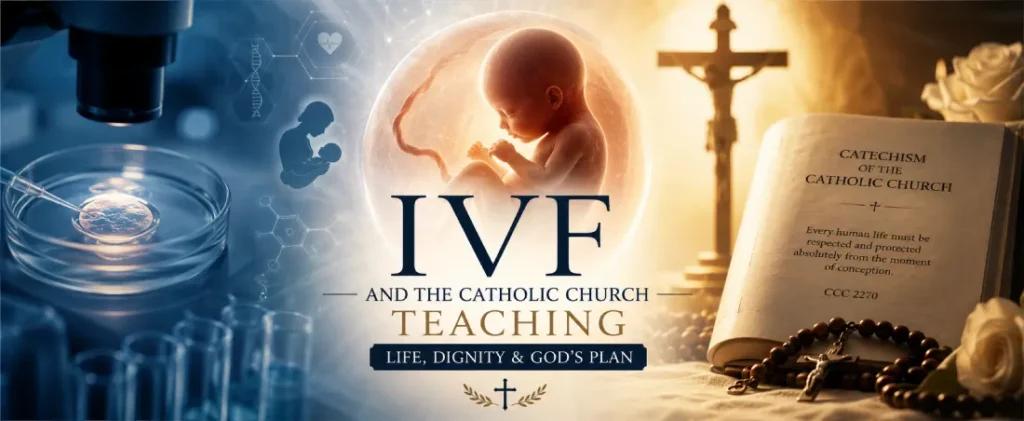
Pastoral & Medical Notice: This article is provided for educational, catechetical, and moral discernment purposes only and does not constitute formal medical diagnosis, clinical treatment, or individualized canonical counsel. Couples discerning reproductive healthcare or facing infertility are encouraged to consult a licensed medical provider specializing in restorative reproductive medicine (such as NaProTechnology) and discuss their specific pastoral circumstances with a faithful Catholic priest or certified bioethicist.
The Catholic Church teaches unequivocally that in vitro fertilization (IVF) is morally illicit in all circumstances. This definitive prohibition is not rooted in an indifference to the heartbreak of infertility, but in the defense of two inviolable realities: the inherent dignity of every human person from the moment of conception, and the sacred, inseparable unity of the marital embrace.
The Core Question: Why Does the Church Oppose IVF?
In vitro fertilization has become a standardized medical procedure, leading many to believe it is a morally neutral solution to infertility. However, authentic Catholic moral theology evaluates both the object of the act and the means utilized, not merely the good intention of the parents.
The Catechism of the Catholic Church and the Congregation for the Doctrine of the Faith (CDF) outline three primary moral and dogmatic reasons why IVF is contrary to God’s design:
- The Inviolable Dignity of the Human Embryo: Human life begins at fertilization and must be protected unconditionally (CCC 2270). Standard IVF procedures commodify early human life, routinely subjecting embryos to freezing, genetic grading, and destruction.
- The Right of the Child to Marital Conception: A child is not a commodity or a property right, but an unrepeatable gift (CCC 2378). Every child possesses the fundamental right to be the direct fruit of the physical, self-giving marital act of their parents.
- The Indivisibility of the Marital Act: God designed the conjugal act to be simultaneously unitive and procreative (Humanae Vitae, n. 12). IVF severs this bond by achieving procreation outside the physical union of husband and wife, transforming procreation into laboratory production.
1. The Human Embryo: A Person with Inherent Dignity
From the instant a human ovum is fertilized, a unique, genetically distinct human being comes into existence. The Church teaches that “human life must be respected and protected absolutely from the moment of conception” (CCC 2270).
“From the time that the ovum is fertilized, a life is begun which is neither that of the father nor the mother; it is rather the life of a new human being with his own growth. It would never be made human if it were not human already.”
— CDF, Declaration on Procured Abortion (1974); cited in Donum Vitae (1987)
The standard clinical process of IVF conflicts directly with this biological and theological reality:
- Hyperovulation and Mass Conception: Multiple embryos are generated in petri dishes to increase the statistical odds of a successful pregnancy.
- Pre-Implantation Genetic Diagnosis (PGD): Embryos are routinely screened for genetic anomalies or chromosomal variations. Those deemed “defective” or of the unwanted sex are systematically discarded.
- Cryopreservation (Embryo Freezing): Unused embryos are placed in liquid nitrogen storage, leaving millions of human beings in a state of suspended animation.
- Selective Reduction: If multiple embryos successfully implant in the uterine wall, doctors frequently perform “selective reductions”—terminating one or more developing fetuses to optimize gestational outcomes.
Under the moral principle articulated by St. Thomas Aquinas (Summa Theologiae I-II, q. 18, a. 2) and reaffirmed in Pope St. John Paul II’s Veritatis Splendor (n. 79), an evil action cannot be justified by a good end. Desiring a child is a profound good, but generating human lives only to expose their siblings to disposal or indefinite cryopreservation is intrinsically disordered.
2. The Biblical and Sacramental Meaning of the Marital Act
Sacred Scripture establishes that procreation is intimately and exclusively woven into the covenantal union of husband and wife. In the Book of Genesis, God reveals this original plan:
“So God created man in his own image, in the image of God he created him; male and female he created them. And God blessed them, and God said to them, ‘Be fruitful and multiply, and fill the earth and subdue it'” (Genesis 1:27–28, RSV-CE).
Christ elevates this union in the Gospel of Matthew, citing Genesis to demonstrate that husband and wife become “one flesh” (Matthew 19:5). Procreation is designed to be the living fruit of this specific physical and spiritual self-giving.
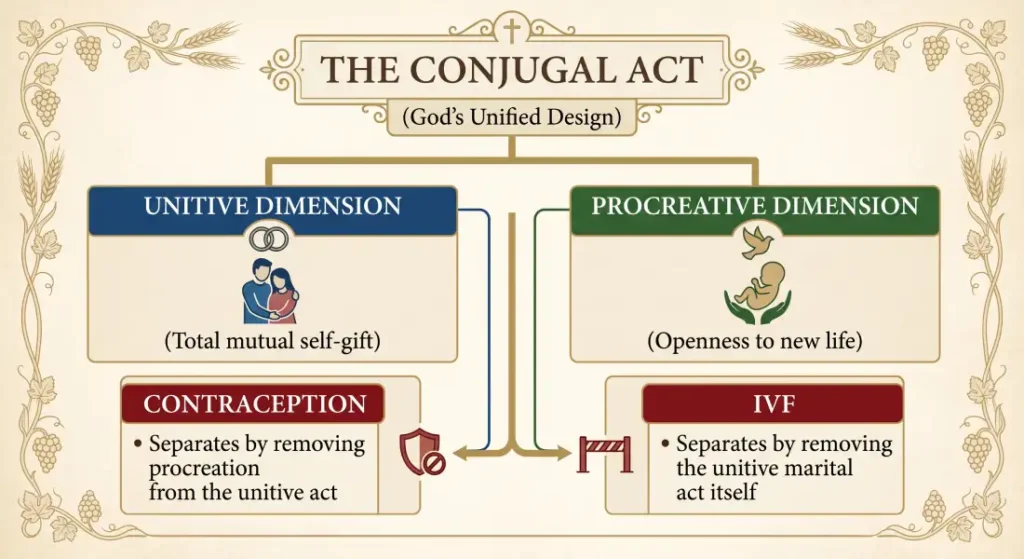
In his 1968 encyclical Humanae Vitae, Pope Paul VI articulated the inseparable connection established by God between the unitive and procreative meanings of the conjugal act (HV, n. 12). Contraception deliberately suppresses the procreative dimension while retaining the physical act. Conversely, IVF extracts procreation from the marital embrace entirely, substituting the marital bed with a laboratory apparatus.
3. Donum Vitae: Homologous vs. Heterologous IVF
The Congregation for the Doctrine of the Faith systematically addressed artificial reproductive technologies in the 1987 instruction Donum Vitae (The Gift of Life) and later in Dignitas Personae (2008). The Magisterium distinguishes between two clinical forms of IVF, declaring both to be gravely contrary to the moral law:
Heterologous IVF (Third-Party Involvement)
Heterologous techniques involve biological material from an outside donor (donor sperm, donor eggs, or surrogate gestational carriers). The Catechism condemns this practice unequivocally:
“Techniques that entail the dissociation of husband and wife, by the intrusion of a person other than the couple (donation of sperm or ovum, surrogate uterus), are gravely immoral. These techniques (heterologous artificial insemination and fertilization) infringe the child’s right to be born of a father and mother known to him and bound to each other by marriage” (CCC 2376).
Homologous IVF (Husband and Wife Material Only)
Many believe that using exclusively the husband’s sperm and the wife’s ovum resolves the moral issue. However, homologous IVF remains illicit because it dissociates generation from the conjugal act itself:
“Conception in vitro is the result of the technical action which presides over fertilization. Such fertilization is neither actually achieved nor positively willed as the expression and fruit of a specific act of the conjugal union” (CDF, Donum Vitae, II, B, 4).
As the Catechism affirms, homologous IVF “deprives human procreation of the dignity which is proper and connatural to it” (CCC 2377). The technician, rather than the loving union of the spouses, becomes the master of the origin of human life.
Bioethical Quick-Reference: Evaluating Fertility Methods
| Procedure / Approach | Moral Status (Catholic Bioethics) | Magisterial Foundation & Rationale |
| IVF (Homologous or Heterologous) | Prohibited (Gravely Immoral) | Replaces the marital act with technological manufacture; commodifies embryos (CCC 2376–2377; Donum Vitae II, B). |
| Surrogacy / Gamete Donation | Prohibited (Gravely Immoral) | Violates the child’s right to originate from their married parents; fractures the marital bond (CCC 2376). |
| NaProTechnology / Restorative Medicine | Morally Permissible & Commended | Diagnoses and heals underlying organic pathologies so conception occurs naturally through intercourse (Donum Vitae II, B, 7). |
| Intrauterine Insemination (IUI) | Prohibited (If Replacing Conjugal Act) | Substitutes the marital act; morally illicit unless the procedure merely assists an already accomplished marital act. |
| Foster Care & Domestic/Global Adoption | Morally Commended | Exemplifies authentic Christian charity and fruitful self-gift to an existing vulnerable child (CCC 2379). |
Moral Paths Forward for Couples Facing Infertility
The cross of infertility carries profound sorrow, and the Church approaches suffering couples with maternal solicitude and pastoral empathy. Pastoral care never requires setting aside moral truth; instead, the Church guides couples toward authentic medical healing and spiritual fruitfulness.
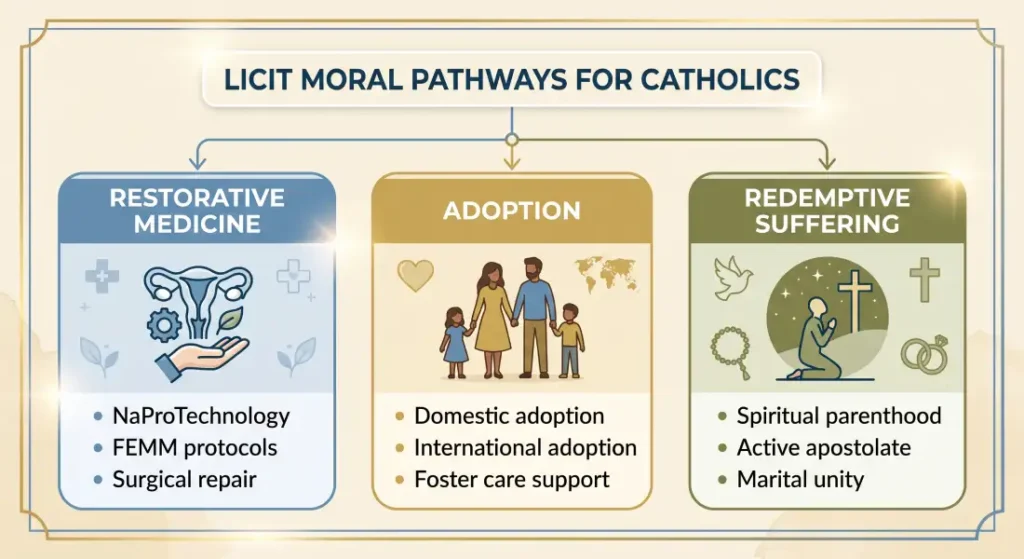
- Restorative Reproductive Medicine (NaProTechnology): Natural Procreative Technology works cooperatively with the female cycle to identify and treat the root causes of infertility (such as endometriosis, hormonal imbalances, or blocked fallopian tubes). Because it heals the body so conception occurs naturally through marital intimacy, it is fully in harmony with Church teaching (Donum Vitae, II, B, 7).
- Adoption and Foster Care: Couples who cannot achieve biological conception are warmly encouraged to welcome children through adoption (CCC 2379). Adoption reflects the supernatural reality of our own adoption as sons and daughters of God (Ephesians 1:5).
- Spiritual Fruitfulness and Redemptive Suffering: When medical restoration is not possible, couples are called to unite their suffering to the Cross of Christ. Physical fruitfulness is not the sole end of marriage; spouses can radiate immense spiritual fruitfulness through apostolates, charity, and deeper mutual self-gift.
Pastoral Prayer for Couples Experiencing Infertility
- For Grieving Spouses: Lord Jesus Christ, Physician of souls, draw near to husbands and wives carrying the heavy cross of infertility. Grant them the grace to find peace in Your divine plan and strengthen their marital covenant in Your love.
- For Moral Discernment: Holy Spirit, Counsel of the faithful, grant clarity and fortitude to couples navigating medical decisions. Guide them to healthcare providers who respect the laws of God and the dignity of the human body.
- For the Unborn: Eternal Father, Creator of all life, we place into Your merciful hands every human embryo currently frozen in laboratories across our world. Raise up voices to defend their inherent right to life, bring an end to their technical manipulation, and grant wisdom to our society to uphold the inviolable sanctity of every human person from conception to natural death.
- Through Our Lady: Holy Mary, Mother of Fair Love, who surrendered your life to God’s providence at the Annunciation, wrap your maternal mantle around every couple yearning for a child. Guide their hearts to trust that God’s goodness remains steadfast. Amen.
Frequently Asked Questions
No. Even when using the genetic material of the married couple, homologous IVF remains morally illicit (CCC 2377). It replaces the conjugal act of self-giving with a laboratory technique and routinely subjects embryonic human beings to cryopreservation, screening, or disposal.
Catholics may licitly pursue restorative medical treatments—such as NaProTechnology, hormonal therapies, and surgical corrections—that identify and heal underlying pathologies. Moral treatments assist the natural conjugal act to achieve conception rather than substituting for it (Donum Vitae, II, B, 7).
The Catholic Church views every child conceived through IVF as a beloved human being created in the image and likeness of God. While the method of conception is objectively contrary to the moral law, the child possesses full, equal human dignity and is unconditionally cherished by God and the Church.
Adoption provides a loving home to an existing child in need of parents, embodying authentic Christian charity without violating any person’s origin (CCC 2379). Conversely, IVF manufactures new human life in a laboratory, treating the child as a product to be generated rather than a gift received through the marital act.
Continue Your Faith Journey
What the Catholic Church Teaches About Surrogacy: Dignity, Marriage, and the Gift of Life
Explore what the Catholic Church teaches about surrogacy, human dignity, and the sacred marital covenant. Learn why the Magisterium protects children as…
Sanctity of Human Life: Pope Benedict XVI at Pavia
Explore Pope Benedict XVI's powerful pro-life message at the tomb of St. Augustine in Pavia. Learn how Sacred Scripture, Evangelium Vitae, and…
Venerable Jérôme Lejeune, Pope Leo XIV, and the Inviolable Dignity of Human Life
Explore how Venerable Jérôme Lejeune's scientific witness and Catholic teaching defend the sacred dignity of human life against modern programmed death. Learn…