
Defund Planned Parenthood: A Catholic Call to Prayer, Stewardship, and Civic Action
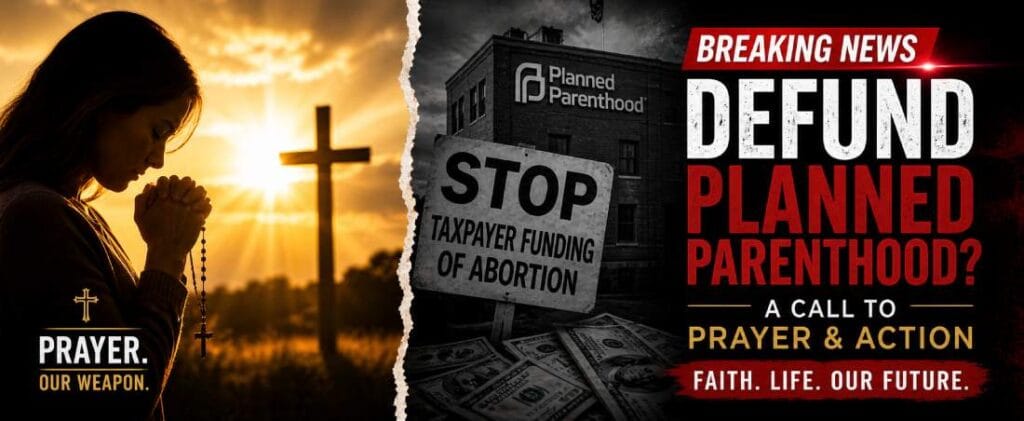
Newly released federal documentation regarding Paycheck Protection Program (PPP) allocations has reignited a critical moral and legal debate across the United States. Congressional oversight committees have highlighted evidence that 38 affiliates of Planned Parenthood Federation of America unlawfully received and retained over $80 million in COVID-19 relief loans. According to Small Business Administration (SBA) affiliation standards, entities operating under unified corporate control with a collective headcount exceeding 500 employees were explicitly prohibited from drawing these small-business emergency funds.
For faithful Catholics, this financial controversy represents far more than an administrative or fiscal irregularity. It directly impacts conscience, public moral coherence, and the sacred obligation to protect human life. As citizens called to witness to the Gospel in the public square, we must examine this issue through the lens of Sacred Scripture, Sacred Tradition, the Catechism of the Catholic Church, and authentic Magisterial teaching.
The Moral Duty to Protect Unborn Human Life
The Catholic Church has unwaveringly affirmed the divine truth regarding the sanctity of human life from its earliest beginnings. As the Catechism of the Catholic Church asserts: “Human life must be respected and protected absolutely from the moment of conception. From the first moment of his existence, a human being must be recognized as having the rights of a person—among which is the inviolable right of every innocent being to life” (CCC 2270).
Abortion is not merely one social issue among many; it is an intrinsic evil that no civil law may ever legitimize. In his landmark encyclical Evangelium Vitae, Pope Saint John Paul II reaffirmed this timeless doctrine: “Direct abortion, that is, abortion willed as an end or as a means, always constitutes a grave moral disorder, since it is the deliberate killing of an innocent human being” (Evangelium Vitae, 57).
When government agencies disperse public funds to organizations whose primary operations include the destruction of unborn children, they create a severe moral conflict for taxpayers. While federal statutes such as the Hyde Amendment have long sought to restrict direct funding of abortion services, financial accounting demonstrates that money is fundamentally fungible. Public subsidies provided for operational overhead, facilities, or general relief inevitably free up internal capital that sustains the broader corporate structure of abortion providers.
Understanding Moral Cooperation in Public Subsidies
Catholic moral theology, articulated by Saint Thomas Aquinas and developed across centuries of Magisterial reflection, offers clear guidance on how believers must navigate institutional injustice (Summa Theologiae, I-II, q. 96).
Citizens paying standard taxes mandated by civil authority generally engage in what moral theology terms remote material cooperation with the evil actions funded by the state. Such indirect tax payments do not constitute a personal sin on the part of the individual taxpayer, provided the taxpayer actively opposes the injustice and does not formally concur with the evil act itself.
However, a distinct moral obligation rests upon citizens in a constitutional republic to actively oppose the systemic misuse of public resources. As the Catechism highlights: “It is necessary that all participate, each according to his position and role, in promoting the common good. This obligation is inherent in the dignity of the human person” (CCC 1913).
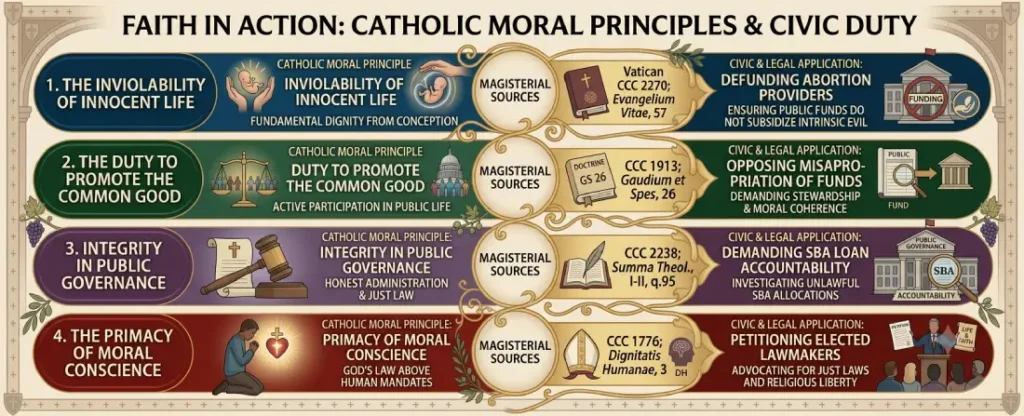
When emergency programs intended to support small businesses and vulnerable workers are exploited to subsidize large, centralized abortion networks, government officials fail in their solemn duty to maintain just governance (CCC 2238).
Spiritual Foundations: Prayer Rooted in Divine Truth
Before embarking on civic engagement, the Christian must establish their efforts upon a firm spiritual foundation. Prayer is not a tactical political maneuver, but our essential spiritual recourse to align our human actions with the Divine Will (CCC 2559).
In addressing structural deception and public injustice, our prayers should focus on four intentions:
- For the Revelation of Truth: Saint Paul instructs believers to “take no part in the unfruitful works of darkness, but instead expose them” (Ephesians 5:11). We pray that all public audits, government inquiries, and administrative reviews proceed with complete transparency and integrity.
- For the Conversion of Hearts: We pray for administrators, healthcare workers, and government officials involved in the abortion industry or its financial oversight. We ask God to soften hardened hearts, bringing them to genuine repentance and a recognition of the sanctity of life.
- For Courage in Leadership: We pray that members of Congress, regulatory leaders, and judicial officers receive the fortitude to uphold moral truth and fiscal integrity, regardless of political expediency (CCC 1808).
- For Pregnant Mothers and Unborn Children: We pray that women in crisis pregnancies find real, compassionate support through life-affirming community resources, holy families, and Catholic charitable ministries.
Actionable Steps for Catholic Civic Engagement
Authentic Catholic faith is never passive. As Saint James famously wrote: “So also faith of itself, if it does not have works, is dead” (James 2:17). Our interior prayer life must produce exterior fruits of justice and charity (CCC 1886, 2442).
Here is how faithful Catholics can take concrete action:
1. Directly Petition Your Congressional Representatives
Contact your U.S. Senators and Representative to voice your moral objection to the improper distribution of federal funds to Planned Parenthood affiliates. Request that Congress support legislative efforts to permanently disqualify abortion providers from receiving taxpayer funding across all federal programs.
2. Support Local Crisis Pregnancy Centers
Directly counteract the culture of death by giving financial support, material goods, and volunteer time to local Catholic and pro-life pregnancy centers. These organizations provide medical care, housing, baby supplies, and emotional support to mothers in need, presenting a true culture of life in action.
3. Practice Informed Catholic Citizenship
Review the voting records and policy positions of candidates running for public office. As the U.S. Catholic Bishops emphasize in Forming Consciences for Faithful Citizenship, defending the direct and intentional destruction of human life is a foundational priority that outweighs ordinary policy disagreements.
Frequently Asked Questions (PAA)
No. Paying required civil taxes is a legal obligation, and the subsequent misuse of those funds by the state constitutes remote material cooperation with evil. Because the individual taxpayer does not intend or directly approve the evil act, it is not a personal sin. However, Catholics remain morally obligated to oppose such funding through lawful civic means.
Direct funding refers to government money explicitly paying for abortion procedures. Indirect funding occurs when government grants or loans cover operational overhead, rent, or non-abortion services for an organization that performs abortions. Catholic moral theology holds that because money is fungible, indirect funding still assists in sustaining institutions that perform intrinsically evil acts.
The Catechism of the Catholic Church teaches that citizens are obliged in conscience not to follow the directives of civil authorities when those directives are contrary to the demands of the moral order, fundamental human rights, or the Gospel (CCC 2242). Citizens must work to reform unjust laws and regulations through peaceable political action.
Source: LifeSiteNews
Continue Your Faith Journey
Dobbs Decision Anniversary: Why the Battle for Life Has Moved from the Courts to the Heart
On the Dobbs decision anniversary, the pro-life mission shifts from courtrooms to human hearts. Discover how Catholic teaching and Evangelium Vitae call…
Venerable Jérôme Lejeune, Pope Leo XIV, and the Inviolable Dignity of Human Life
Explore how Venerable Jérôme Lejeune's scientific witness and Catholic teaching defend the sacred dignity of human life against modern programmed death. Learn…
What the Catholic Church Teaches About Surrogacy: Dignity, Marriage, and the Gift of Life
Explore what the Catholic Church teaches about surrogacy, human dignity, and the sacred marital covenant. Learn why the Magisterium protects children as…