
Venerable Jérôme Lejeune, Pope Leo XIV, and the Inviolable Dignity of Human Life
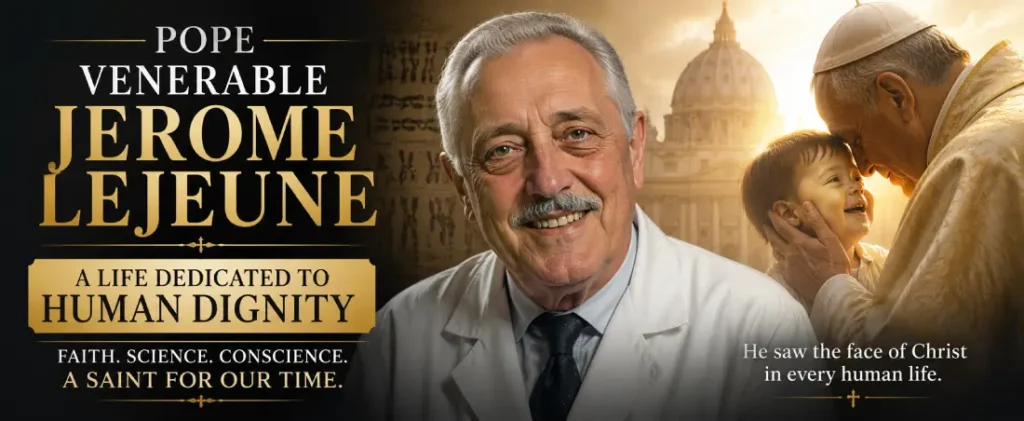
When Pope Leo XIV received the staff of the Jérôme Lejeune Foundation to mark the centenary of Venerable Jérôme Lejeune’s birth, the Holy Father delivered an urgent message. He forcefully condemned the “programmed death” of embryos and the elderly—a phrase that cuts through modern euphemisms used to mask the deliberate destruction of innocent human life.
This pronouncement addresses a central pillar of Catholic moral theology. It reasserts the core message of Pope St. John Paul II’s encyclical Evangelium Vitae and honors the heroic witness of Venerable Jérôme Lejeune, the French geneticist who discovered the chromosomal cause of Down syndrome and spent his life defending vulnerable children.
| Dimension | Magisterial & Theological Anchor | Core Catholic Teaching |
| Beginning of Life | CCC 2270; Evangelium Vitae 73 | Absolute protection of human embryos from the moment of conception. |
| End of Life | CCC 2258; Evangelium Vitae 12 | Unconditional rejection of euthanasia; duty to accompany the suffering. |
| Human Dignity | Summa Theologiae I, q. 93; Gen 1:27 | Image of God (Imago Dei) is rooted in creation, not utility or physical ability. |
Who Was Venerable Jérôme Lejeune?
Venerable Jérôme Lejeune was a French layman, father, and world-renowned scientist. In 1958, he identified Trisomy 21 as the cause of Down syndrome. This groundbreaking scientific breakthrough opened the door to modern human genetics.
However, Lejeune’s career took a dramatic turn when medical technologies began using his discovery to screen and abort children with Down syndrome. Recognizing that his research was being turned against his patients, he chose to defend them publicly.
“Technique is neutral,” Dr. Lejeune famously observed. “When it is placed at the service of man, it heals; when it is placed at the service of ideology, it destroys.”
Lejeune sacrificed prestigious research grants, international honors, and career advancement because he refused to separate his scientific work from his Catholic faith. By standing firm against embryonic destruction and selective abortion, he demonstrated that scientific truth and divine revelation are complementary.
The Theology of “Programmed Death”
Pope Leo XIV’s condemnation of “programmed death” targets a modern utilitarian error. In modern fertility clinics, research laboratories, and healthcare facilities, human life is frequently evaluated by algorithmic standards, financial efficiency, or biological perfection.
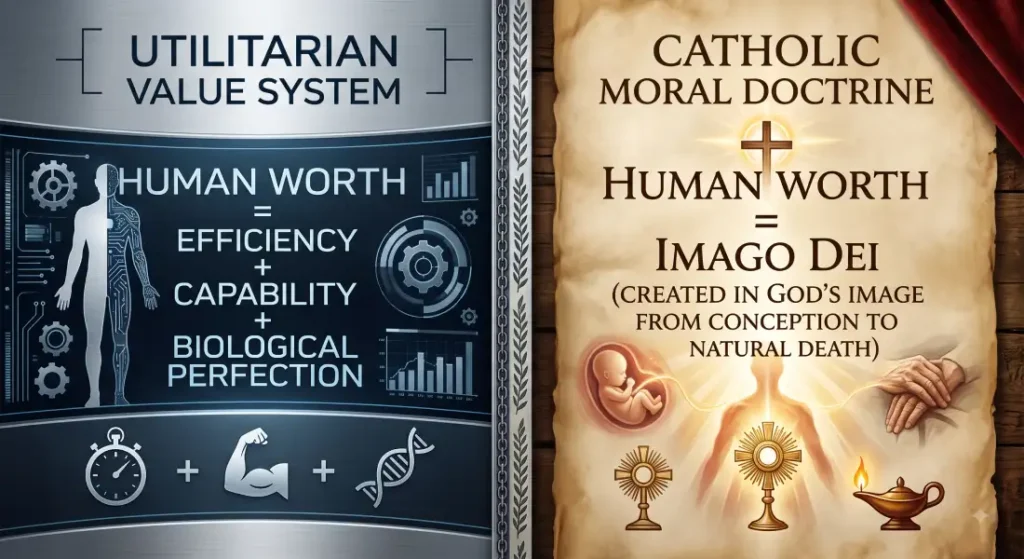
This mechanical approach treats human embryos as disposable biological material and the elderly as burdens to be managed. Catholic moral theology explicitly rejects this view.
The Image of God (Imago Dei)
Human dignity is not granted by the state, earned through productivity, or determined by biological health. In the Summa Theologiae (I, q. 93), St. Thomas Aquinas explains that the image of God is present in every human being by virtue of their rational nature and capacity to know and love God.
Because God directly creates the human soul, every person possesses infinite intrinsic worth. As the Psalmist proclaims:
“For thou didst form my inward parts, thou didst knit me together in my mother’s womb. I praise thee, for thou art fearful and wonderful. Wonderful are thy works!” (Psalm 139:13–14, RSV-CE)
When an embryo is destroyed in an in vitro fertilization (IVF) laboratory, or when an elderly patient is pressured into assisted suicide, an assault is committed against God’s handiwork.
Biblical and Catechetical Foundations
The Catholic Church’s teaching on the sacredness of human life is consistent, immutable, and grounded in Divine Revelation.
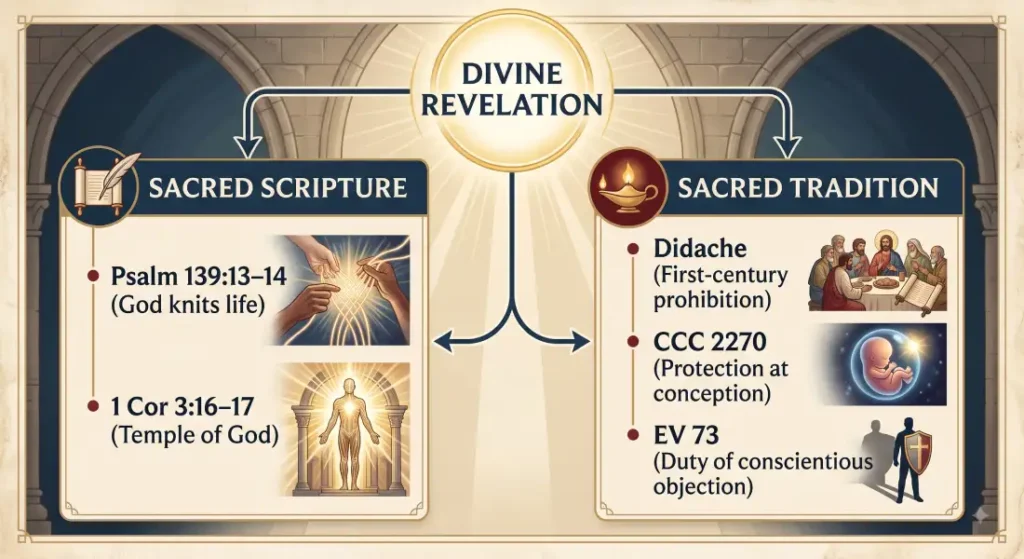
1. The Body as the Temple of God
Saint Paul warns against the destruction of human life, writing to the Corinthians:
“Do you not know that you are God’s temple and that God’s Spirit dwells in you? If any one destroys God’s temple, God will destroy him. For God’s temple is holy, and that temple you are.” (1 Corinthians 3:16–17, RSV-CE)
This passage applies directly to the human person at every stage of development. The embryo, though small and vulnerable, is a temple of God.
2. Immediate Respect for Embryonic Life
The Catechism of the Catholic Church explicitly defines the status of embryonic human life in paragraph 2270:
“Human life must be respected and protected absolutely from the moment of conception. From the first moment of his existence, a human being must be recognized as having the rights of a person—among which is the inviolable right of every innocent being to life.”
The Church teaches that moral law permits no exceptions for embryo destruction, regardless of the potential medical advancements promised by scientific research.
Confronting the Culture of Death
In Evangelium Vitae, Pope Saint John Paul II diagnosed the underlying spiritual conflict of our age, identifying a “war of the powerful against the weak”.
“A life which would require greater acceptance, love and care is considered useless, or held to be an intolerable burden, and is therefore rejected in one way or another.” (Evangelium Vitae, 12)
This culture of death manifests in distinct ways across society:
- Prenatal Eugenics: High rates of abortion follow prenatal diagnoses of Down syndrome in many Western nations.
- Embryonic Discard: Millions of human embryos are frozen, experimented upon, or destroyed in IVF processes worldwide.
- Euthanasia Pressures: The elderly, chronically ill, and disabled face subtle societal pressure to choose medically assisted death to avoid burdening caregivers.
Catholic moral teaching opposes these practices completely. In Evangelium Vitae 73, the Church teaches that civil laws authorizing abortion or euthanasia are “completely lacking in authentic juridical validity”. Catholics have a grave moral obligation to oppose such legislation through conscientious objection.
Three Actionable Commitments for Faithful Catholics
Living as an authentic Catholic in a culture of death requires concrete action. Following the example of Venerable Jérôme Lejeune, Catholics are called to fulfill three commitments:
1. Reject Utilitarian Compromise
Catholics must maintain an uncompromising witness against embryonic destruction, abortion, and euthanasia. This means refusing to support political campaigns, medical research projects, or healthcare policies that treat human life as disposable.
2. Provide Practical Pastoral Care
Defending life requires active support for families in need. Parishes must welcome families raising children with special needs, support mothers facing unplanned pregnancies, and establish ministries for the elderly and homebound. Supporting organizations like the Jérôme Lejeune Foundation directly funds authentic, ethical medical care.
3. Advocate for Truth in the Public Square
Faithful Catholics must speak out clearly and charitably against societal errors regarding human dignity. When biological research or medical protocols diminish human worth, Catholics are called to offer the Church’s clear vision of accompaniment, palliative care, and unconditional respect.
Prayer for the Defense of Human Life
Lord God, Creator of all life, Grant us the courage of Venerable Jérôme Lejeune, Who risked career and status to defend Your most vulnerable children.Strengthen all scientists, physicians, and lawmakers, That they may align human knowledge with Divine truth.Protect all unborn embryos, children with disabilities, And elderly persons facing the pressure of abandonment.Through Jesus Christ our Lord, Amen.
Frequently Asked Questions
Venerable Jérôme Lejeune (1926–1994) was a French geneticist who discovered the cause of Down syndrome (Trisomy 21). Declared Venerable by Pope Francis in 2021, he is celebrated for risking his career to defend unborn children with intellectual disabilities from selective abortion.
The Catholic Church teaches that human life begins at conception and must be respected absolutely (CCC 2270). Human embryos possess inviolable dignity and rights as human persons, making embryonic destruction for research, IVF discarding, or abortion intrinsically evil.
Pope Leo XIV used “programmed death” to describe the technological and utilitarian system that decides which lives are worth living based on efficiency, genetic perfection, or convenience. It condemns discarding embryos in laboratories and pressuring the sick or elderly toward euthanasia.
Yes. According to Evangelium Vitae 73, civil laws permitting abortion or euthanasia lack juridical validity. Catholics have a grave moral duty to oppose such laws through conscientious objection and must never participate in or fund actions that violate human life.
Continue Your Faith Journey

What the Catholic Church Teaches About Surrogacy: Dignity, Marriage, and the Gift of Life
Explore what the Catholic Church teaches about surrogacy, human dignity, and the sacred marital covenant. Learn why the Magisterium protects children as…
Dobbs Decision Anniversary: Why the Battle for Life Has Moved from the Courts to the Heart
On the Dobbs decision anniversary, the pro-life mission shifts from courtrooms to human hearts. Discover how Catholic teaching and Evangelium Vitae call…
Sanctity of Human Life: Pope Benedict XVI at Pavia
Explore Pope Benedict XVI's powerful pro-life message at the tomb of St. Augustine in Pavia. Learn how Sacred Scripture, Evangelium Vitae, and…